

 Français (France)
  Nederlands (nl-NL)
 The Aswan High Dam is a large hydraulic structure on the Nile, located near Aswan in southern Egypt. Completed in 1970, it transformed water management in the country by regulating floods, supporting permanent irrigation, and generating electricity on a large scale. Its construction created Lake Nasser, a vast artificial reservoir extending southward. The dam continues to play a strategic role in Egypt’s water supply, energy production, and agricultural planning. It also remains closely linked to national infrastructure policy, environmental management, and the long-term use of the Nile’s resources.
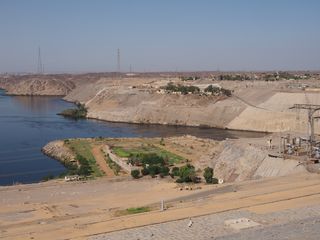
Aswan • Aswan High Dam
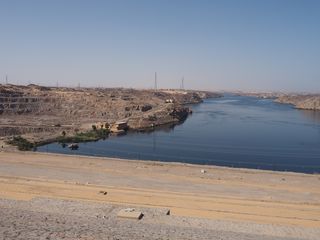
Aswan • Aswan High Dam
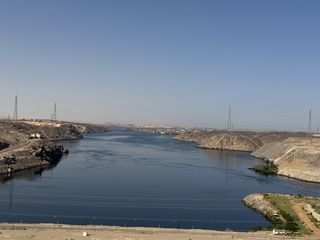
Aswan • Aswan High Dam
Aswan High Dam
The Aswan High Dam in Modern Egyptian History
Origins and Political Setting
The Aswan High Dam was built on the Nile near Aswan in southern Egypt, upstream from the earlier Aswan Low Dam. Its creation belonged to a decisive phase in Egypt’s twentieth-century state planning, when control of the Nile became a central instrument of economic policy. Before the dam was built, Egyptian agriculture remained exposed to the annual rhythm of the river, with floods that could be either insufficient or destructive. The new structure was intended to transform this uncertain cycle into a regulated hydraulic system.
The project became closely associated with the government of Gamal Abdel Nasser after the 1952 revolution and the end of the monarchy. For the Egyptian state, the dam was not only a technical undertaking but also a political statement. It expressed the ambition to modernize agriculture, expand electricity production, support industrial development, and demonstrate national control over a resource on which the country depended.
Construction and International Involvement
The financing and construction of the Aswan High Dam were shaped by the geopolitical tensions of the 1950s and 1960s. Initial Western support was withdrawn, leading Egypt to seek assistance from the Soviet Union. This decision connected the project to Cold War diplomacy, but the dam’s primary purpose remained domestic: the regulation of water, the stabilization of irrigation, and the production of hydroelectric power.
Major construction work began in 1960 and continued for about a decade. The project required large-scale mobilization of labor, engineering expertise, construction materials, and international technical assistance. The dam was completed in 1970, creating a new hydraulic regime for the Nile in Egypt. Its completion marked a major shift in the country’s management of water, replacing dependence on seasonal flood patterns with a system based on storage, release, and long-term planning.
Lake Nasser and Social Consequences
The construction of the dam created Lake Nasser, a vast artificial reservoir extending southward from Aswan. This new lake was essential to the dam’s function, as it stored water for irrigation, electricity generation, and flood control. Its formation also transformed the landscape of Nubia, submerging settlements, agricultural land, and archaeological sites.
One of the most significant social consequences was the displacement of Nubian communities from areas that were flooded by the reservoir. These populations were relocated, altering long-established relationships between people, land, and the river. The history of the dam is therefore inseparable from the human cost of the reservoir’s creation.
The flooding of ancient sites also led to major salvage operations. Several monuments in Nubia were dismantled and moved to higher ground before the rising waters reached them. The relocation of the temples of Abu Simbel became the most widely known example of this process. These operations made the dam a turning point not only in Egyptian water management but also in the history of archaeological preservation in the Nile Valley.
Contemporary World Context
The Aswan High Dam was constructed during a period marked by decolonization, Cold War rivalry, and large state-led development projects. In the same decade, the Berlin Wall was built, the Cuban Missile Crisis took place, and the first human spaceflights demonstrated the political value attached to technological achievement. Many newly independent or postcolonial states were investing in major infrastructure as a means of asserting sovereignty. The dam belongs to this historical moment of large-scale planning and technical ambition.
Later Use and Historical Significance
After its completion, the Aswan High Dam became a central component of Egypt’s water and energy infrastructure. It reduced the destructive impact of Nile floods, supported perennial irrigation, and supplied hydroelectric power for industrial and domestic use. Its operation allowed the state to plan agricultural production with greater regularity, although it also changed the downstream movement of silt that had historically contributed to soil fertility.
The dam remains closely linked to the political memory of the Nasser era. It represents a period when the Egyptian state sought to reshape the country through centralized planning and technical modernization. At the same time, its history includes environmental and social consequences that continue to shape discussions about water management, sedimentation, population pressure, and the long-term use of Nile resources. Its present role is therefore both functional and historical: it remains an operating structure while also standing as a material record of Egypt’s twentieth-century development policies.
Structural Design and Technical Configuration of the Aswan High Dam
Site Placement and Overall Form
The Aswan High Dam stands across the Nile upstream from the city of Aswan, where the river valley allowed the creation of a large storage reservoir behind the structure. Its position was chosen for hydraulic control rather than visual prominence. The dam is conceived as a long engineered barrier linking both banks of the river, with its form determined by water pressure, foundation stability, discharge capacity, and the need to regulate the flow between Lake Nasser and the downstream Nile.
The structure is an embankment dam rather than a masonry or concrete wall. Its architectural character therefore lies in mass, slope, layering, and hydraulic organization. The dam is approximately 3,830 metres long, about 111 metres high, and nearly 980 metres wide at the base. These proportions create a broad, low profile in relation to its length. Its geometry depends on resistance through weight and volume, using carefully graded materials instead of a narrow vertical retaining face.
The dam cannot be understood as a single isolated object. Its architectural organization includes the main embankment, the upstream reservoir, intake structures, spillways, power-generation installations, service roads, inspection areas, and downstream water-management systems. The visible line of the dam marks the transition between the stored water of Lake Nasser and the controlled river below. This makes the monument a territorial structure, organized around storage, release, protection, and distribution.
Embankment Structure, Materials, and Internal Organization
The body of the Aswan High Dam is built from large quantities of rock, sand, clay, and compacted fill. Its construction does not rely on a homogeneous mass. Instead, the dam is arranged as a zoned embankment, with different materials assigned to specific structural functions. Dense impervious material limits seepage, while coarser zones provide weight, drainage, filtration, and resistance against deformation. This internal order is central to the dam’s architecture, although most of it is invisible from the exterior.
The impervious core is one of the principal structural elements. It restricts the movement of water through the embankment and protects the dam against uncontrolled seepage. Around this core, filter and drainage layers manage internal water pressure and prevent fine material from being washed out. The technical sophistication of the dam is therefore not expressed through ornament, but through the controlled relationship between permeability, compaction, slope, and hydraulic load.
The outer faces of the dam are shaped to resist erosion and maintain the stability of the embankment. The upstream slope is exposed to the reservoir and must withstand changes in water level, wave action, and long-term contact with the stored water. The downstream slope is designed for stability, access, and surveillance. Platforms, service routes, and maintenance zones form part of the architectural layout, creating an infrastructure whose surfaces are organized for inspection and operation rather than ceremonial use.
Hydraulic Components and Power-Generation Layout
The architectural functioning of the Aswan High Dam depends on the integration of hydraulic structures into and around the embankment. Intake works, conduits, gates, control systems, and discharge channels direct water according to irrigation, power-generation, and flood-management requirements. These elements give the dam its active role: it is not only a retaining mass, but a regulated system of controlled openings and flows.
The hydroelectric power station is a major component of the site. Water from Lake Nasser is directed through intake structures and conduits toward turbines that convert the hydraulic head into electricity. After passing through the generating equipment, the water returns to the downstream Nile. The spatial arrangement separates stored water, pressure conduits, mechanical equipment, control areas, and outflow zones. This organization reflects the operational need for efficiency, safety, monitoring, and regular maintenance.
Spillways and discharge structures are essential to the dam’s safety architecture. They allow excess water to be released when reservoir levels require controlled reduction. Their placement and dimensions are determined by the need to handle large flows without damaging the embankment or causing uncontrolled erosion downstream. These components also influence the site’s overall configuration, because high-volume discharge must be directed through stable channels and protected zones. The dam’s architecture is therefore based on a balance between retention and release.
Conservation, Maintenance, and Technical Adaptation
The conservation of the Aswan High Dam differs from the preservation of a traditional architectural monument. Its survival depends on continuous technical monitoring rather than restoration of decorative fabric. The embankment, drainage systems, gates, conduits, turbines, control mechanisms, and electrical equipment all require inspection and maintenance. Particular attention is given to seepage, settlement, internal pressure, erosion, and the mechanical reliability of the hydraulic installations.
Sedimentation in Lake Nasser is one of the long-term issues affecting the dam’s operation. The reservoir traps part of the sediment load that the Nile once carried farther downstream. This process does not change the visible form of the dam directly, but it affects storage capacity, reservoir management, and the conditions under which the structure functions. For this reason, the architectural integrity of the dam is linked to the broader technical management of the water body behind it.
Current preservation concerns also involve the continued adaptation of the dam to Egypt’s water and energy needs. The main embankment remains a massive and stable structure, but the equipment associated with power production, drainage, and flow regulation must be kept operational. The architectural value of the Aswan High Dam lies in this functional composition: a vast engineered form whose mass, internal zoning, hydraulic devices, and territorial scale are inseparable from its continuing use.