Français (France)
  Nederlands (nl-NL)
 Semana Santa in Seville is one of Spain’s most prominent religious events. This Christian celebration draws thousands of participants and visitors each year, who gather to witness the processions organized by local brotherhoods. These solemn parades move through the city during Holy Week, accompanied by music, incense, and carriers of religious floats. The event reflects the enduring influence of Catholic tradition in Andalusian society and the active role of local communities in preserving it. Semana Santa in Seville is widely regarded as a key expression of Spain’s intangible cultural heritage.
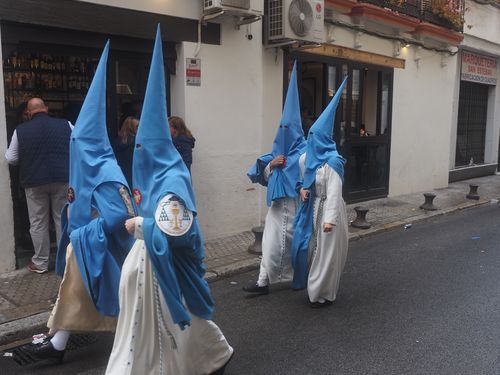
Sevilla • Semana Santa in Sevilla
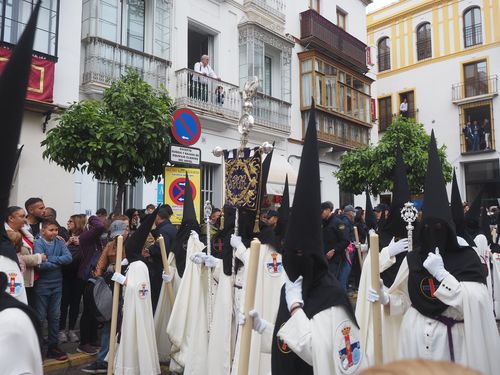
Sevilla • Semana Santa in Sevilla

Sevilla • Semana Santa in Sevilla
Tradition profile
Semana Santa in Sevilla
Tradition category: Christian celebrations
Tradition family: Religious traditions
Tradition genre: Religious Festivals and Celebrations
Geographic location: Séville • Andalusia • Spain
• Links to •
• List of videos about Toledo, Seville, Ronda, Granada, Baena on this site •
Spain • Holy Week celebrations • Andalusia and Toledo
Semana Santa in Seville: Power, Devotion, and the Evolution of a Cultural Rite
The Semana Santa (Holy Week) tradition in Seville—sometimes mistakenly associated with Toledo—emerged as a deeply structured religious practice with significant political and social motivations. Rooted in the Catholic fervor of the early modern era, its evolution over five centuries reflects broader shifts in Spanish society, European religious history, and global cultural exchange.
Political and Social Foundations of the Tradition
The origins of Semana Santa in Seville can be traced back to the late 15th and early 16th centuries, following the Reconquista and the consolidation of Christian rule under the Catholic Monarchs. In this context, the Catholic Church, aligned with the Spanish Crown, sought to reinforce religious orthodoxy through powerful public rituals. The formation of confraternities (cofradías) to organize processions was not only a religious gesture but also a tool of social organization and political control.
These lay brotherhoods structured urban society along lines of neighborhood, profession, and social class, reinforcing communal identities and obedience to the moral order of the Counter-Reformation. Public processions of penitents, adorned religious floats (pasos), and dramatic reenactments of the Passion of Christ offered a visual catechism for the largely illiterate population, while also reinforcing loyalty to both Church and Crown.
Historical Milestones and Their Regional Impact
Semana Santa gained momentum in the 16th century, as Spain was asserting itself as a global Catholic empire. The Council of Trent (1545–1563) catalyzed a reinvigoration of Catholic ritual and iconography, encouraging expressive and immersive devotional practices. The Baroque period saw the rise of elaborate pasos, the refinement of musical compositions, and the elevation of processions into an aesthetic and spiritual spectacle.
Key events such as the Napoleonic invasion, the liberal revolutions of the 19th century, and the anti-clerical policies of the Second Spanish Republic (1931–1939) led to temporary declines, suppressions, or adaptations of the tradition. However, Franco’s regime revived Semana Santa as a symbol of Catholic nationalism, instrumentalizing it as a display of unity and cultural identity.
Culturally, the tradition deepened its role in Andalusian identity, promoting local craftsmanship (woodcarving, embroidery, music) and reinforcing social solidarity through the enduring structure of confraternities. Economically, the celebrations generate significant income, particularly in recent decades due to their touristic appeal, contributing to local hospitality, artisanship, and urban heritage management.
Global Context and Cross-Cultural Comparisons
Semana Santa in Seville emerged during a time of intense religious competition in Europe, notably the Protestant Reformation. While Protestant nations rejected religious pageantry as idolatry, Catholic countries—especially Spain and Italy—embraced processions as public affirmations of faith. Through Spanish colonization, similar traditions developed in Latin America (e.g., Antigua, Guatemala or Taxco, Mexico), the Philippines, and parts of Italy and Portugal.
Unlike many static religious rituals, Semana Santa in Seville evolved into a multi-sensory, participatory event involving sight, sound, smell (incense), and physical endurance, setting it apart from more liturgical or private forms of devotion elsewhere.
Transformations Across Centuries
The tradition has undergone multiple transformations:
- Secularization pressures during liberal and republican periods led to periods of suppression or reinterpretation.
- In the post-Franco era, it reemerged as both a devotional act and a cultural phenomenon, no longer monopolized by religious institutions.
- The inclusion of women, modern communication tools, and professional management reflect an openness to change while retaining core symbolism.
- Its aestheticization for tourists and cameras introduced new challenges to authenticity, often criticized by purists.
These changes mirror shifting power dynamics, external cultural influences, and internal debates over the role of tradition in a modern society.
Present-Day Significance and Challenges
Semana Santa in Seville remains one of Spain’s most attended religious events, involving over 60 brotherhoods, tens of thousands of participants, and hundreds of thousands of spectators annually. Though not yet inscribed on UNESCO’s Intangible Cultural Heritage list, it is included in the Spanish national inventory, with ongoing efforts for broader recognition.
Its current cultural importance is twofold: it functions as a spiritual anchor for many Sevillanos, and as a global symbol of Andalusian heritage, drawing interest from scholars, artists, and travelers.
However, modern challenges threaten its continuity:
- Tourism saturation risks turning a sacred ritual into a commercial spectacle.
- Climate events and urban pressures (noise, congestion) disrupt the traditional cadence of processions.
- Generational shifts and urban migration may weaken the traditional transmission of knowledge and participation.
Efforts to preserve the tradition now focus on education, community engagement, and the balanced integration of heritage policies, aiming to sustain its vitality while respecting its sacred origins.
⸻
Semana Santa in Seville is not a relic of the past, but a living, evolving expression of collective identity. Rooted in religious devotion and shaped by centuries of history, it continues to reflect the resilience, creativity, and cohesion of Andalusian society—offering the world both a window into its soul and a mirror of the broader human quest for meaning through ritual.
Semana Santa in Seville: A Cultural Innovation Forged in Ritual and Community
The Semana Santa (Holy Week) celebration in Seville—sometimes mistakenly associated with Toledo—is one of the most distinctive examples of cultural innovation to emerge from early modern Spain. More than a religious commemoration, it developed as a complex system of rituals, symbols, and social organization that mirrored the grandeur, values, and collective identity of its time. Its enduring resonance across centuries speaks to its adaptability, regional character, and increasing international relevance.
A Social Innovation Rooted in Devotion and Order
Emerging in the 16th century during the height of the Catholic Counter-Reformation, Semana Santa in Seville responded to a dual imperative: reaffirming Christian faith and reinforcing civic unity. The creation of cofradías (lay brotherhoods) reflected a pioneering form of social organization, assigning each neighborhood or guild the responsibility of planning and executing a religious procession. These brotherhoods functioned not only as spiritual communities but also as instruments of mutual aid, social control, and cultural production.
This model of lay religious participation—structured yet inclusive—was revolutionary for its time. It gave both elites and artisans a visible, dignified role in public life, enhancing communal bonds and reinforcing shared values such as sacrifice, penance, and collective memory.
Symbols and Rituals of a Monumental Society
Semana Santa is rich in powerful imagery that reflects the values of post-Reconquista Andalusian society—particularly its emphasis on visual splendor, discipline, and public piety. Among its most iconic features are:
- Pasos: Monumental religious floats depicting scenes from the Passion of Christ or the Virgin Mary, carried through the streets by costaleros hidden beneath the structure. Some of these pasos weigh over 2,000 kg and are adorned with baroque statues, gold leaf, candles, and elaborate floral arrangements.
- Nazarenos: Hooded penitents, often walking barefoot for hours, symbolize anonymity, humility, and repentance. Their conical hoods (capirotes) have become emblematic of the tradition.
- Marching bands: Each procession is accompanied by solemn music specifically composed for Holy Week, heightening the emotional intensity of the event.
These elements illustrate not only religious devotion but also artistic excellence and urban cooperation, showcasing the craftsmanship, musical heritage, and organizational sophistication of Seville’s society at the time.
Fusion of Regional Customs and Global Influences
Semana Santa in Seville exemplifies a unique cultural synthesis. While firmly rooted in Andalusian Catholicism, it incorporates elements from:
- Medieval liturgical theatre, in its narrative structure and performative intensity.
- Moorish aesthetics, visible in the decorative motifs and architectural routes taken by the processions.
- Renaissance and Baroque artistic traditions, particularly in sculpture and embroidery.
Its diffusion throughout the Spanish empire—most notably to Mexico, Peru, and the Philippines—attests to its transcultural adaptability and exportability. Today, many cities in Latin America organize Holy Week processions modeled on the Sevillian format.
Anecdotes, Figures, and Recognition
Semana Santa in Seville involves:
- Over 60 brotherhoods
- More than 50,000 direct participants (nazarenos, costaleros, musicians)
- Approximately 1 million visitors annually, generating significant economic impact for the city.
One particularly moving ritual occurs during the Madrugá, the night between Holy Thursday and Good Friday, when the most iconic brotherhoods—such as La Macarena and El Gran Poder—carry their pasos through the city in near silence, drawing immense crowds in reverent awe.
While Semana Santa is not yet inscribed on UNESCO’s list of Intangible Cultural Heritage, it is part of Spain’s national heritage registry, and efforts toward international recognition continue. Such a designation would strengthen preservation measures, attract scholarly attention, and provide safeguards against the threats of over-commercialization.
Preservation and Global Perception
The tradition faces several modern challenges:
- The tension between sacred ritual and tourist spectacle, which can dilute its spiritual essence.
- Generational shifts in religious participation.
- Urban congestion and the logistical strain of accommodating vast numbers of spectators.
- Climate change, with rain occasionally forcing the cancellation of centuries-old processions.
Nonetheless, Semana Santa remains deeply meaningful to locals and captivating to outsiders. It has inspired exhibitions, films, and academic studies across Europe and the Americas. Its resilience lies in its ability to bridge past and present, faith and artistry, local belonging and global curiosity.
⸻
Semana Santa in Seville stands as a living testament to cultural ingenuity, where ritual becomes both a mirror and a medium for expressing a society’s soul. As it continues to evolve, it offers not only a spiritual journey but also a model for how communities can preserve their heritage through participation, reinvention, and shared meaning.
 Links to the main sections of the site