Français (France)
  Nederlands (nl-NL)
 Toledo’s Semana Santa is one of the city’s most significant religious events. Held annually during Holy Week, it involves multiple brotherhoods parading through historic streets with “pasos” depicting scenes from the Passion. The processions unfold within a setting of narrow alleys and ancient buildings, creating a striking contrast with the solemnity of the ceremonies. In Toledo, the celebration is known for its dignified tone, visual austerity, and strong community involvement. Appreciated for both its cultural and spiritual importance, the event draws considerable local and visitor attention through a well-structured and widely followed schedule.
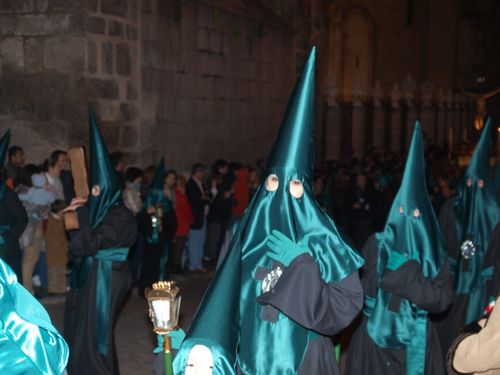
Tolède • Semana Santa in Toledo: Sevilla
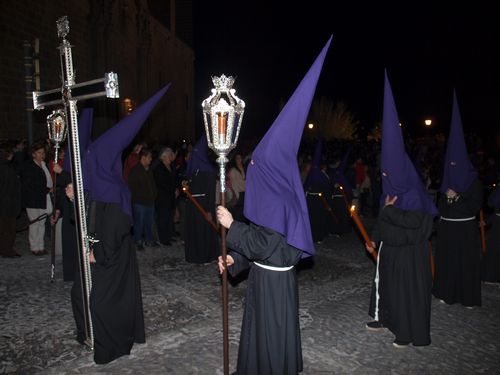
Tolède • Semana Santa in Toledo: Sevilla
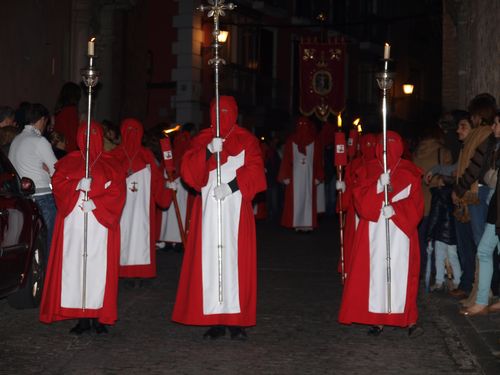
Tolède • Semana Santa in Toledo: Toledo
Tradition profile
Semana Santa in Toledo
Tradition category: Christian celebrations
Tradition family: Religious traditions
Tradition genre: Religious Festivals and Celebrations
Cultural heritage: Christian
Geographic location: Tolède • Andalusia • Spain
• Links to •
• List of videos about Toledo, Seville, Ronda, Granada, Baena on this site •
Spain • Holy Week celebrations • Andalusia and Toledo
Semana Santa in Toledo: A Living Ritual Shaped by Power, Faith, and Social Change
Political and Social Motivations Behind Its Origins
The origins of Semana Santa in Toledo are deeply tied to the political and religious climate of late medieval and early modern Spain. Although public expressions of devotion existed earlier, the practice of organized Holy Week processions gained momentum in the 15th and 16th centuries. This period saw the consolidation of the Spanish monarchy, the growing authority of the Catholic Church, and the response to internal diversity—particularly the coexistence and subsequent expulsion of Jewish and Muslim populations.
Semana Santa became a tool of religious unification and social discipline. The Counter-Reformation (16th century), led by the Catholic Church in response to Protestantism, emphasized highly visual, emotionally charged expressions of faith. Processions served as a means of reaffirming Catholic orthodoxy and aligning local populations with state and Church authority. In Toledo—then a major religious, intellectual, and political center—the ritual took on particular weight, reflecting its role as the seat of the primate of Spain.
Historical Milestones and Regional Impact
Over the centuries, Semana Santa in Toledo was shaped by major historical disruptions: the Napoleonic Wars, the liberal revolutions of the 19th century, the Spanish Civil War, and the Franco regime. During liberal and secular movements, processions were suppressed or reduced; during Franco’s rule, they were revived and promoted as expressions of national Catholic identity.
These fluctuations affected the social fabric of Toledo. Confraternities (cofradías) that organized the processions evolved from religious guilds to civic associations, fostering social cohesion but also reflecting changing class structures. The economic aspect grew in the 20th century, with Semana Santa becoming a driver of cultural tourism, local craftsmanship (woodcarving, embroidery, silverwork), and small-scale commerce during the festivities.
lobal Context and Comparative Practices
Semana Santa emerged in a world where public religion was deeply intertwined with governance. In Catholic regions such as Italy, Portugal, and parts of Latin America, similar traditions developed—marked by theatrical processions, religious imagery, and community participation. However, Toledo’s version stands out for its sobriety, medieval urban backdrop, and symbolic silence in some processions.
By contrast, Protestant regions saw the suppression of such rituals, while in Eastern Christianity, Holy Week was celebrated through liturgy rather than public spectacle. The Spanish model, and specifically Toledo’s, later influenced similar practices in the Americas, particularly in countries like Mexico, Peru, and the Philippines.
Transformations Through the Centuries
Semana Santa in Toledo has undergone significant transformations reflecting broader societal changes. From being a strictly devotional event, it has also become a cultural and civic celebration. The inclusion of women, young people, and a more diverse range of participants mirrors modern shifts toward inclusivity and community heritage.
Technological advancements—such as electric lighting, live broadcasts, and digital promotion—have redefined the experience while helping to ensure continuity. At the same time, the original religious intensity has, for some, been replaced by aesthetic or cultural appreciation.
Cultural Relevance and Current Challenges
Today, Semana Santa remains one of Toledo’s most prominent traditions, attracting tens of thousands of visitors annually. Although not yet inscribed on UNESCO’s list of Intangible Cultural Heritage (unlike Seville’s), it enjoys national recognition and is part of Spain’s broader religious and cultural calendar.
Preservation faces several modern threats: generational disengagement, the decline of traditional artisanship, urban development affecting routes, and the risk of commercialization. Balancing authenticity with accessibility is a constant concern. Efforts to document, archive, and educate are ongoing, supported by both religious institutions and municipal bodies.
Semana Santa in Toledo is more than a religious observance. It is a ritual that has continuously adapted to political regimes, cultural influences, and social dynamics. Its endurance speaks to its capacity to be both a mirror of its time and a guardian of collective memory.
Semana Santa in Toledo: A Cultural Innovation Rooted in Devotion and Identity
Social and Cultural Innovation at Its Origins
The emergence of Semana Santa in Toledo during the late Middle Ages and early modern period reflected significant innovation in both religious expression and social organization. In the context of the Catholic Church’s growing influence and the rise of the Spanish monarchy, public rituals were reimagined as tools for unity, education, and control. Semana Santa processions provided a theatrical yet deeply spiritual response to the need for collective identity, especially following the religious fragmentation of the Reformation and the multicultural complexities of cities like Toledo, which had hosted Christian, Jewish, and Muslim communities.
The structure of the processions—organized by confraternities often tied to guilds or neighborhoods—demonstrated a new model of civic engagement and lay participation. These brotherhoods managed their own statues, costumes, music, and liturgical elements, showcasing a system where religious devotion merged with local pride and artistic craftsmanship.
Symbols and Rituals as Reflections of Grandeur
Semana Santa in Toledo is known for its visual austerity, yet each element is charged with symbolic weight. The “pasos,” intricate wooden floats depicting the Passion of Christ, are carried by volunteers and accompanied by penitents in traditional robes and pointed hoods (capirotes). The choice of silence in some processions—particularly the Procesión del Silencio—is especially striking and stands as a powerful statement of collective reflection.
The solemn rhythm of the processions through Toledo’s narrow, winding streets heightens the impact of the visuals. Lanterns, incense, and medieval music add to the sensory experience. The heavy pasos, some requiring dozens of bearers, demonstrate physical devotion and communal effort. These objects are not only liturgical; they are also masterpieces of sculpture and iconography, reflecting both religious commitment and the grandeur of Spanish baroque artistic heritage.
Blending Local Traditions with External Influences
While deeply rooted in Castilian Catholicism, Toledo’s Semana Santa incorporates diverse influences. The use of theatrical elements echoes Italian processional models developed during the Counter-Reformation. At the same time, the symbolism and social structure of the confraternities are reminiscent of Islamic and Jewish communal traditions that had long shaped Toledo’s social fabric.
The religious processions also took inspiration from pilgrimage culture, liturgical drama, and public penance rituals seen across medieval Europe, making them both distinctively local and part of a broader Christian tradition.
Notable Practices and Cultural Significance
One of the most iconic events is the Procesión del Santo Entierro on Good Friday, which draws thousands of spectators and unites numerous confraternities. Another is the Cristo de la Vega procession, associated with a local legend and venerated beyond purely religious circles. In 2023, local authorities estimated over 70,000 people participated or attended Semana Santa events in Toledo.
Though not yet inscribed on UNESCO’s Intangible Cultural Heritage list, Semana Santa traditions in other Spanish cities (like Seville) have received such recognition. Toledo’s own candidacy, if proposed, could significantly enhance efforts to protect its fragile artistic legacy, support intergenerational transmission, and reinforce international awareness of its unique contributions to world heritage.
Semana Santa in Toledo is not only a spiritual expression but also a living archive of cultural synthesis, social structure, and artistic excellence. Its ability to adapt while preserving its core rituals makes it a powerful example of enduring tradition in a rapidly changing world.
 Links to the main sections of the site