Français (France)
  Nederlands (nl-NL)
 Angklung is a musical tradition originating from Bandung, in the province of Java, Indonesia. Made of bamboo tubes mounted on a frame, the instrument produces melodic tones when shaken. Recognized by UNESCO as Intangible Cultural Heritage of Humanity, angklung represents cooperation and community harmony, as each performer plays a single note within a collective ensemble. It continues to be taught in schools and showcased at cultural events across Indonesia and abroad, preserving an artistic practice that combines creative expression with social values.

Bandung • Angklung

Bandung • Angklung
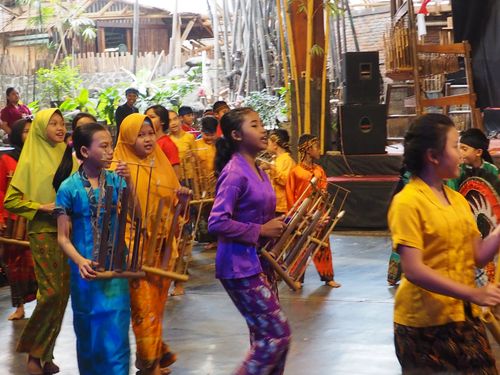
Bandung • Angklung
Tradition profile
Angklung
Tradition category: Concerts and musical shows
Tradition family: Traditional music
Tradition genre: Performing arts
Geographic location: Bandung • Java • Indonesia
• Links to •
• List of videos about Jakarta, Bandung on this site •
Indonesia • Java • Jakarta and Bandung
• References •
UNESCO: Indonesian Angklung
History of the Angklung Tradition in Bandung (Java, Indonesia)
Origins and Early References
The angklung is a traditional bamboo instrument originating from the Sundanese region of West Java, particularly around Bandung, Indonesia. Historical references trace its use back to the 13th century, during the era of early Sundanese kingdoms. The instrument consists of two or three bamboo tubes attached to a bamboo frame, producing resonant tones when shaken. Its name derives from the Sundanese word angkleung-angkleungan, describing the swinging motion of the instrument. Initially, the angklung was played during agricultural rituals devoted to Dewi Sri, the rice and fertility goddess, symbolizing gratitude for a good harvest and the hope for prosperity.
Ritual and Communal Use in Precolonial Java
By the 15th century, the angklung had become deeply rooted in agrarian ceremonies and community festivals. Each instrument produced only one or two notes, requiring multiple players to create melodies, a feature that mirrored the spirit of cooperation within rural communities. Ensembles often included 30 to 40 performers, each responsible for a specific pitch. The music followed a pentatonic scale typical of Sundanese culture. The angklung thus functioned as a communal form of expression, uniting villagers through rhythmic coordination and collective participation.
Suppression during Colonial Rule
The arrival of Dutch colonial rule in the 17th century marked a turning point. Colonial authorities, viewing certain indigenous practices as “pagan,” discouraged or outright banned ritual performances involving the angklung. This policy led to the decline of the instrument’s ceremonial use. However, rural artisans around Bandung preserved the craft of bamboo instrument-making, allowing the angklung to survive as part of local village life. By the 19th century, its use had shifted from ritual contexts to folk celebrations, weddings, and informal gatherings.
Revival and Musical Reform in the 20th Century
The revival of the angklung is closely linked to Daeng Soetigna (1908–1984), a schoolteacher from Bandung who modernized the instrument in 1938. He developed the diatonic angklung, tuned to the Western musical scale, enabling it to be integrated into orchestras and modern educational systems. After Indonesia gained independence in 1945, the new government promoted the angklung as a symbol of national unity and cultural identity. By the 1950s, it was introduced in schools across West Java and later throughout the archipelago.
Institutionalization and Cultural Preservation
A major milestone occurred with the establishment of the Saung Angklung Udjo in 1966 by Udjo Ngalagena and his wife. This cultural center, located in Bandung, became a hub for teaching, producing, and performing angklung music. Each year, it welcomes around 200,000 visitors, many of them students. In the 1970s and 1980s, performances organized by Bandung ensembles gained national and international attention, representing Indonesia in cultural missions to Japan and Europe.
Global Recognition and Contemporary Developments
In 2010, UNESCO inscribed the angklung on the Representative List of the Intangible Cultural Heritage of Humanity. This recognition revived public interest and led to the creation of more than 150 bamboo workshops in Bandung alone. Today, both traditional pentatonic and modern diatonic angklungs coexist. Large orchestras involving up to 500 musicians perform regularly in schools and cultural centers, reflecting the endurance and adaptability of this tradition.
The history of the angklung in Bandung illustrates the resilience of Indonesian cultural practices, capable of evolving from rural spirituality to global cultural representation while preserving their social essence.
Sociology of the Angklung Tradition in Bandung (Java, Indonesia)
Community Expression and Collective Identity
In Bandung, the angklung is not merely a musical instrument but a medium of collective identity. Its performance structure—each musician playing a single note within a group—represents the values of harmony and cooperation that underpin Indonesian society. Ensembles typically include 30 to 50 participants, blending various ages and social backgrounds. Through this coordination, the angklung embodies the principle that unity arises from individual contribution, a social metaphor widely embraced in civic and educational contexts.
Education and Transmission of Values
The Indonesian Ministry of Education introduced angklung instruction in schools during the 1970s, establishing it as a cornerstone of cultural education. In Bandung alone, more than 90% of primary schools teach angklung playing as part of their music curriculum. The activity fosters teamwork, concentration, and discipline while promoting interethnic understanding. Teachers view it as a pedagogical tool that strengthens both cultural awareness and civic responsibility. In recent years, educational programs have integrated angklung performances into national celebrations such as Independence Day and Youth Pledge Day.
Gender Roles and Cultural Participation
Women have played a central role in the transmission and management of the angklung tradition. Approximately 60% of angklung instructors in Bandung are women, many associated with community foundations and local cultural centers. They lead training sessions, organize performances, and coordinate inter-school competitions. This active involvement not only preserves traditional craftsmanship but also promotes gender inclusivity within the cultural sphere. The participation of young women in teaching and performing reflects broader social changes in contemporary Indonesia.
Economic Impact and Cultural Tourism
The angklung tradition supports a thriving local economy. The manufacture of bamboo instruments, together with the production of accessories and souvenirs, sustains around 2,000 artisans in the Bandung region. The Saung Angklung Udjo remains the most significant cultural and economic institution, employing several hundred people and hosting daily performances for tourists. Annual attendance surpasses 100,000 visitors, making it one of West Java’s leading cultural attractions. This synergy between heritage and tourism illustrates the adaptability of traditional arts in a market-oriented urban society.
Urban Integration and Social Cohesion
Bandung’s rapid urbanization has not weakened the angklung tradition; instead, it has enhanced its role as a unifying practice. Public performances bring together residents from diverse neighborhoods, often in cooperation with schools and local associations. Workshops located on the outskirts of the city employ entire families, connecting rural craftsmanship with urban demand. The angklung thus functions as a bridge between traditional community life and the dynamics of modern city culture.
Globalization and Modern Identity
In an era of globalization, the angklung has evolved into an international symbol of Indonesian soft power. Ensembles from Bandung regularly perform at festivals in Asia and Europe, presenting the angklung as a contemporary cultural ambassador. The 2011 Guinness World Record for the world’s largest angklung performance, with over 5,000 participants, reinforced its global visibility. Today, universities in Tokyo, Seoul, and London include angklung studies in ethnomusicology programs.
The sociological dimension of the angklung demonstrates how a rural ritual instrument became a national emblem of education, cooperation, and creativity. In Bandung, its continued vitality reflects the capacity of traditional practices to adapt to social change while preserving their communal and ethical core.
 Links to the main sections of the site