Français (France)
  Nederlands (nl-NL)
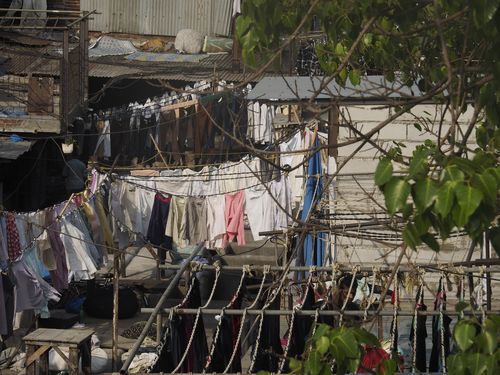
 Dhobi Ghat, located in Mumbai in the Indian state of Maharashtra, is one of the largest open-air laundries in India. This extensive complex of washing basins, work platforms, and drying areas is used daily by professional washermen known as “dhobis,” who clean laundry from hotels, hospitals, businesses, and private households. The site functions both as a collective workplace and as a recognizable element of Mumbai’s urban landscape. Dhobi Ghat illustrates the continuity of a traditional professional activity adapted to the needs of a large and densely populated modern metropolis.
Mumbai • Dhobi Ghat

Mumbai • Dhobi Ghat

Mumbai • Dhobi Ghat
Tradition profile
Dhobi Ghat
Tradition category: Public laundry
Tradition family: Crafts and professions
Tradition genre: Trade and Local Creativity
Geographic location: Mumbai • Maharashtra • India
• Links to •
• List of videos about Mumbai on this site •
Mumbai (Bombay) - megalopolis of western India • Maharashtra, India
Dhobi Ghat in Mumbai: History of a Collective Laundry System and Urban Profession
Origins and Formation of the Site
Dhobi Ghat, located in central Mumbai, is one of the largest open-air laundry complexes in India. The site is associated with the profession of the “dhobis,” washermen specialized in cleaning textiles for private households, institutions, hotels, and commercial activities. This occupation forms part of a long urban tradition of textile maintenance services that developed in major cities across the Indian subcontinent.
The expansion of Dhobi Ghat is closely connected to the development of Bombay during the British colonial period. From the nineteenth century onward, the rapid growth of the port, railway infrastructure, industry, and colonial administration generated increasing demand for large-scale laundry services. Hotels, military facilities, hospitals, offices, and residential districts required the daily cleaning of significant quantities of linen and clothing.
Within this context, a centralized washing area was progressively established near important transport routes and railway connections. The concentration of washing activities into a dedicated urban space allowed greater efficiency than the dispersed systems previously used in different neighborhoods and water points throughout the city.
The location of the laundry complex also reflected practical considerations linked to water access, transportation, and proximity to densely populated commercial districts. Over time, Dhobi Ghat evolved into an organized professional environment closely integrated into Mumbai’s urban economy.
Professional Organization and Community Structure
The dhobi profession historically relied on strong family and community networks. Washing, drying, ironing, and delivery activities were often divided among members of the same family or professional group. This organization contributed to the continuity of the profession despite the economic and social transformations affecting Mumbai throughout the twentieth century.
Dhobi Ghat developed as a collective workspace in which each washerman or family group used specific washing platforms and drying areas. The distribution of workspaces followed practical and professional arrangements that allowed the treatment of large quantities of laundry within a relatively compact area.
The profession occupied an important social role within the urban structure of Mumbai. Many dhobi families specialized in serving particular clients or sectors, including hospitals, restaurants, railway companies, or hotels. Long-term customer relationships became a central part of the economic stability of the profession.
The transmission of technical knowledge occurred mainly through direct participation in daily work. Younger generations learned sorting methods, washing techniques, textile handling, and delivery organization through continuous practical involvement within family-based working groups.
Economic Development and Urban Transformation
The evolution of Dhobi Ghat reflects the broader transformation of Mumbai into one of India’s largest metropolitan centers. Industrialization, population growth, and the expansion of commercial districts increased the importance of collective laundry services during the twentieth century. The site became an essential component of the city’s logistical and service infrastructure.
Mumbai’s railway system played a major role in this development. Efficient transportation connections enabled the rapid circulation of laundry between residential, commercial, and industrial districts. This accessibility contributed significantly to the long-term survival of the laundry complex despite increasing urban density and land pressure.
During the second half of the twentieth century, Dhobi Ghat began facing competition from mechanized laundries, domestic washing machines, and industrial cleaning companies. These changes gradually altered the economic structure of the profession. Nevertheless, the site remained active because of its ability to process large quantities of laundry at relatively low operational costs.
The visual organization of the laundry complex also progressively transformed Dhobi Ghat into a recognizable element of Mumbai’s urban identity. The repetitive arrangement of basins, drying lines, and workspaces became closely associated with representations of the city in photography, cinema, and documentary work.
Contemporary Importance and Preservation Challenges
Today, Dhobi Ghat continues to function as an active workplace despite the profound economic transformations affecting Mumbai. The site still provides laundry services for hotels, hospitals, restaurants, businesses, and private households. It also remains an important example of the continuity of a traditional urban profession within a modern megacity.
Several contemporary challenges affect the future of the site. Urban redevelopment projects, rising land values, infrastructure modernization, and environmental concerns increasingly influence the organization of the laundry complex. Access to water, wastewater management, and working conditions have become central issues in discussions concerning the preservation and modernization of the site.
The transmission of the profession also represents an important challenge. Some younger members of dhobi families now seek employment in other economic sectors, while the physical demands of the work make the profession less attractive than in previous generations.
Despite these transformations, Dhobi Ghat continues to preserve a distinctive collective working system rooted in long-standing professional traditions. The site remains both an active economic space and a significant testimony to the social and urban history of Mumbai.
Work Organization and Laundry Techniques at Dhobi Ghat in Mumbai
General Organization of the Collective Laundry
Dhobi Ghat operates as a large collective workspace dedicated to washing, drying, ironing, and processing laundry on an industrial scale through largely manual methods. The site is organized around hundreds of concrete washing pens aligned in dense rows separated by narrow circulation paths. Each washing station is generally assigned to an individual worker or a family group that uses the same area on a regular basis.
The daily activity begins early in the morning with the arrival of laundry collected from hotels, hospitals, restaurants, offices, railway services, and private households. Bundles of textiles are transported by handcarts, bicycles, motorcycles, or small delivery vehicles before being distributed among the different washing sections.
The functioning of the site depends on a highly specialized division of labor. Some workers concentrate on washing and rinsing, while others are responsible for sorting, drying, ironing, folding, or transporting finished laundry back to clients. This collective organization allows very large quantities of textiles to be processed simultaneously within a relatively compact urban space.
Internal circulation forms an essential aspect of the working environment. Workers constantly move between washing basins, drying areas, storage sections, and ironing workshops, creating a continuous flow of activity throughout the site.
Washing Methods and Professional Techniques
Laundry work at Dhobi Ghat continues to rely heavily on manual techniques. Textiles are first sorted according to fabric type, color, level of dirt, and required treatment. This stage is important for preventing damage and avoiding color transfer during the washing process.
After sorting, the laundry is soaked in water mixed with detergent or soap before undergoing repeated cycles of scrubbing, rinsing, and beating. One of the most recognizable techniques involves striking wet fabric against stone or concrete washing platforms in order to remove deeply embedded dirt. The movement requires considerable physical coordination and experience, especially when handling heavier fabrics such as bedsheets or industrial linens.
Different detergents, bleaching agents, and cleaning products are used depending on the material being treated. Some textiles require prolonged soaking or gentler handling, while others undergo more intensive washing cycles. The workers develop practical expertise in identifying the appropriate treatment for each category of fabric.
After washing, the textiles are wrung manually to remove excess water before being transported to drying areas. The work takes place in a humid environment where efficiency and rhythm are essential for maintaining productivity throughout the day.
Ironing forms another important stage of the process. Several workshops within the complex continue to use large charcoal-heated irons alongside more modern electric equipment. Large sheets, uniforms, and tablecloths are carefully folded and prepared for delivery according to client requirements.
Drying Areas and Visual Environment
The drying sections constitute one of the most recognizable visual elements of Dhobi Ghat. Hundreds of clotheslines stretched between structures allow large quantities of laundry to dry simultaneously. Hanging fabrics create dense linear compositions that continuously change throughout the day according to the movement of workers and the progression of the washing cycle.
Drying depends primarily on sun exposure and air circulation. Workers must constantly adapt their organization to changing weather conditions, humidity levels, and seasonal variations. During the monsoon period, operations become more complex and additional covered areas may be required to protect laundry from heavy rainfall.
The surrounding built environment includes ironing workshops, storage spaces, sorting areas, and residential sections connected directly to the professional activity of the site. Many workers and their families live close to the washing areas, creating a strong continuity between workplace and domestic space.
The sound environment of Dhobi Ghat is dominated by the repetitive impact of fabrics against washing stones, conversations between workers, movement through narrow corridors, and the continuous handling of textiles. The site functions as a dense acoustic environment shaped by constant physical labor.
Participants and Transmission of Knowledge
The functioning of Dhobi Ghat historically depends on family-based professional networks. Technical knowledge related to washing, sorting, drying, and ironing is usually transmitted through direct participation in daily work. Younger generations often begin with simpler tasks before gradually acquiring more advanced skills linked to textile handling and production organization.
Men frequently perform the most physically demanding activities, including transporting heavy bundles and carrying out intensive washing operations. Women often participate in sorting, folding, ironing, and logistical organization, although the exact distribution of work varies between families and working groups.
The management of laundry requires constant coordination between participants. Orders must be identified precisely in order to avoid mistakes during redistribution. Workers use systems of marking, memorization, and categorization developed through long professional experience.
Despite the presence of mechanized laundries elsewhere in Mumbai, Dhobi Ghat still depends heavily on manual expertise. Knowledge of fabrics, detergent use, drying conditions, and ironing techniques remains essential to the functioning of the site.
Distinctive Features and Contemporary Adaptations
Dhobi Ghat is distinguished by its exceptional scale and by the density of its spatial organization. Few collective laundries in the world continue to operate on such a large scale within the center of a modern megacity. The site combines older labor-intensive methods with certain contemporary adaptations introduced in response to changing urban conditions.
Mechanical equipment has gradually appeared in some sections of the complex, particularly for ironing and water extraction. Nevertheless, a large proportion of the work continues to be performed manually because the traditional organization remains economically efficient for handling high laundry volumes at relatively low operational cost.
Urban transformation in Mumbai increasingly affects the functioning of the site. Questions related to water supply, wastewater management, worker safety, and infrastructure modernization influence the evolution of the laundry complex. Rising land values and urban redevelopment projects also create pressure on the long-term future of the area.
Despite these changes, Dhobi Ghat preserves a highly specific working environment based on repetitive technical gestures, collective spatial organization, and the continuity of a traditional urban profession transmitted across generations.
 Links to the main sections of the site