

 Français (France)
 Nederlands (nl-NL)
Of Hindu tradition, the Vaghela of Dandahi ruled for approximately 50 years, ± between 1450 and 1500 over all or part of West India, during the Medieval Period.
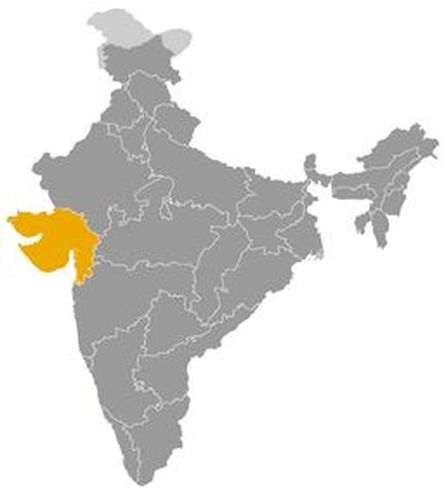
This map illustrates the maximum territory that the Vaghela of Dandahi Dynasty had reached at its height, covering the current regions of Gujarat in India. Its main purpose is to provide a visual aid to understand the geographical extent of this dynasty. However, it's important to note that the contemporary borders of these regions may not necessarily coincide with the historical territories.
The Vaghelas of Dandahi: Local Authority and Patronage in Gujarat
A Local Ruling House within the Vaghela Clan
The designation “Vaghelas of Dandahi” identifies the local ruling family associated with Virasimha, also known as Veer Singh, and his wife, Queen Rudabai. It distinguishes this household from the Vaghela dynasty that governed Gujarat during the thirteenth and early fourteenth centuries. The name is best understood as a geographical designation rather than evidence that the family officially styled itself as a separate dynasty.
The disappearance of the earlier Vaghela kingdom did not necessarily entail the disappearance of every family belonging to the clan. The inscription at Adalaj establishes the presence of a Vaghela territorial ruler in the late fifteenth century. However, it does not provide a complete genealogy connecting him to Gujarat’s former sovereigns. The history of this local house must therefore be reconstructed from its own surviving evidence.
Territorial Government under the Gujarat Sultanate
The Adalaj inscription identifies Virasimha as a son of Mahipa and associates his authority with the territory of Dandahi. It describes him using royal titles and praise. Such language establishes the status claimed for him within the commemorative text, but does not by itself demonstrate political independence or authority extending across Gujarat.
The same inscription dates Rudabai’s foundation to the reign of Sultan Mahmud Begada. It therefore places the local ruling household within the wider political framework of the Gujarat Sultanate. The distinction is between the regional sovereign named in the dating formula and the family responsible for the foundation. The evidence does not establish the precise fiscal, military or administrative obligations connecting Virasimha’s household with the sultan.
Rudabai’s Patronage and Financial Resources
The clearest surviving expression of the family’s resources is the Adalaj stepwell, completed in 1499. Its inscription attributes the foundation to Rudabai and connects it with the spiritual welfare of her deceased husband. Her role is consequently more substantial than that of a figure preserved only in later storytelling: she appears in the monument’s own record as its patron.
The inscription states that approximately five hundred thousand tankas were spent from the treasury. Although translating this amount into modern purchasing power would be unreliable, the recorded expenditure conveys the scale of the undertaking. Construction required stone, transport, skilled carving and the coordination of labour. Rudabai’s commission demonstrates access to substantial resources, even though the sources do not reveal the household’s revenue system or provide accounts explaining how those funds accumulated.
Water Infrastructure and Local Economic Activity
The stepwell provided access to groundwater through descending stairs and successive landings. This arrangement accommodated changes in the water level and made the structure useful beyond a single season. The investment linked commemoration of a deceased ruler with the provision of a shared resource. Its economic significance lay first in supporting the water requirements of the surrounding community.
Covered galleries and sheltered platforms also provided places to pause and rest. A dependable water source could serve people moving through the locality as well as nearby residents. Nevertheless, its broader commercial effects cannot be quantified from the surviving evidence. There is no adequate basis for attributing a comprehensive trading policy, a network of market institutions or extensive hydraulic development to the Vaghelas of Dandahi.
Cultural Expression through Architectural Patronage
Adalaj’s decoration combines religious figures, human scenes and vegetal and geometric ornament. Its execution demonstrates the employment of craftspeople capable of integrating elaborate sculpture with a multilevel hydraulic structure. The commission reflects the artistic practices available in late fifteenth-century Gujarat, where different ornamental repertoires could coexist within one building.
This combination should not automatically be treated as evidence of joint financing by Hindu rulers and the Muslim sultan. Decorative forms reveal artistic choices and workshop skills more directly than political sponsorship. Rudabai’s patronage is supported by the inscription; additional claims about the organisation of the commission require separate evidence.
Commemorative Tradition and the Limits of Dynastic History
Later accounts describe Virasimha’s death in conflict with Mahmud Begada, the sultan’s proposed marriage to Rudabai and her suicide after completion of the well. These episodes belong to the monument’s traditional narrative and must be distinguished from the information recorded in its inscription. They cannot independently establish the family’s political history.
The documented contribution of the Vaghelas of Dandahi centres on local territorial authority and Rudabai’s architectural patronage. A continuous succession of rulers, secure founding and ending dates, and a complete relationship with the earlier Vaghela sovereigns remain unestablished. The stepwell preserves a specific household’s public commission rather than a comprehensive record of an enduring regional state.
The Vaghelas of Dandahi: Territorial Presence and Relations with the Gujarat Sultanate
A Local Ruling House in Fifteenth Century Gujarat
The designation “Vaghelas of Dandahi” identifies the local ruling family associated with Virasimha, also known as Veer Singh, and his wife Rudabai. Its geographical presence is documented principally through the inscription at the Adalaj stepwell, completed in 1499. This record connects Virasimha with the territory of Dandahi, but does not describe its boundaries sufficiently to support a detailed reconstruction of his possessions.
This household must be distinguished from the earlier Vaghela dynasty that exercised sovereignty over much of Gujarat during the thirteenth century. The territories of that kingdom cannot automatically be assigned to the later rulers of Dandahi. A shared clan designation does not establish continuity of government, inheritance of particular estates or preservation of the earlier kingdom’s geographical extent.
Adalaj as the Most Secure Geographical Reference
Adalaj provides the clearest identifiable location associated with the family. Situated north of Ahmedabad, near present day Gandhinagar, it preserves the monumental foundation commissioned by Rudabai. The stepwell establishes a direct connection between her household and a specific settlement. Its construction also demonstrates access to the resources necessary to organise a substantial public work within that locality.
The presence of the foundation does not, however, establish that Adalaj served as a capital or permanent administrative headquarters. The inscription does not describe a palace, governmental institutions or a hierarchy of settlements. The place where Rudabai commissioned the well must therefore be distinguished from the wider territory attributed to her husband. The size and composition of that territory remain insufficiently documented.
Dandahi and the Problem of Territorial Boundaries
Dandahi appears in the inscription as the territory associated with Virasimha’s authority. The name is consequently a historical geographical reference rather than a modern administrative designation. It should not be mapped directly onto the boundaries of present districts, whose organisation reflects later changes in government, settlement and territorial administration.
The evidence examined does not provide a reliable inventory of villages, forts, agricultural estates or dependent settlements controlled by this house. It also does not establish successive stages of conquest, territorial division or contraction. A narrative describing an expanding principality would therefore exceed what can presently be supported. The secure geographical framework is a local authority connected with Dandahi and commemorated through Rudabai’s foundation at Adalaj.
Position within the Gujarat Sultanate
The stepwell inscription dates the foundation to the reign of Sultan Mahmud Begada. It thus places the household’s patronage within the political framework of the Gujarat Sultanate. The record acknowledges the regional sovereign while preserving the name and status of a local ruler and identifying his wife as the person responsible for the monument.
This combination is significant for understanding the scale of the family’s authority. Virasimha’s royal titles need not imply sovereignty over Gujarat as a whole. Equally, the reference to the sultan does not erase the local household’s access to wealth or its capacity to undertake public construction. The inscription records both levels of political identity without explaining their complete institutional relationship.
The precise terms connecting Dandahi with the sultanate remain uncertain. The available information does not establish particular military obligations, tribute payments or conditions governing the recognition of local authority. Describing Virasimha categorically as an independent monarch, tributary ruler or appointed official would therefore require evidence beyond the inscription’s commemorative language.
Neighbouring Powers and the Reach of Local Patronage
Later narratives describe conflict between Virasimha and Mahmud Begada, followed by the ruler’s death and the sultan’s involvement in completing the well. These accounts belong to the traditional history of the monument. They cannot independently establish the boundaries of Dandahi, the date of an annexation or the course of a military campaign.
No specific diplomatic relationship with other neighbouring dynasties can be reconstructed from the documents examined. The most tangible geographical effect of the family’s patronage concerns Adalaj itself. The stepwell supported access to water and provided sheltered spaces for users. Its benefits could extend to travellers as well as residents, but a wider circle of beneficiaries does not demonstrate political control over the places from which they came.
The inscription at the Adalaj stepwell, dated 1499, records a genealogy comprising Mokala, Karna, Mularaja, Mahipa and Virasimha. This family sequence does not establish a succession of dated reigns. The list below includes Virasimha, who is explicitly associated with the government of Dandahi. His wife Rudabai is identified as queen and patron of the stepwell, but no personal reign or regency is established. The previously suggested limits, approximately 1450–1500, are not documented dynastic dates.
- Virasimha (Veer Singh) (late fifteenth century, before 1499; reign dates unknown) • Ruler of Dandahi, described as king in the inscription. His wife Rudabai commissioned the Adalaj stepwell in his memory.
 Links to the main sections of the site