

 Français (France)
 Nederlands (nl-NL)
Of Hindu tradition, the Pawar dynasty ruled for approximately 220 years, ± between 1728 and 1948 over all or part of Central India, during the Colonial Period and the Modern Period.
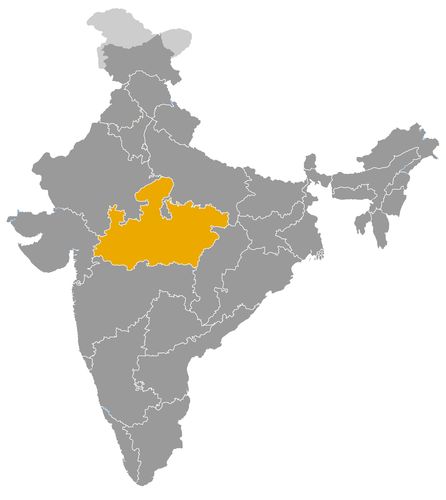
This map illustrates the maximum territory that the Pawar Dynasty had reached at its height, covering the current regions of Madhya Pradesh in India. Its main purpose is to provide a visual aid to understand the geographical extent of this dynasty. However, it's important to note that the contemporary borders of these regions may not necessarily coincide with the historical territories.
The Pawar Dynasty of Dhar and Dewas: Maratha Power and Regional Heritage in India
Establishing Pawar Authority in Malwa
The Pawars, also known as Puars or Powars, were among the Maratha ruling houses established in central India during the eighteenth century. Their principal branches governed Dhar and the two Dewas states until integration into independent India in 1948. Although connected by family identity and political origins, these principalities maintained separate administrations and followed distinct historical paths.
Their establishment in Malwa accompanied Maratha expansion during the weakening of Mughal imperial authority. From the late 1720s, Pawar commanders acquired or consolidated territorial and fiscal rights in the region. Udaji Rao and Anand Rao were associated with Dhar, while Tukoji Rao and Jivaji Rao founded the Dewas lines. Their authority emerged within a system combining military service, territorial grants and revenue collection.
Dhar and Dewas within the Maratha Political System
The Pawars helped establish a lasting Maratha presence in Malwa, a region connecting the Deccan with northern India. Their possessions, situated in present day Madhya Pradesh, formed part of a broader political landscape that included the Scindia and Holkar domains.
Relations among these houses combined cooperation with competition. Despite the precedence of the peshwas at Pune, regional leaders pursued their own territorial and financial interests. Dhar experienced pressure from stronger neighbours, limiting its freedom of action.
Dewas developed an unusual political arrangement. Two related lines shared the same capital while maintaining distinct territories and institutions. This structure illustrates the composite character of Maratha power. The Pawars governed several related principalities rather than a unified kingdom, and their survival depended on negotiation as well as military resources.
Princely Government under British Supremacy
The wars of the early nineteenth century transformed this regional balance. Following the defeat of the major Maratha powers, Dhar and Dewas entered the British system of protection. Agreements concluded around 1818 and 1819 preserved their existence while restricting their external independence.
The rulers retained dynastic status and responsibilities for internal administration. However, diplomacy and important aspects of princely government became subject to colonial supervision. Disputed successions, royal minorities and administrative difficulties could bring British intervention.
The Pawars consequently became participants in the wider system of princely India. Their continued rule preserved local institutions, but operated within an imperial hierarchy. Dynastic continuity should therefore be distinguished from unrestricted sovereignty.
Agriculture, Revenue and Regional Commerce
Agriculture provided the principal economic foundation of the Pawar states. Land revenue supported their administrations, courts and military establishments. Exchanges between villages, market settlements and capitals connected rural producers with urban consumers.
Dhar and Dewas benefited from their positions within Malwa’s regional communications network. Merchants, artisans and financial intermediaries contributed to economic activity. Court expenditure also generated demand for buildings, textiles, ceremonial objects and specialized services.
Political instability could undermine these advantages. Military operations and demands imposed by neighbouring powers placed pressure on local resources. Under British supremacy, the states gradually adapted to changing transport connections and commercial conditions. These developments did not produce equal benefits across society, and the rural population remained central to public revenue.
Hindu Patronage and the Representation of Dynastic Identity
The Pawar ruling families were Hindu. Support for religious institutions and observances contributed to their legitimacy and their relationships with local communities. Their Maratha identity developed alongside the established cultural traditions of Malwa.
At Dewas, palaces and royal chhatris expressed this dynastic presence. These commemorative monuments preserved the memory of rulers and presented the ruling houses as enduring institutions. Their architectural legacy remains a visible component of the city’s historical identity.
Dhar and Mandu also contained substantial monuments predating Pawar rule. Buildings associated with the medieval Paramaras, the Malwa sultans and the Mughals must be distinguished from later Pawar contributions. Possession of a historic site does not establish responsibility for constructing its monuments, and individual attributions require specific evidence.
Integration into India and Regional Historical Significance
After independence in 1947, the Pawar principalities joined the Indian Union and were incorporated into Madhya Bharat in 1948. Their former territories now lie within Madhya Pradesh.
The dynasty’s importance is primarily regional. Its branches contributed to Maratha expansion into central India and later represented the persistence of local hereditary authority under British supremacy. Their legacy combines princely institutions, an agricultural economy, religious patronage and architectural commemoration. Considered together, Dhar and Dewas reveal how related ruling houses adapted to changing political systems while retaining separate identities.
The Territories of the Pawar Dynasty: Dhar and Dewas in Central India
Maratha Settlement and the Formation of Regional States
The Pawars, also known as Puars or Powars, established several territorial powers in Malwa during the eighteenth century. Their principal branches governed Dhar and the two Dewas states until their integration into independent India in 1948. These possessions lay within present day Madhya Pradesh, but they never constituted a single unified Pawar kingdom.
Their establishment accompanied Maratha expansion as Mughal authority weakened. From the late 1720s, Pawar commanders consolidated their position through military activity, territorial grants and revenue rights. Their political geography must be distinguished from that of the medieval Paramara dynasty, despite genealogical traditions connecting the two families.
Dhar and Its Principal Territorial Centres
The Dhar branch developed its authority around the historic town of Dhar. Udaji Rao and Anand Rao were associated with the formation of the principality, whose boundaries encompassed only part of the surrounding region.
Administrative descriptions from the later princely period identify Dhar, Badnawar, Kukshi, Dharampuri and Mandu among its territorial divisions. These centres illustrate a domain extending across parts of the Malwa plateau and towards the Narmada valley.
Mandu was a prestigious possession because of its earlier status as a capital and its architectural heritage. However, its inclusion within Dhar does not make the Pawars responsible for its principal palaces, mosques and tombs. Most originated under earlier rulers. Pawar territorial authority must therefore be distinguished from architectural patronage.
Dewas and the Coexistence of Two Ruling Branches
At Dewas, the lines founded by Tukoji Rao and Jivaji Rao developed into two related houses, subsequently known as the Senior and Junior branches. They shared Dewas as their capital but maintained separate administrations and territorial possessions.
Their lands included dispersed groups of villages rather than a single compact block surrounding the city. This arrangement made boundaries and jurisdiction more complicated than those of a conventional state with one capital and a continuous hinterland.
The historical principalities should not be equated with the modern Dewas district. That district incorporated territories formerly belonging to several other powers, including Gwalior, Indore, Dhar and Bhopal. Present administrative boundaries consequently provide an imperfect guide to the extent of Pawar rule.
Relations with the Scindia and Holkar Houses
The Pawars occupied a political landscape dominated by stronger Maratha neighbours. The Scindias, associated with Gwalior and Ujjain, and the Holkars, established around Indore and Maheshwar, commanded substantial military and financial resources.
Shared Maratha affiliations did not prevent competition. Territorial claims, revenue demands and strategic interests could bring these houses into conflict. Cooperation within the broader Maratha system existed alongside pressure on smaller principalities.
Dhar experienced encroachments and demands from the Scindias and Holkars during the late eighteenth and early nineteenth centuries. Preserving its territory required negotiation and political resilience as well as military resistance. Pawar history therefore concerns the survival of regional domains more than uninterrupted expansion.
Fragmented Authority and the Limits of Territorial Claims
Malwa contained a complex mixture of princely possessions, local chiefships and overlapping fiscal rights. Collecting tribute or exercising temporary military influence did not necessarily amount to direct administration.
This distinction matters when assessing Pawar territorial extent. Their commanders participated in wider Maratha campaigns, but every region reached by those armies did not become a hereditary Pawar possession.
There is consequently no single date representing the territorial apex of a common Pawar state. Dhar and Dewas followed different trajectories. Boundaries recorded during the colonial period offer firmer evidence than maps assigning all Maratha conquests to individual ruling families. Their principal domains remained concentrated within Malwa.
British Protection and Integration into Independent India
Agreements concluded around 1818 and 1819 placed the Pawar principalities under British protection. Their continued existence was recognized, while their independent diplomatic and military activity became restricted.
British supremacy changed relations with neighbouring dynasties by placing disputes within an imperial framework. Territorial survival increasingly depended on recognized princely status rather than the ability to expand through warfare.
Following independence in 1947, Dhar and both Dewas states joined the Indian Union. Their incorporation into Madhya Bharat in 1948 ended their separate territorial governments. Their former possessions now belong to Madhya Pradesh, preserving the geographical legacy of Maratha settlement within the modern administrative structure of India.
This chronology combines three parallel branches: Dhar, Dewas Senior and Dewas Junior. They did not constitute a unified state. The rulers generally bore the title of raja; the heads of all three branches received the title of maharaja in 1918 under British supremacy. Dates follow dynastic succession and do not always imply personal government, particularly during minorities. Some early dates vary between chronologies. Princely rule in Dhar was interrupted between 1858 and 1860. The final territorial reigns end with the states’ integration in 1948; subsequent purely titular periods are excluded. Entries are ordered by the beginning of each reign.
- Udaji Rao I Pawar (1728–1732) • Dhar: first ruler of the branch in the chronology adopted here.
- Tukoji Rao I Pawar (1728–1754) • Dewas Senior: founded the ruling line.
- Jivaji Rao Pawar (1728–1774) • Dewas Junior: founded the parallel ruling line.
- Anand Rao I Pawar (1732–1736) • Dhar: consolidated the establishment of Pawar authority at Dhar.
- Yeshwant Rao I Pawar (1736–1761) • Dhar: governed during Maratha expansion in central India.
- Krishnaji Rao I Pawar (1754–1789) • Dewas Senior: succeeded as a minor, under Savitribai’s regency until 1756.
- Khande Rao Pawar (1761–1782) • Dhar: succeeded during his minority.
- Sadashiv Rao I Pawar (1774–1790) • Dewas Junior: succeeded Jivaji Rao.
- Anand Rao II Pawar (1782–1807) • Dhar: reigned during rivalry among the Maratha powers.
- Tukoji Rao II Pawar (1789–1827) • Dewas Senior: initially under regency; his state entered British protection in 1818.
- Rukmangad Rao Pawar (1790–1817) • Dewas Junior: governed before the establishment of British protection.
- Ramchandra Rao I Pawar (1807–1810) • Dhar: a child ruler under Maina Bai’s regency.
- Ramchandra Rao II Pawar (1810–1833) • Dhar: initially a minor; British protection was established during his reign in 1819.
- Anand Rao Pawar (1817–1840) • Dewas Junior: concluded the British protection treaty in 1818.
- Rukmangad Tukoji Rao Pawar (1827–1860) • Dewas Senior: succeeded as a minor, under Bhawanibai’s regency until 1835.
- Yeshwant Rao II Pawar (1834–1857) • Dhar: succeeded during his minority and ruled under British supremacy.
- Haibat Rao Pawar (1840–1864) • Dewas Junior: adopted successor of Anand Rao.
- Anand Rao III Pawar (1857–1858 and 1860–1898) • Dhar: his reign was interrupted by the temporary abolition of the state; exercised personal government from 1864.
- Krishnaji Rao II Pawar (1860–1899) • Dewas Senior: succeeded as a minor; Yamunabai served as regent until 1867.
- Narayan Rao Pawar (1864–1892) • Dewas Junior: initially ruled under regency until 1877.
- Malhar Rao Pawar (1892–1934) • Dewas Junior: raja, then maharaja from 1918; exercised personal government from 1913.
- Udaji Rao II Pawar (1898–1926) • Dhar: succeeded as a minor; raja, then maharaja from 1918.
- Tukoji Rao III Pawar (1899–1937; personal government interrupted in 1934) • Dewas Senior: raja, then maharaja in 1918; left the state in 1934.
- Anand Rao IV Pawar (1926–1948) • Dhar: maharaja, initially under regency; the branch’s last territorial ruler.
- Sadashiv Rao II Pawar (1934–1943) • Dewas Junior: maharaja, succeeded Malhar Rao.
- Vikram Singh Rao Pawar (1937–1947) • Dewas Senior: maharaja, relinquished his throne before becoming ruler of Kolhapur.
- Yeshwant Rao Pawar (1943–1948) • Dewas Junior: the last ruling maharaja before integration into India.
- Krishnaji Rao III Pawar (1947–1948; under regency) • Dewas Senior: the last ruling maharaja, under Pramilabai’s regency.
 Links to the main sections of the site