Français (France)
  Nederlands (nl-NL)
 Of Hindu tradition, (with additional Jain influence), the Chudasama dynasty ruled for approximately 598 years, ± between 875 and 1473 over all or part of West India, during the Classical Period and the Medieval Period.
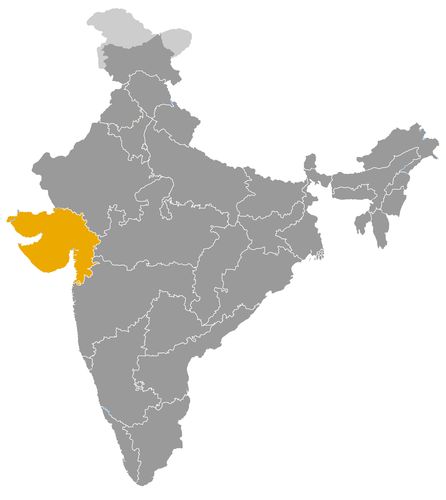
This map illustrates the maximum territory that the Chudasama Dynasty had reached at its height, covering the current regions of Gujarat in India. Its main purpose is to provide a visual aid to understand the geographical extent of this dynasty. However, it's important to note that the contemporary borders of these regions may not necessarily coincide with the historical territories.
The Chudasama Dynasty and Its Role in the History of Western India
A regional dynasty rooted in Saurashtra
The Chudasama dynasty holds an important place in the regional history of western India, especially in the Saurashtra peninsula of present-day Gujarat. Centred mainly on Junagadh, Vanthali and the area around Mount Girnar, the Chudasamas did not create a large empire comparable to the great imperial powers of the subcontinent. Their importance lies instead in their long regional presence, their ability to preserve local authority, and their association with one of the most historically and religiously significant landscapes of Gujarat.
The dynasty is usually placed between the early medieval period and the fifteenth century, although the chronology of its earlier rulers remains uncertain. Much of the early history of the Chudasamas is preserved through bardic traditions, later genealogies and regional narratives. The later period, especially from Mandalika I onward, is better supported by inscriptional evidence. This mixture of history and memory is itself significant, because it shows how the Chudasamas became part of the political imagination of Saurashtra.
A local power between autonomy and subordination
Politically, the Chudasamas represented a regional ruling house that had to survive between stronger powers. Their territory lay in a zone contested by the major dynasties of Gujarat, especially the Chaulukyas, also known as the Solankis, later the Vaghelas, and finally the Gujarat Sultanate. The Chudasamas alternated between phases of autonomy, conflict, subordination and restoration.
Junagadh was central to their political role. Its location near Mount Girnar gave the dynasty both defensive and symbolic strength. The region contained fortified sites, sacred landscapes, agricultural areas and routes connecting the interior of Gujarat with the Saurashtra peninsula. By controlling this area, the Chudasamas were able to maintain a distinct local authority even when larger states claimed overlordship.
Their conflicts with the Chaulukyas of Anahilavada occupy an important place in regional tradition. Figures such as Graharipu, Navaghana and Khengara appear in accounts of resistance, rivalry and restoration. These stories cannot always be read as precise political chronicles, but they reflect the importance of the Chudasamas as a local force in the wider power struggles of medieval Gujarat.
A cultural identity linked to Junagadh and Mount Girnar
The cultural role of the Chudasama dynasty is closely connected with Junagadh, Uparkot and Mount Girnar. These sites were not only political centres, but also places of religious memory. Mount Girnar was important for Jain, Hindu and older sacred traditions. The Chudasama presence in this region linked the dynasty to a landscape of pilgrimage, temple patronage and regional identity.
The dynasty’s cultural impact should therefore be understood less through large imperial monuments than through its association with local sacred geography. Traditions attribute to Chudasama rulers the protection, restoration or support of religious and defensive sites. Even when details remain difficult to verify, these associations show how the dynasty came to be remembered as a guardian of Saurashtra’s cultural continuity.
The Chudasamas also became part of Rajput historical memory in western India. Bardic traditions presented their rulers through themes of honour, loyalty, resistance, dynastic legitimacy and heroic defeat. Such narratives helped preserve their status after the end of their political sovereignty. They also shaped the way later communities understood Junagadh and Saurashtra as regions with a distinct historical identity.
Economic foundations in agriculture, routes and local exchange
The economic base of Chudasama power was regional rather than imperial. Their authority depended on the agricultural resources of Saurashtra, local taxation, pastoral activity, markets and control of routes. The region was not uniformly fertile, but it contained productive zones, fortified settlements and connections to trade routes leading toward the coast and the Gujarat mainland.
Junagadh’s position allowed the Chudasamas to benefit from movements of goods, pilgrims and local merchants. The Saurashtra peninsula had links with the Arabian Sea, even if the Chudasamas themselves were not primarily a maritime dynasty. Their territory lay between inland Gujarat and coastal exchange networks, giving them access to both agrarian income and commercial circulation.
Temples and religious institutions also had an economic role. They received donations, held land, attracted pilgrims and supported artisans and service communities. By associating themselves with such institutions, the Chudasama rulers strengthened both their legitimacy and their local economic base. Their power was therefore sustained by a combination of land revenue, sacred patronage and regional exchange.
Relations with neighbouring dynasties and the Gujarat Sultanate
The Chudasama dynasty’s role in Indian history is best understood through its relations with neighbouring powers. With the Chaulukyas, the relationship was one of rivalry and periodic subordination. The Chaulukyas sought to bring Saurashtra under wider Gujarati control, while the Chudasamas defended their regional base around Junagadh.
After the decline of the Chaulukyas, the Vaghelas and later the Delhi-linked and Gujarat-based Muslim powers changed the political environment. The rise of the Gujarat Sultanate in the fifteenth century proved decisive. Mandalika III, the last effective Chudasama ruler, was defeated by Mahmud Begada, bringing Junagadh under the control of the sultanate. This ended the dynasty’s independent sovereignty, but not its historical memory.
The Chudasamas therefore illustrate the complex nature of medieval Indian politics. They were not merely minor local chiefs, but regional rulers who negotiated, resisted and adapted within a changing hierarchy of power. Their history shows how local dynasties could survive for centuries in the shadow of larger kingdoms and sultanates.
A lasting regional legacy in western India
The Chudasama dynasty’s importance lies in its endurance, its regional rootedness and its cultural association with Junagadh and Saurashtra. Its rulers helped preserve a local political identity in a region repeatedly contested by stronger powers. They also became embedded in the historical traditions of Gujarat through legends, genealogies, sacred sites and memories of resistance.
In the broader history of India, the Chudasamas demonstrate the importance of regional dynasties in shaping local landscapes, political identities and cultural memory. Their power was limited in scale, but historically significant. Through their connection with Junagadh, Mount Girnar and the Saurashtra peninsula, they remain an essential dynasty for understanding the medieval history of western India.
The Geographic Extent of the Chudasama Dynasty in Medieval Saurashtra
A regional kingdom centred on Junagadh and western Gujarat
The Chudasama dynasty ruled in western India, mainly in the Saurashtra peninsula of present-day Gujarat. Its principal centres were Junagadh, Vanthali and the area around Mount Girnar. The dynasty did not control a vast empire, but it maintained a durable regional presence in a strategically important part of western India. Its power was rooted in a landscape of fortified towns, sacred hills, agricultural zones, pastoral lands and routes connecting inland Gujarat with the Arabian Sea coast.
Junagadh was the most important centre of Chudasama authority. Located near Mount Girnar, it offered both defensive strength and symbolic prestige. The surrounding region contained old religious sites, local markets, villages and routes leading toward other parts of Saurashtra. Control of this area allowed the Chudasamas to preserve a distinct political identity even when larger powers claimed influence over Gujarat.
A territory with flexible and changing boundaries
The geographic extent of the Chudasama kingdom should be understood with caution. Medieval regional polities rarely had fixed borders in the modern sense. Chudasama authority varied according to military success, alliances, external pressure and internal stability. At times, the dynasty controlled Junagadh, Vanthali and neighbouring areas directly. At other times, its power was reduced, contested or subordinated to stronger rulers.
Their domain was probably strongest in the central and southern parts of Saurashtra, especially around Junagadh and the Girnar region. Influence may have extended over nearby rural districts, local chiefs and pilgrimage routes. However, this influence did not always mean direct administration. Authority could be expressed through tribute, military presence, recognition by local elites, temple patronage or control of key forts.
This flexible geography helped the Chudasamas survive for centuries. Even when defeated or weakened, they could rely on a regional base, local loyalties and the defensive advantages of Saurashtra. Their political strength was therefore not measured only by territorial size, but by their ability to preserve continuity in a contested frontier zone of Gujarat.
Relations with the Chaulukyas of Anahilavada
The most important early relationship shaped by Chudasama geography was their rivalry with the Chaulukyas, also known as the Solankis, whose capital was at Anahilavada in northern Gujarat. The Chaulukyas aimed to extend authority over the wider Gujarat region, including Saurashtra. This brought them into direct conflict with the Chudasamas, whose power was based on the autonomy of Junagadh and its surrounding territories.
Regional traditions describe conflicts involving rulers such as Graharipu, Navaghana and Khengara. These accounts often combine history, bardic memory and legend, but they reflect a real political tension. For the Chaulukyas, control over Saurashtra meant access to routes, sacred centres, local revenue and the western peninsula. For the Chudasamas, resistance to Chaulukya dominance was essential to preserving dynastic legitimacy.
This rivalry produced periods of interruption, subordination and restoration. The Chudasamas were sometimes weakened by stronger Gujarati powers, yet their line reappeared repeatedly in regional tradition. Their territorial identity was therefore closely linked to the idea of recovery and resistance.
Junagadh, Mount Girnar and the symbolic geography of power
The Chudasama kingdom was not only a political territory. It was also a sacred and cultural landscape. Mount Girnar, near Junagadh, was an important religious centre for Jain, Hindu and older traditions. By ruling in this area, the Chudasamas were associated with a region of pilgrimage and religious prestige.
Control over Junagadh and Girnar gave the dynasty symbolic authority beyond its military strength. The protection or patronage of sacred sites helped reinforce local legitimacy. Fortifications, temples, routes and pilgrimage centres created a geography in which political power and religious memory were closely connected.
This symbolic geography also affected relations with neighbouring dynasties. Larger powers seeking control over Saurashtra were not only pursuing land or taxation. They were also trying to absorb a region with important religious and historical prestige. The Chudasamas, by contrast, presented themselves as local guardians of that landscape.
Coastal connections and economic importance in Saurashtra
Although the Chudasamas were not primarily a maritime dynasty, their territory lay within a peninsula closely connected to the Arabian Sea. Saurashtra contained ports, coastal routes and links with inland Gujarat. Goods, pilgrims, merchants and pastoral communities moved through the region, making it economically valuable.
The Chudasamas benefited from this geography indirectly. Their control of inland centres such as Junagadh allowed them to draw revenue from agriculture, local markets, roads and religious activity. Their territory connected the agrarian interior with coastal exchange networks. This position made Saurashtra attractive to larger states that wanted to integrate the peninsula into wider political and commercial systems.
Economic geography therefore influenced political relations. The Chaulukyas, the Vaghelas and later the Gujarat Sultanate all had reasons to control or dominate Saurashtra. The Chudasamas’ regional authority stood in the way of broader state formation in Gujarat.
Pressure from the Vaghelas and the Gujarat Sultanate
After the decline of Chaulukya power, the Vaghelas and later the Muslim powers of Gujarat changed the political setting of Saurashtra. The Chudasamas continued to rule locally, but their autonomy became increasingly vulnerable. Stronger states had greater military and fiscal resources and could project authority into the peninsula more effectively.
The rise of the Gujarat Sultanate in the fifteenth century was decisive. Mandalika III, the last effective Chudasama ruler, was defeated by Mahmud Begada. This brought Junagadh under the authority of the sultanate and ended Chudasama sovereignty as an independent regional power.
A limited but historically significant territorial legacy
The Chudasama dynasty controlled a limited but important territory. Its core lay around Junagadh, Vanthali and Mount Girnar, with variable influence over parts of Saurashtra. It was never a large empire, but its position made it central to the political history of western Gujarat.
The dynasty’s geographic extent shaped its relations with neighbouring powers. Its location brought it into rivalry with the Chaulukyas, into later tension with the Vaghelas, and finally into conflict with the Gujarat Sultanate. Its history shows how a regional dynasty could survive for centuries by controlling a strategic, sacred and economically connected landscape. The Chudasamas remain important because they represent the resilience of local power in medieval western India.
The Chudasama rulers of Saurashtra, centred on Junagadh and Vanthali, are often designated in regional traditions by the title Ra, sometimes connected with Ranaka. The early reigns rely largely on bardic traditions and later reconstructions, so their dates are indicative, while the chronology after Mandalika I is better supported by inscriptions.
- Chudachandra (c. 875–907) • Traditional founder of the dynasty, he is said to have established Chudasama power in Saurashtra.
- Mularaja (c. 907–915) • He belongs to the poorly documented early phase of Chudasama succession.
- Vishwavarah (c. 915–940) • His reign is mentioned in later reconstructions of the dynastic genealogy.
- Graharipu (c. 940–982) • Associated with Junagadh, he is best known from accounts of conflict with the Chaulukyas of Anahilavada.
- Kavat (c. 982–1003) • He ruled during a period when Chudasama authority in Saurashtra remained contested.
- Dyas (c. 1003–1010) • His reign is linked to traditions of conflict with neighbouring powers in Gujarat.
- Navaghana I (c. 1020–1044) • He is presented as the restorer of Chudasama power after an interruption or outside domination.
- Khengara I (c. 1044–1067) • He consolidated the regional authority of the Chudasamas around Junagadh.
- Navaghana II (c. 1067–1098) • His reign is associated with rivalry against the Chaulukyas and with local heroic traditions.
- Khengara II (c. 1098–1125) • He is linked to accounts of war against Jayasimha Siddharaja and to the legend of Ranakadevi.
- Navaghana III (c. 1125–1140) • He is said to have restored Chudasama authority after another phase of Chaulukya domination.
- Kavat II (c. 1140–1152) • His reign belongs to a poorly documented period of dynastic continuity.
- Jayasimha or Graharipu II (c. 1152–1180) • He appears in later lists of Chudasama rulers of Saurashtra.
- Raisimha (c. 1180–1184) • His short reign is known from later genealogical traditions.
- Mahipala or Gajraj (c. 1184–1201) • He ruled during a phase when Chudasama power remained under pressure from neighbouring dynasties.
- Jayamal (c. 1201–1230) • He belongs to the transitional period before the better attested chronology of the later Chudasamas.
- Mahipala (c. 1230–1253) • His reign is associated with regional conflicts in Saurashtra.
- Khengara (c. 1253–1260) • He is said to have strengthened Chudasama authority against local groups and chiefs.
- Mandalika I (1294–1306) • The first Chudasama ruler clearly attested by inscriptions, he ruled during the Delhi Sultanate invasions of Gujarat.
- Navaghana (1306–1308) • He briefly succeeded Mandalika I during a period of external pressure.
- Mahipala I (1308–1331) • He maintained Chudasama power in Saurashtra after the troubles of the early fourteenth century.
- Khengara (1331–1351) • He is associated with the restoration or strengthening of religious and political sites in Saurashtra.
- Jayasimha I (1351–1378) • He continued dynastic rule in a region exposed to the powers of Gujarat and Delhi.
- Mahipala II (1378–1384) • His brief reign preceded that of Mokalasimha.
- Mokalasimha (1384–1396) • He ruled during a period of regional reorganisation after the weakening of Chaulukya and Vaghela power.
- Mandalika II (1396–1400) • His short reign is attested in the later Chudasama succession.
- Meliga (1400–1416) • He maintained dynastic authority during the rise of the Gujarat Sultanate.
- Jayasimha II (1416–1430) • He ruled amid growing pressure from the sultans of Gujarat.
- Mahipala III (1430–1451) • He preceded the last major independent Chudasama reign.
- Mandalika III (1451–1472) • The last effective Chudasama king, he was defeated by Mahmud Begada, ending dynastic sovereignty over Junagadh.
 Links to the main sections of the site