

 Français (France)
  Nederlands (nl-NL)
 Bharat Mata Mandir is a cultural monument located in Varanasi, in the state of Uttar Pradesh, India. This distinctive site is known for its symbolic and civic purpose, dedicated to the idea of the Indian nation rather than to traditional religious worship. It holds a special place among the city’s landmarks, as Varanasi is more commonly associated with temples and riverfront ghats. The monument appeals to visitors interested in modern Indian history, expressions of national identity, and unusual forms of urban heritage. Its educational and commemorative role makes it different from conventional sacred sites.
Monument profile
Bharat Mata Mandir
Monument category: Memorial monument
Monument family: Monument for cultural purposes
Monument genre: Cultural or scientific
Geographic location: Varanasi • Uttar Pradesh • India
Construction period: 20th century AD
• Links to •
• List of videos about Varanasi on this site •
Varanasi (Benares), India's holiest city • Uttar Pradesh, India
Bharat Mata Mandir in Varanasi: Origins of a National Monument
Foundation and political purpose
Bharat Mata Mandir, located in Varanasi in the state of Uttar Pradesh, was conceived during the late colonial period, when Indian nationalist movements were seeking new public symbols. Unlike conventional Hindu temples dedicated to a deity, this monument was created in honour of Bharat Mata, the personified image of India as a motherland. Its founders used the language and spatial prestige of a temple while redirecting devotion toward the nation.
The initiative is generally associated with the industrialist, philanthropist and nationalist leader Shiv Prasad Gupta, an influential figure in Varanasi. He intended the building to serve as a unifying civic monument rather than a sectarian shrine. The choice of Varanasi gave the project additional symbolic force, since the city already held immense religious and intellectual authority.
Construction began around 1918 and was completed during the 1920s. The monument was formally inaugurated in 1936 by Mohandas Karamchand Gandhi, whose presence confirmed the building’s importance within the broader nationalist movement.
A new type of sacred-national space
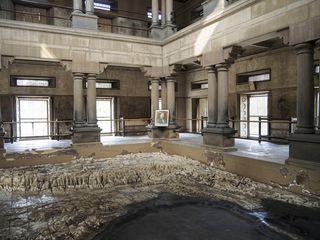
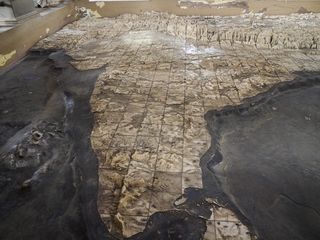
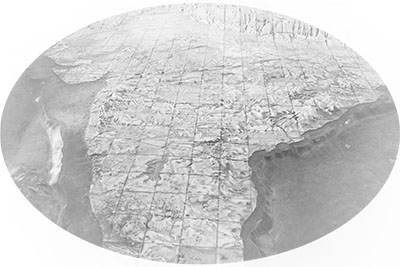
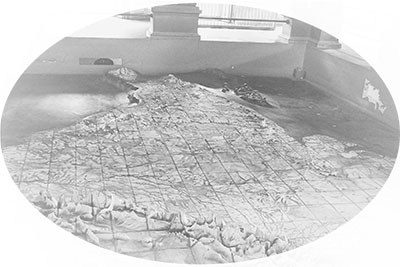
The defining feature of Bharat Mata Mandir is its large marble relief map of the Indian subcontinent. Instead of a cult image placed in an inner sanctum, the territory itself occupies the central position. This was a deliberate departure from orthodox temple practice.
The monument transformed geography into a civic object of reverence. Mountains, plains and coastlines were represented materially, allowing visitors to contemplate India as a unified physical entity. In the political climate of the time, this carried clear meaning: the land preceded provincial, linguistic and communal divisions.
The building therefore functioned simultaneously as memorial, educational site and symbolic temple. It was accessible to visitors of different backgrounds and did not depend on ritual participation in the manner of a traditional shrine.
Use after independence
After Indian independence in 1947, Bharat Mata Mandir lost its original role as a monument of anti-colonial aspiration, yet it did not become obsolete. Its meaning shifted from nationalist mobilisation to historical remembrance and civic heritage.
Visitors increasingly came to see it as a distinctive landmark of Varanasi, separate from the city’s better-known ghats and religious temples. It offered a different narrative of the city: one linked to modern political thought, public education and the cultural forms of nationalism.
The monument continued to host local visitors, students and travellers interested in the symbolic history of modern India. Maintenance efforts focused especially on preserving the marble map, which remains the centrepiece of the complex.
Present significance and preservation
Today Bharat Mata Mandir occupies an unusual category. It is neither a conventional place of worship nor a museum in the strict sense. Its significance lies in the fusion of sacred architectural vocabulary with secular patriotic purpose.
The site remains valuable because it preserves a material expression of how sections of the Indian independence movement imagined national unity. Rather than relying solely on speeches or texts, the founders embodied political identity in built form.
Preservation concerns involve the building fabric, visitor circulation and the long-term care of the carved marble relief. The monument’s historical value depends as much on its symbolic programme as on its physical survival.
Global historical context
The principal construction phase of Bharat Mata Mandir took place between the end of the First World War and the interwar period. Several European empires collapsed after 1918. The Republic of Turkey was proclaimed in 1923. China remained under a republican government during a politically unstable era. In the United States, the economic expansion of the 1920s ended with the financial crash of 1929.
Architectural Composition of Bharat Mata Mandir in Varanasi
Site layout and external configuration
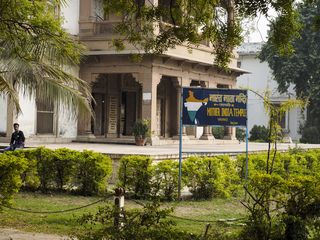
Bharat Mata Mandir stands within the urban fabric of Varanasi as a freestanding civic monument set back from surrounding streets. Unlike many older sacred structures embedded in narrow lanes or attached to temple precincts, the building occupies a more open plot that allows frontal visibility and clearer access. This separation reinforces its commemorative and institutional character.
The monument is organised as a symmetrical masonry structure with a rectangular or near-rectangular footprint. Its massing is restrained, favouring balanced proportions over vertical emphasis. The composition relies on a raised plinth, central entrance axis and regular façades rather than on the progressive enclosure typical of many ritual temple complexes.
The external silhouette adopts elements associated with North Indian temple architecture, yet without the dense subsidiary shrines or elaborate perimeter layers common in orthodox compounds. The result is a simplified monumental envelope suited to public visitation.
Structural system and construction materials
The building belongs to the early twentieth-century phase of institutional construction in northern India, when traditional visual vocabularies were often combined with newer structural methods. Load-bearing masonry walls likely form the principal envelope, assisted where necessary by reinforced concrete or steel elements for wider spans and durability.
Stone, plastered surfaces and dressed masonry define much of the visible exterior. These materials provide permanence and civic gravitas while linking the monument visually to public architecture of the era. Floors and circulation zones were designed for regular pedestrian use rather than restricted ceremonial movement.
The most significant material component is the large marble relief map installed inside the building. Marble was selected not only for prestige but for technical reasons: it allows precise carving, stable edges, readable contours and long-term resistance to wear. Its pale surface also improves legibility under changing interior light.
Interior organisation and spatial hierarchy
The internal arrangement differs fundamentally from a conventional Hindu temple. Instead of a sanctum centred on a deity image, the principal hall is organised around the three-dimensional topographic map of the Indian subcontinent. This feature determines the architecture of the interior.
Circulation is planned to permit visitors to move around the map, observe it from several sides and read geographic forms progressively. The central object functions simultaneously as exhibit, symbolic focus and spatial anchor. The surrounding room requires adequate clearance, open sightlines and controlled proportions so viewers can understand the composition as a whole.
Columns, wall openings and ceiling height are subordinated to this viewing role. Where supports are present, they frame rather than dominate the central chamber. Secondary spaces such as entrance halls, staircases or peripheral rooms guide visitors toward the main volume.
This organisation gives the monument a museum-like logic housed within a temple-derived shell. The architecture directs attention toward contemplation and observation rather than ritual procession.
Stylistic language and distinctive features
Bharat Mata Mandir borrows recognisable temple vocabulary while modifying its meaning. Exterior elevations may include chhatri-like kiosks, parapet articulation, moulded cornices, arched or trabeated openings and modest tower forms reminiscent of shikhara profiles. These elements create familiarity without binding the monument to one sectarian tradition.
Decoration is more restrained than in many pilgrimage temples. Surface treatment supports dignity and symbolism rather than sculptural abundance. Ornament remains subordinate to geometry, rhythm and proportion.
The building’s most distinctive architectural decision is the replacement of the deity image by a territorial map. This transforms the symbolic function of the structure. Spatial reverence is transferred from cult statue to landform, making architecture an active participant in the monument’s ideological programme.
Another notable characteristic is the balance between sacred typology and civic accessibility. Entrances are broad, movement is direct, and the interior remains intelligible even to visitors unfamiliar with temple ritual conventions.
Alterations, maintenance and conservation issues
Because the monument’s importance depends heavily on its interior marble map, conservation priorities extend beyond walls and roof. Surface erosion, staining, mechanical damage and poor repairs can reduce the readability of carved relief features. Preservation therefore requires specialised stone care as well as standard building maintenance.
The early twentieth-century fabric may also involve later repairs to plaster, drainage, flooring or structural reinforcement. Moisture infiltration, pollution deposits and traffic vibration can affect long-term condition.
Any modern intervention must preserve the visual relationship between entrance sequence, central hall and map display. Excessive partitions, intrusive lighting or uncontrolled signage would weaken the original concept.
Bharat Mata Mandir remains architecturally unusual because it merges temple form, commemorative intent and educational display within a coherent structure. Its significance lies less in monumental scale than in the precision with which architecture was adapted to an unconventional national symbol.