

 Français (France)
  Nederlands (nl-NL)
 New Jerusalem Church in Tharangambadi, Tamil Nadu, is one of the main surviving landmarks connected with the Danish Lutheran presence on the Coromandel Coast. The Protestant church is associated with the development of some of the earliest Lutheran missions in India and with cultural exchanges between Europe and southern India. Still functioning as a place of worship, the church remains an important historical monument within the former Danish settlement of Tranquebar. The site also reflects the religious and cultural influence of Protestant missionary activities in this coastal region during the colonial period.
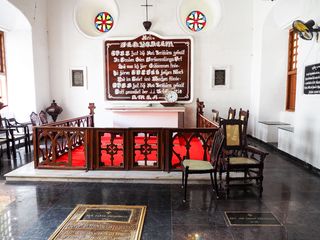
Tharangambadi (Tranquebar) • New Jerusalem Church
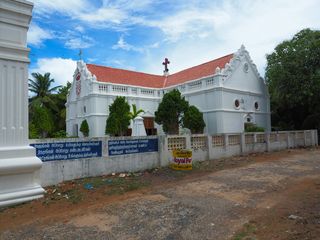
Tharangambadi (Tranquebar) • New Jerusalem Church
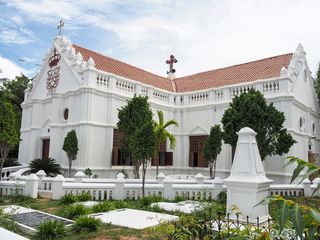
Tharangambadi (Tranquebar) • New Jerusalem Church
Monument profile
New Jerusalem Church
Monument category: Church
Monument family: Church, cathedral, basilica, chapel
Monument genre: Religious
Cultural heritage: Christian
Geographic location: Tharangambadi (Tranquebar) • Tamil Nadu • India
Construction period: 18th century AD
• Links to •
• List of videos about Tharangambadi (Tranquebar) on this site •
Tharangambadi (Tranquebar), former Danish trading post • Tamil Nadu, India
New Jerusalem Church and the Development of the Lutheran Mission in Tranquebar
Foundation of the Church within the Danish Settlement
New Jerusalem Church was constructed in Tharangambadi, formerly known as Tranquebar, during the early eighteenth century as part of the Danish Lutheran mission established in the colonial settlement on the Coromandel Coast. Construction began shortly after the arrival of the missionaries Bartholomäus Ziegenbalg and Heinrich Plütschau, who had been sent by the Danish crown to organise Protestant missionary activity in southern India. The church was completed and consecrated in 1718, replacing earlier and more limited spaces used for worship by the growing Christian community.
The establishment of the church formed part of a broader effort to create a permanent institutional centre for the Lutheran mission in Tranquebar. The building was intended not only for religious ceremonies but also for preaching, education, and the organisation of Tamil Protestant congregations connected with the Danish mission.
Missionary Activity and Cultural Role
New Jerusalem Church became closely associated with the linguistic, educational, and religious work carried out by the Lutheran missionaries in Tranquebar. Bartholomäus Ziegenbalg conducted extensive studies of Tamil language and culture while also producing translations of Christian texts into Tamil. The church functioned as a central location for Protestant worship and for the dissemination of Lutheran teachings among local converts.
The mission linked to the church also contributed to the development of Protestant printing activities in South India. Religious publications, educational texts, and translated material circulated through institutions connected with the church and the mission settlement. Schools associated with the Lutheran community reinforced the cultural influence of the mission within the coastal region surrounding Tranquebar.
The church therefore played both a religious and intellectual role in the Danish colony, extending beyond purely liturgical functions.
Transformations and Preservation of the Monument
After the decline of Danish political influence in Tranquebar, the church continued to serve the local Protestant community. Despite changes in colonial administration and regional political control, the building retained its religious function throughout successive historical periods.
Its coastal location exposed the structure to humidity, saline air, and periodic deterioration associated with the tropical maritime environment. Several restoration campaigns were undertaken during the twentieth century and the beginning of the twenty-first century in order to preserve the building and maintain its continued use as a church.
The 2004 Indian Ocean tsunami affected several historic sectors of Tharangambadi and increased concern regarding the preservation of colonial and religious heritage within the town. Conservation work carried out after this event contributed to the protection of New Jerusalem Church as one of the principal surviving monuments linked to the Danish Lutheran mission in India.
Today, the church remains an active place of worship while also serving as an important historical landmark associated with Protestant missionary history on the Coromandel Coast.
International Historical Context
The construction of New Jerusalem Church took place during the early eighteenth century, a period marked by the expansion of European trading settlements and missionary activities across Asia. Protestant monarchies in northern Europe increasingly supported overseas religious missions during this era. At the same time, European trading companies strengthened their commercial presence along the Indian Ocean routes. Regional South Indian powers continued to control important coastal territories and maritime trade networks on the Coromandel Coast.
Architectural Structure and Spatial Organisation of New Jerusalem Church
Position within the Colonial Urban Layout of Tranquebar
New Jerusalem Church occupies a prominent position within the former Danish colonial quarter of Tharangambadi, historically known as Tranquebar, on the Coromandel Coast of Tamil Nadu. The church forms part of the planned urban structure established during the Danish colonial period, characterised by rectilinear streets and a relatively ordered distribution of administrative, residential, and religious buildings. Its placement within this urban environment reflects the central role played by the Lutheran mission inside the colonial settlement.
The church stands within a relatively open area compared with the denser surrounding residential sectors. Its white-plastered façades and elevated roofline allow the building to remain visually distinct within the historic townscape. The orientation of the structure also responds to the climatic conditions of the coastal region, particularly the need for natural ventilation and protection against seasonal monsoon rains.
Structural Composition and Building Techniques
The building follows a restrained architectural vocabulary associated with early eighteenth-century Protestant missionary churches. The structure is based primarily on thick masonry walls that provide both structural stability and thermal insulation in the humid maritime environment. Exterior surfaces are coated with lime plaster, a material widely used in coastal colonial architecture because of its resistance to moisture and saline air.
The church incorporates a pitched tiled roof supported by timber frameworks. This roofing system allows efficient drainage during heavy monsoon rainfall while also improving air circulation within the interior spaces. The roof structure combines European construction principles with locally available materials and labour techniques adapted to the climatic conditions of southeastern India.
The walls contain regularly spaced openings that ensure sufficient light and ventilation inside the building. The dimensions of these openings remain moderate in order to preserve the strength of the load-bearing masonry. Construction methods prioritised durability and functionality rather than elaborate decorative treatment.
Façades and Architectural Character
The external appearance of New Jerusalem Church is dominated by symmetrical organisation and relatively simple geometric forms. The principal façade is structured around a central entrance framed by evenly distributed openings and restrained architectural detailing. Arched windows contribute to the rhythm of the elevations while allowing natural illumination of the nave.
Unlike many Catholic colonial churches built along the Indian coastline during the same period, New Jerusalem Church displays limited sculptural decoration and minimal ornamental programmes. The visual emphasis is placed on balanced proportions, regular surfaces, and the clarity of structural lines. This architectural sobriety corresponds closely to Lutheran liturgical principles, which generally favoured preaching and congregational worship over highly elaborate visual decoration.
Vertical elements remain relatively restrained compared with the monumental towers or heavily articulated façades seen in certain Iberian colonial churches. The church instead relies on the simplicity of its volumes and the contrast between white plastered surfaces and the surrounding tropical environment.
Interior Arrangement and Liturgical Space
The internal layout is organised around a spacious nave intended to accommodate congregational worship and religious instruction. The spatial arrangement reflects Protestant liturgical priorities by maintaining clear visibility toward the pulpit and principal ceremonial areas. Secondary chapels and highly compartmentalised spaces are absent, reinforcing the functional simplicity of the plan.
High ceilings improve air circulation and reduce heat accumulation inside the church. The interior preserves structural elements such as timber beams and substantial masonry supports that remain visible in several sections of the building. Natural lighting enters primarily through lateral openings positioned along the nave walls.
Interior decoration remains limited in comparison with contemporaneous Catholic churches in coastal India. Decorative emphasis is concentrated instead on inscriptions, liturgical furnishings, and selected memorial elements connected with the Lutheran mission and the Protestant community of Tranquebar. The restrained interior environment contributes to the strong spatial coherence of the building.
Restoration and Architectural Preservation
The coastal location of New Jerusalem Church has exposed the structure to continuous deterioration caused by humidity, saline air, and seasonal weather conditions. Several restoration campaigns were undertaken during the twentieth century and early twenty-first century to preserve the masonry, roof structures, plaster coatings, and timber components.
The 2004 Indian Ocean tsunami increased concerns regarding the vulnerability of historic buildings within Tharangambadi. Additional conservation work focused on structural reinforcement, moisture control, and the repair of weather-damaged sections. Restoration policies generally aimed to preserve the historical appearance of the church while maintaining its continued religious function within the local Protestant community.
Today, New Jerusalem Church remains one of the best-preserved examples of Danish Protestant ecclesiastical architecture on the Coromandel Coast.