

 Français (France)
  Nederlands (nl-NL)
 The Cathedral of Málaga is a major religious monument shaped by a prolonged construction period spanning the 16th to the 18th century. Its appearance reflects successive architectural phases, giving the structure a distinctive character within the city’s evolving urban setting. The building is closely linked to the religious and political changes that followed the Reconquest and continues to function as an important cultural and liturgical centre. The incomplete second tower, a result of halted works, has become a recognisable feature that contributes to the cathedral’s identity and public perception, reinforcing its significance in both local heritage and civic life.
Monument profile
the Cathedral
Monument category: Cathedral
Monument family: Church, cathedral, basilica, chapel
Monument genre: Religious
Cultural heritage: Christian
Geographic location: Malaga • Andalusia • Spain
Construction period: 16th century AD
• Links to •
• List of videos about Malaga on this site •
Malaga, the Cathedral • Andalusia, Spain
History of the Cathedral of Málaga
The Cathedral of Málaga, officially dedicated to the Incarnation, is one of the most representative monuments of early modern Andalusia. Its construction, which spanned from the late 15th century to the 18th century, reflects the political, social, and religious reorganisation that followed the conquest of the city by the Catholic Monarchs. The monument’s layered history, marked by periods of intense activity, prolonged interruptions, and significant transformations, provides insight into the evolution of Malaga from a fortified Nasrid port to a major urban centre of the Spanish monarchy. Its incomplete silhouette, particularly the missing southern tower, has become one of its defining visual and cultural features.
Political and social context of construction
The cathedral project emerged in the immediate aftermath of the conquest of Malaga in 1487. As one of the last strongholds of the Nasrid Kingdom, the city became a symbolic target for Ferdinand and Isabella, whose consolidation of power depended on integrating former Muslim territories into the Castilian crown. Building a monumental cathedral on the site of the former mosque served as a deliberate gesture of religious replacement and political affirmation. The aim was not only to establish Catholic worship but also to restructure urban identity and assert the new order imposed by the monarchy.
The choice to erect a cathedral of considerable scale aligned with broader political ambitions. The Catholic Monarchs sought to legitimise their authority through visible, enduring monuments that signalled both spiritual and institutional stability. The construction also reflected the aspirations of the newly established bishopric, which intended to position Malaga as a major ecclesiastical seat in the region. Local elites, often originating from families relocated after the conquest, supported the initiative to reinforce their status and foster a distinctly Christian civic culture.
Rivalries and alliances shaped early decisions as well. The bishopric of Seville and the archbishopric of Granada maintained influence over the region, compelling Malaga’s ecclesiastical authorities to advocate for a building that would elevate the city’s religious prominence. Relations with the crown were equally decisive: periods of royal favour brought resources, while political crises or shifting priorities resulted in delayed or suspended works.
Major historical events affecting the site
The first construction phase began in the early 16th century, characterised by the transition from Gothic to Renaissance architectural concepts. However, progress was slowed by financial shortages, epidemics, and political tensions during the succession from the Catholic Monarchs to Charles V. Work advanced irregularly, with modifications to the initial plans reflecting stylistic changes and practical constraints.
The 17th century was marked by repeated interruptions due to economic crises, wars, and natural disasters. The War of Spanish Succession diverted significant resources away from ecclesiastical building projects, leaving several sections incomplete. Earthquakes in the region also caused structural damage that required immediate repair, further delaying new construction.
The 18th century saw renewed activity, particularly the extension of the main façade and the completion of the north tower. However, the ambitious plan to erect a symmetrical south tower was abandoned. Explanations vary: some attribute the halt to fiscal hardship, others to the reallocation of funds for coastal fortifications. This abandonment ultimately produced the asymmetry that defines the cathedral’s current appearance.
During the 19th century, the cathedral’s function and surroundings changed significantly. Secularisation policies, political conflict, and urban modernisation led to alterations within the building and the removal or relocation of some artworks. Although the site did not suffer catastrophic destruction, certain decorative elements were damaged during episodes of unrest, including the Spanish Civil War.
Global context during the period of construction
The centuries during which the cathedral was erected coincided with profound architectural and cultural transformations across Europe. In the late 15th and early 16th centuries, many regions were transitioning from medieval building traditions to Renaissance principles based on classical geometry, symmetry, and proportion. Major cathedrals and civic buildings in Italy, France, Germany, and the Low Countries were being redesigned to reflect new artistic ideals.
Spain, emerging as a global power through its imperial expansion, adopted these trends while adapting them to local conditions. The Cathedral of Málaga reflects this broader movement: its blend of Gothic structural concepts, Renaissance order, and later Baroque embellishment mirrors patterns seen in other major Iberian religious monuments. The long duration of the project also parallels global developments in which major religious structures—such as St Peter’s Basilica in Rome or the Cathedral of Mexico City—underwent centuries-long construction that incorporated evolving artistic languages.
Transformations and changes over time
Because of the prolonged construction period, the cathedral underwent numerous modifications that altered its internal and external configuration. Several chapels were redesigned to accommodate changing liturgical practices and the arrival of new devotional artworks. Retables and sculptural ensembles introduced during the Baroque period replaced earlier elements, contributing to the visual stratification of the interior.
Practical concerns also generated architectural adjustments. The unrealised south tower required stabilisation measures to prevent structural imbalance, including reinforcement of the adjacent sections of the façade. Later interventions addressed wear, erosion, and damage caused by humidity—an issue exacerbated by the cathedral’s proximity to the coast.
Urban evolution further transformed the monument’s relationship with its surroundings. The medieval street network gradually gave way to planned avenues and public squares. As Malaga expanded, the cathedral shifted from a compact setting within the historic core to a major reference point within a modernising city. Views toward the monument were opened or altered through urban reforms, reinforcing its prominence within the civic landscape.
Contemporary role and cultural significance
Today, the Cathedral of Málaga stands as an essential symbol of the city’s identity. It functions both as an active centre of Catholic worship and as a cultural landmark attracting numerous visitors. Its distinctive form, especially the incomplete tower, has become a recognizable emblem used in local branding and tourism.
The cathedral continues to host major religious celebrations, most notably those of Holy Week, which constitute a central element of Malaga’s cultural life. Additionally, concerts, exhibitions, and guided tours highlight its artistic and historical significance. The building’s layered architecture serves as a pedagogical tool for understanding the transitions between Gothic, Renaissance, and Baroque aesthetics in Spain.
Its significance extends beyond regional boundaries: it is frequently referenced in studies of early modern Iberian architecture and included in comparative research on long-duration cathedral construction. Although it is not listed as a World Heritage Site, its inclusion in national heritage registers underscores its importance and the need for ongoing conservation.
Current conservation challenges and preservation strategies
The cathedral faces a series of conservation challenges linked to its materials, environment, and urban context. Coastal humidity contributes to stone erosion, while pollution from increasing urban traffic accelerates the deterioration of sculptural elements. Temperature fluctuations and seismic activity pose additional risks to the structure.
Tourism also presents managerial challenges. High visitor numbers increase wear on floors, chapels, and circulation areas, requiring continuous monitoring. Conservation policies therefore prioritise structural stability, façade protection, and restoration of artworks. Recent initiatives have included the reinforcement of the vaults, cleaning of stone surfaces, consolidation of wooden elements, and improvements to drainage systems.
Urban development around the cathedral must also be managed carefully. Vibrations from nearby traffic, infrastructure projects, and dense footfall are monitored to prevent long-term damage. Efforts to balance accessibility, cultural use, and preservation shape the monument’s present and future trajectory.
The Cathedral of Málaga thus embodies the intertwined histories of conquest, religious transformation, artistic evolution, and urban development. Its layered construction, incomplete form, and enduring role within the community make it a unique example of Spain’s architectural and cultural heritage.
Architecture of the Cathedral of Málaga
The Cathedral of Málaga, dedicated to the Incarnation, is a major example of early modern ecclesiastical architecture in Andalusia. Built largely between the 16th and 18th centuries, it combines late Gothic structural principles with Renaissance ordering and Baroque decoration. The result is a building that appears stylistically coherent at first sight, yet is in reality the product of successive design decisions, changing technical possibilities and shifting aesthetic preferences. Its incomplete southern tower, contrasting with the fully realised northern one, further underlines the historical complexity of the project and has become an architectural hallmark in itself.
Architectural and technological innovations
The cathedral was designed at a moment when Gothic traditions were giving way to Renaissance concepts derived from classical antiquity. This transition is visible in the way structural logic and spatial clarity are treated. The plan adopts a relatively regular grid of bays, with piers and arches aligned to create a clear rhythm along the three naves. This contrasts with the more irregular layouts of medieval churches and reflects an increasing reliance on geometric planning and proportional systems.
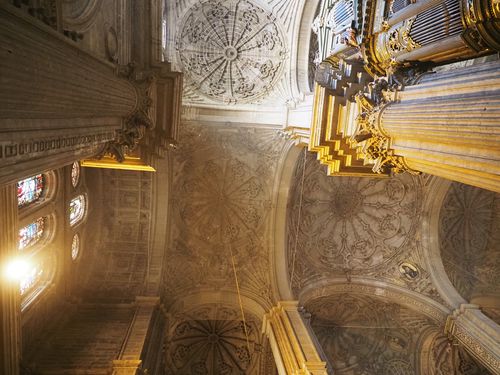
In terms of structural stability, the building incorporates innovations typical of the period. The piers supporting the vaults are compound but more compact than high Gothic clusters, allowing for greater visual unity and an impression of solidity. The vaulting systems, while still relying on rib structures, are simplified and integrated into a more homogeneous ceiling pattern. This responds both to new engineering confidence and to aesthetic preferences for calm, continuous surfaces rather than highly fragmented Gothic webs.
Ventilation and lighting benefitted from a more controlled use of openings. Large, well-proportioned windows in the upper levels of the nave and side aisles allow daylight to penetrate deeply without overexposing the interior. Combined with high ceilings and generous internal volume, this contributes to air circulation and mitigates the impact of the Mediterranean climate. The overall design reveals an awareness of environmental conditions that goes beyond purely symbolic concerns.
At an urban scale, the cathedral anchors the historic centre of Málaga. Its massing, orientation and relationship with the surrounding streets and squares were conceived to create prominent visual perspectives. The siting on the former Great Mosque reinforces continuity of place, while redefining the area around it as a focal point of Christian civic life.
Materials and construction methods
The building fabric is primarily composed of local limestone, chosen for its availability and workable texture. This stone allows fine carving on façades, portals and capitals, while offering sufficient compressive strength to support tall walls and vaults. In areas exposed to greater mechanical stress—such as corners, buttresses and tower bases—denser varieties of stone were often used to increase durability.
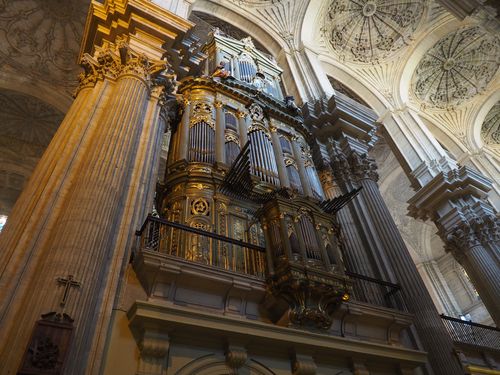
Columns and certain interior elements are fashioned from marble or harder stone, materials associated with prestige and durability. Their use in arcades and choir enclosures has both structural and visual implications: they carry important loads while contributing to a sense of refinement and vertical emphasis.
Vaulting employs techniques that combine traditional rib construction with thicker infilling, typical of the period’s move toward more robust, monolithic ceilings. Timber plays a crucial role in roof structures and secondary spaces. Wooden trusses, designed according to geometric patterns, distribute loads efficiently and accommodate slight movements caused by thermal changes or seismic activity.
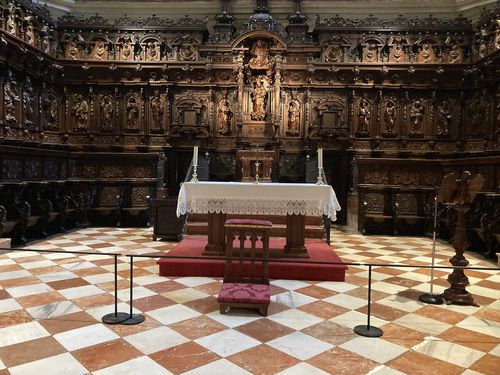
Surface finishes incorporate stucco, polychrome wood and metalwork. Stucco is used to create mouldings, cornices and ornamental details that can be executed relatively quickly and adjusted as designs evolve. Carved and painted wood appears in the choir stalls, pulpits and altarpieces, demonstrating advanced carpentry and sculptural skills. Iron and bronze elements, such as railings and grilles, provide both security and delicate visual screens, integrating functional requirements into the decorative scheme.
Architectural and artistic influences
The Cathedral of Málaga is shaped by overlapping influences. Gothic heritage remains visible in the vertical thrust of the interior, in the use of pointed arches in some structural zones and in the organisation of the space into multiple naves of similar height. At the same time, Renaissance principles guide the overall composition: bays follow regular modules, classical orders structure façades and interior elevations, and proportions aim at harmonic balance rather than dramatic contrast.
Italian Renaissance models reached Spain through treatises, imported works of art and the movement of architects and sculptors. These influences can be seen in the use of pilasters, entablatures and semi-circular arches on the exterior. The façade integrates superimposed orders, niches with statuary and a carefully arranged sequence of voids and solids that reflects knowledge of classical vocabulary, interpreted through local taste.
Baroque contributions are especially evident in the later phases. Dynamic elements, richer sculptural programmes and more complex profiles appear in chapels, altarpieces and parts of the main façade. These additions overlay the earlier structural framework without fundamentally altering it, resulting in a palimpsest of styles that reveals shifting devotional and aesthetic priorities.
Regional features persist alongside these broader trends. Certain decorative motifs, treatment of wood ceilings and ornamental details recall the Mudéjar tradition, a legacy of the long coexistence of Christian and Islamic cultures in Andalusia. In this sense, the cathedral demonstrates how local craftsmanship adapted international models to a specific historical and geographical context.
Spatial organisation and structural features
The plan follows a three-aisled basilican layout with a relatively shallow transept and an extended chancel area. The side aisles are only slightly lower than the central nave, contributing to a hall-like impression. This configuration enhances spatial continuity and allows for a broad, unified interior volume, in contrast with the more compartmentalised spaces of earlier churches.
Chapels line the side aisles and ambulatory, some projecting slightly beyond the outer walls. Each chapel reflects the tastes and patronage of different periods, housing altarpieces, sculptures and funerary monuments. The cumulative effect is a series of self-contained devotional spaces integrated into the greater architectural whole.
The choir occupies a central position, enclosed by elaborate wooden stalls and framed by sculpted screens. This placement reflects post-Tridentine liturgical practice, emphasising the role of the clergy and the importance of choral worship.
Externally, the completed north tower rises prominently above the façade. Its design combines robust lower stages with more articulated upper levels, including openings for bells and decorative cornices. The absence of the planned south tower creates a striking asymmetry that distinguishes Málaga from many other Iberian cathedrals, where twin-tower façades became common. This incomplete scheme is one of the building’s most recognisable structural particularities.
Statistics and anecdotes
The cathedral’s interior length is approximately 120 metres, with a central nave rising to over 40 metres at its highest point. The north tower reaches around 80 metres, making it a dominant feature of the city skyline. The interior accommodates numerous chapels, altars and artworks, reflecting centuries of patronage by bishops, noble families and confraternities.
Popular tradition attaches several anecdotes to the incomplete tower. One widely circulated story suggests that funds intended for its construction were redirected to other public works, including fortifications and charitable projects, possibly beyond Spain. Although the historical accuracy of these accounts is debated, they contribute to the building’s identity and to its local nickname, often translated as “the one-armed lady” in reference to its single finished tower.
The long duration of construction itself is noteworthy. Spanning roughly three centuries, it allowed successive generations of architects and artisans to leave their mark, making the cathedral a condensed record of changing architectural languages in early modern Spain.
Recognition and conservation issues
Architecturally, the Cathedral of Málaga is significant because it encapsulates the transition from late medieval to early modern design in the Iberian Peninsula and because it illustrates the adaptation of Renaissance and Baroque models to a southern Spanish port city. Its prominence in the urban fabric and its distinctive asymmetrical façade contribute to its recognition both nationally and internationally.
Conservation challenges are linked to the nature of its materials and its urban setting. Limestone sculpture and masonry are vulnerable to pollution-related decay, salt crystallisation and biological growth. Timber elements face risks from humidity, insects and temperature fluctuations. The cathedral’s location in a dense historic centre exposes it to vibrations and environmental stress associated with traffic and tourism.
Restoration campaigns have focused on consolidating vaults, stabilising towers, cleaning and protecting façades, and conserving interior artworks. Current strategies seek to balance public access, liturgical functions and long-term preservation. Monitoring systems, periodic surveys and careful selection of restoration materials and methods are central to this approach.
Through its architecture, the Cathedral of Málaga expresses not only religious and artistic aspirations but also the technical, social and cultural conditions of the centuries that produced it. It remains a key reference point for understanding the built heritage of Andalusia and the evolution of cathedral architecture in early modern Europe.