

 Français (France)
  Nederlands (nl-NL)
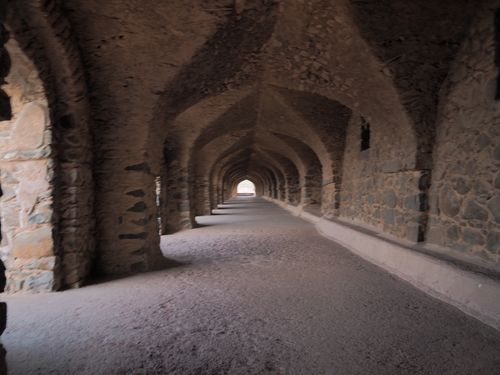
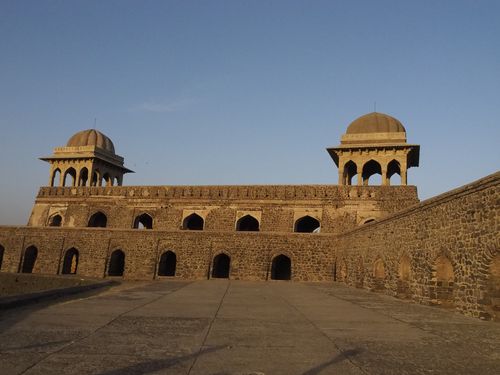
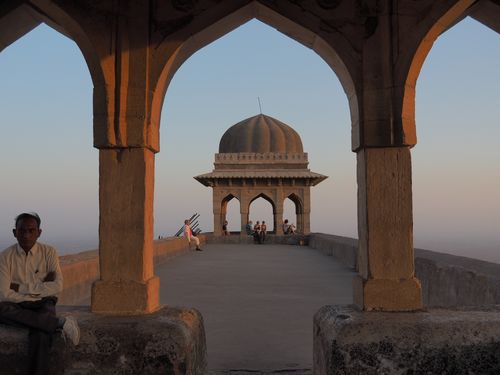
 The Roopmati Pavilion, located in Mandu in the Indian state of Madhya Pradesh, is a historic structure offering panoramic views of the Narmada River and the surrounding landscape. Built in stone, it features elegant architecture with distinctive domes and spacious terraces. Closely associated with legendary accounts, it is often linked to Queen Roopmati and Sultan Baz Bahadur. Today, the site is a notable attraction, valued for its scenic setting and cultural significance in the history of Mandu.
Monument profile
Roopmati Pavilion
Monument category: Terrasse
Monument family: Palace and Annexes
Monument genre: Residential
Cultural heritages: Islamic, Hindu
Geographic location: Mandu • Madhya Pradesh • India
Construction period: 15th century AD
• Links to •
• Dynasties that contributed to the construction of the monument •

• List of videos about Mandu on this site •
Mandu, ghost capital • Madhya Pradesh, India
History of the Roopmati Pavilion in Mandu, India
Political and Social Context of the Construction
The Roopmati Pavilion, located in Mandu, Madhya Pradesh, is an architectural marvel that holds immense historical and cultural significance. It was constructed during the reign of Baz Bahadur, the last independent ruler of the Malwa Sultanate, in the mid-16th century.
The pavilion is closely associated with the legendary love story between Baz Bahadur and Roopmati, a poet and musician. According to local traditions, Baz Bahadur was captivated by her beauty and melodious voice, and he commissioned the construction of this pavilion so that she could have an unobstructed view of the sacred Narmada River, which she revered.
However, beyond its romantic associations, the construction of this pavilion also had political and strategic undertones. The Malwa Sultanate was facing growing threats from the Mughal Empire, particularly under Emperor Akbar, who was expanding his control over central India. Mandu, with its fortified location on a plateau, was a crucial defensive stronghold. The pavilion’s elevated position offered a clear vantage point over the surrounding landscape, allowing for military surveillance while serving as a retreat for the ruler.
The construction of such a structure also reflected the cultural ambitions of Baz Bahadur, who was known for his patronage of music, poetry, and architecture. He sought to establish Mandu as a center of art and refinement, drawing from both Persian and indigenous Indian influences.
Major Historical Events Impacting the Site
Shortly after its construction, the pavilion and Mandu itself became embroiled in the Mughal conquest of Malwa. In 1561, Akbar’s general Adham Khan launched an attack on the region. Baz Bahadur was defeated, and Mandu fell to the Mughal forces.
Roopmati, unwilling to be captured, is said to have taken her own life, adding to the tragic aura of the pavilion. The Mughal conquest marked the end of Malwa’s independence, and the site lost its significance as a royal retreat.
Under Mughal rule, Mandu became a provincial stronghold, but the pavilion itself was not repurposed for major administrative or military use. Over the centuries, as power shifted between the Marathas and later the British colonial administration, Mandu gradually declined, and the pavilion, like many other structures in the city, fell into disrepair.
In the 19th century, British officers and historians, drawn to the romantic allure of Mandu’s ruins, documented the pavilion and its associated legends. This renewed interest helped preserve the site, preventing further degradation.
Global Context at the Time of Construction
The mid-16th century saw the rise of monumental architecture across the world. In India, the Mughal Empire was laying the foundation for some of its most iconic structures, including the Humayun’s Tomb in Delhi (built in the 1560s), which later influenced the Taj Mahal. Elsewhere, the Ottoman Empire was constructing the grand Suleymaniye Mosque in Istanbul, while in Europe, the Renaissance movement was transforming urban landscapes with magnificent cathedrals and palaces.
The Roopmati Pavilion, although modest in comparison to these grand projects, represents an important regional architectural achievement, reflecting the blend of Islamic, Persian, and Rajput styles prevalent in Malwa at the time.
Transformations and Modifications of the Monument
Over the centuries, the pavilion underwent structural deterioration due to natural weathering, lack of maintenance, and human intervention. Unlike other forts and palaces that were adapted for later use, the Roopmati Pavilion was largely left untouched, preserving much of its original character.
During the British colonial period, the site became a place of historical curiosity, leading to some conservation efforts. The Archaeological Survey of India (ASI) took over its maintenance in the 20th century, focusing on stabilizing the stone structures and preventing further erosion.
Today, the site remains relatively unaltered, apart from essential repairs to its domes, archways, and staircases.
The Role and Cultural Importance of the Pavilion Today
The Roopmati Pavilion is one of the most visited heritage sites in Mandu, drawing tourists, historians, and artists alike. It is widely celebrated for its picturesque setting and its connection to the folklore of Baz Bahadur and Roopmati, which has been immortalized in poetry and local storytelling.
The pavilion is not used for religious or ceremonial functions, but it holds a strong cultural and symbolic identity in Madhya Pradesh. Festivals and cultural events in Mandu often highlight its romantic and historical significance.
The site is also an important educational landmark, frequently studied by historians and conservationists who seek to understand the architectural and social history of medieval India.
Current State of Conservation and Challenges
The pavilion faces several modern conservation challenges:
- Environmental threats: The semi-arid climate of Mandu, combined with monsoon rains, leads to erosion of the stone structures. Water infiltration weakens the mortar and foundations.
- Tourism pressure: Increasing visitor numbers, while beneficial for local tourism, pose risks of damage to the structure due to foot traffic and inadequate management of visitor behavior.
- Urbanization and development: Although Mandu itself remains a relatively preserved historical site, expansion and infrastructural development in the surrounding areas could pose indirect risks to its scenic and historical integrity.
The Archaeological Survey of India (ASI) has implemented regular maintenance programs, including:
- Stone reinforcement and cleaning
- Structural support for weakened walls and domes
- Controlled access to prevent excessive foot traffic in fragile areas
There have been discussions about proposing Mandu as a UNESCO World Heritage Site, which could enhance funding and protection for monuments like the Roopmati Pavilion.
Conclusion
The Roopmati Pavilion is more than just an architectural structure; it is a symbol of romance, political intrigue, and artistic refinement in medieval India. Built during the twilight years of the Malwa Sultanate, it reflects both the cultural aspirations of its patron and the turbulent historical shifts of its time.
Despite the ravages of time and conquest, the pavilion remains one of Mandu’s most captivating landmarks, drawing admiration for its aesthetic beauty, panoramic views, and deep historical connections. Efforts to preserve and promote the site continue, ensuring that future generations can experience its enduring legacy.
Architectural Analysis of the Roopmati Pavilion in Mandu, India
Technological and Architectural Innovations of the Time
The Roopmati Pavilion, an iconic structure in Mandu, Madhya Pradesh, exemplifies the architectural ingenuity of 16th-century Indo-Islamic construction. Built under the reign of Baz Bahadur, the last ruler of the Malwa Sultanate, the pavilion is a fine example of functional and aesthetic design adapted to the climatic and topographical conditions of the region.
One of the most striking features of the pavilion is its strategic location atop a plateau, which not only provides a panoramic view of the Narmada River but also integrates natural ventilation and temperature regulation—a crucial factor in the semi-arid climate of Mandu. The open colonnades and large terraces allow air to circulate freely, keeping the interiors cool even during the peak of summer.
The elevated position of the structure is not only an aesthetic choice but also serves defensive and surveillance purposes. From its vantage point, movements in the valley below could be easily monitored, making it a valuable watchtower in addition to being a royal retreat.
The stability of the structure is another remarkable aspect of its design. The pavilion’s arches and pillars follow principles of load distribution, reducing stress on the foundation and preventing structural collapse due to seismic activity. The use of intricate interlocking stonework ensures long-term durability, a technique widely employed in the Sultanate and Mughal eras.
Materials and Construction Methods
The pavilion is primarily built of locally sourced sandstone, a material chosen for its strength, thermal insulation, and aesthetic quality. Sandstone, known for its resistance to weathering, was a preferred material in many medieval Indian structures.
- Red and yellow sandstone were used, blending seamlessly with the natural landscape, giving the pavilion an earthy, harmonious appearance.
- Lime mortar was used as a binding agent, reinforcing the structural integrity while allowing flexibility against minor earth movements.
- The domes and arches were constructed using the Persian technique of voussoirs (wedge-shaped stones) to evenly distribute weight and prevent collapse.
The pavilion’s roofing system is another example of advanced construction techniques. The double-layered domes serve both aesthetic and functional purposes, reducing heat absorption while creating an imposing architectural profile.
Architectural and Artistic Influences
The architecture of the Roopmati Pavilion reflects a fusion of Islamic, Persian, and Rajput influences, a hallmark of the Malwa Sultanate. The pavilion follows a symmetrical layout, characteristic of Islamic design, while incorporating Rajput-style open galleries and domed pavilions.
Key architectural elements include:
- Arched openings inspired by Persian architecture, creating a sense of openness and grandeur.
- Domes with ribbed detailing, influenced by Afghan and early Mughal styles.
- Carved balustrades and parapets, featuring geometric motifs typical of Indo-Islamic design.
Unlike grand palaces of the Mughal era, the Roopmati Pavilion adopts a more minimalist aesthetic, with little ornamental embellishment. The focus is instead on architectural symmetry, spatial arrangement, and integration with the landscape.
Organization and Spatial Structure
The pavilion follows a well-organized spatial plan, emphasizing both functionality and aesthetic appeal.
- The Main Pavilion – The central structure, featuring wide terraces, allows visitors to experience the vast expanse of the landscape below.
- The Domes – Two large domes crown the structure, offering shade and enhancing the pavilion’s skyline.
- Open Archways and Colonnades – These serve to regulate airflow and reduce heat accumulation inside the structure.
- The Staircases – Leading from the base of the structure to the terraces, they are built with stone slabs, designed to withstand centuries of use.
- The pavilion’s multi-tiered structure ensures that it blends seamlessly with the surrounding hills, creating an organic relationship between architecture and environment.
Notable Dimensions and Anecdotes
The Roopmati Pavilion, although modest in comparison to larger fortifications, boasts impressive proportions:
Height: Approximately 15–20 meters, enhancing its visibility from the plains below.
Width: Around 40 meters, allowing for large open terraces.
One of the most fascinating legends about the pavilion is its association with Roopmati, a singer and poet whose love story with Baz Bahadur has been immortalized in folklore. According to legend, she would sing to the Narmada River from the terrace, believing it to be sacred. This has given the pavilion an air of mysticism and romance, making it a popular subject in literature and art.
International Recognition and Conservation Challenges
The Roopmati Pavilion, although not designated as a UNESCO World Heritage Site, is recognized as a protected historical monument under the Archaeological Survey of India (ASI).
Key conservation challenges include:
- Erosion from monsoon rains, which gradually wears down the sandstone structure.
- Tourism impact, with increasing foot traffic causing wear and tear.
- Lack of extensive documentation, limiting large-scale conservation efforts.
Restoration measures undertaken include:
- Structural reinforcements to prevent further degradation of the domes and terraces.
- Restricted access to certain fragile areas, ensuring longevity.
- Periodic cleaning and maintenance, preserving the pavilion’s aesthetic integrity.
Future conservation plans could involve nominating Mandu as a UNESCO World Heritage Site, which would provide greater funding and legal protection.
Conclusion
The Roopmati Pavilion stands as a testament to the architectural ingenuity of the Malwa Sultanate, balancing functionality, aesthetic grace, and strategic importance. Its adaptive construction techniques, climate-conscious design, and cultural significance make it one of Mandu’s most enduring landmarks.
Despite centuries of political change and environmental challenges, the pavilion remains a beacon of history and romance, drawing visitors who seek to immerse themselves in its architectural splendor and legendary past. Efforts to preserve and promote the site will ensure that its historical and architectural legacy continues for generations to come.