

 Français (France)
  Nederlands (nl-NL)
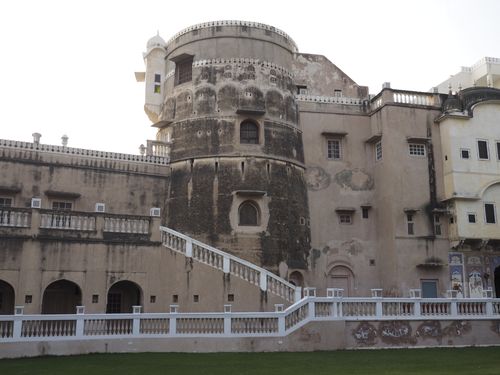
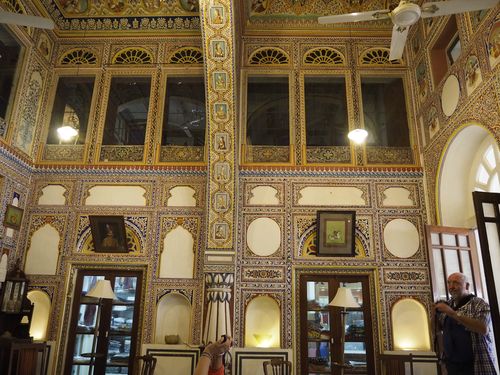
 The havelis of Mandawa, in the Indian state of Rajasthan, are an important part of the region’s cultural and architectural heritage. Built mainly by wealthy merchants, these large residences are notable for their courtyards, decorated facades, and extensive frescoes that reflect a period of prosperity. Mandawa is considered one of the best-known towns in the Shekhawati area, precisely because of the remarkable concentration of these traditional houses. While some remain private, others have been restored and converted into places open to visitors, ensuring both preservation and continued use. They stand today as a significant attraction for travelers interested in experiencing a vivid example of Rajasthan’s artistic and social legacy.

Monument profile
Havelis
Monument category: Havelis
Monument family: Historic or traditional habitat
Monument genre: Residential
Cultural heritages: Hindu, Jain
Geographic location: Mandawa • Rajasthan • India
Construction period: 18th century AD
• Links to •
• List of videos about Mandawa on this site •
Mandawa, the havelis • Rajasthan, India
• References •
Wikipedia EN: Mandawa
TV 5 Monde: Les Havelis à retaper au Rajasthan
JaipurLove: Mandawa, Rajasthan’s open art gallery town
History of the Havelis in Mandawa (Rajasthan, India)
The havelis of Mandawa, located in the Shekhawati region of Rajasthan, represent one of the most significant ensembles of merchant mansions in northern India. Built primarily between the eighteenth and nineteenth centuries, they provide insight into the socio-political and economic dynamics of their time. These residences embody not only wealth and status but also the interaction between local traditions, regional power structures, and broader global currents of commerce and culture.
Political and Social Context of Construction
The emergence of the havelis in Mandawa coincided with the decline of the Mughal Empire in the eighteenth century. As imperial authority weakened, regional powers, particularly the Rajput rulers of Shekhawati, gained greater autonomy. The Shekhawat clan established Mandawa as a fortified trading post, attracting merchants who found protection under local rulers. The construction of havelis was directly tied to the ambitions of wealthy Marwari trading families.
These merchants amassed fortunes through caravan trade linking Delhi with ports in Gujarat and the wider Indian Ocean. Havelis were therefore built both as residences and as symbols of prosperity. Their monumental facades communicated social standing and reinforced the bond between mercantile elites and Rajput rulers. Politically, they expressed the growing independence of local powers and the shifting alliances between merchant patrons and regional chieftains. Socially, they served as nodes of family prestige, with each haveli functioning as a physical marker of clan identity and status.
Major Historical Events Affecting the Site
Throughout the late eighteenth and nineteenth centuries, Mandawa and its havelis were influenced by political turbulence. Periodic conflicts between Rajput states, incursions by neighboring powers, and the spread of British colonial authority reshaped the region. The Shekhawats maintained their strongholds but had to adapt to the rising dominance of the East India Company.
During times of instability, the havelis themselves were relatively protected due to their residential nature and integration into the urban fabric. However, as many merchant families shifted their commercial bases toward Calcutta, Bombay, or Delhi in the nineteenth century, their houses in Mandawa were gradually abandoned. Some fell into disrepair, while others were looted or neglected during transitions of power.
Despite these challenges, the havelis endured. Certain families invested in periodic restorations, while others allowed their properties to be repurposed as warehouses or, later, as guesthouses. In the twentieth century, the havelis saw new cycles of decline and revival, with renewed attention as part of Rajasthan’s cultural heritage and tourism economy.
Global Context
The construction of havelis in Mandawa corresponds to a broader global phenomenon: the architectural display of mercantile wealth. In eighteenth-century Europe, bourgeois families in cities like Venice, Antwerp, and Paris built townhouses that symbolized economic power. In Central Asia, merchants of Bukhara and Samarkand created richly decorated residences that combined utility with grandeur. The havelis of Mandawa thus fit into a worldwide pattern of merchant elites translating commercial success into monumental domestic architecture.
Like their counterparts elsewhere, Mandawa’s havelis were not merely functional dwellings but statements of cultural and economic ambition. Their scale and ornamentation positioned them as local equivalents of palaces, though constructed by traders rather than by sovereign rulers.
Transformations Over the Centuries
The havelis have undergone significant transformations over time. Structurally, many were expanded or embellished with frescos depicting not only mythological and religious themes but also images of modernity: trains, telegraphs, and steamships. This visual evolution reflected the merchants’ engagement with global change while retaining their traditional architectural frameworks.
As economic power shifted away from Shekhawati, many havelis lost their primary residential role. Some were divided among heirs, while others were sold or adapted for new uses. In recent decades, a number of havelis have been converted into heritage hotels, balancing tourism demand with efforts at preservation. Others remain abandoned, vulnerable to decay and structural collapse.
Role in Contemporary Culture
In the present day, the havelis of Mandawa are central to the town’s cultural and economic identity. They attract scholars, artists, and tourists, offering a tangible record of Rajasthan’s mercantile history. Their frescoes, covering walls and ceilings with elaborate narratives, are valued not only as decoration but as visual archives of social and economic life.
Local communities view the havelis both with pride and with pragmatism: they are symbols of heritage, but also resources that can generate revenue through tourism. The conversion of several havelis into boutique hotels has reinforced Mandawa’s role as a gateway to the Shekhawati region. The mansions also play a part in cultural festivals and serve as backdrops for cinematic productions, further embedding them in India’s cultural landscape.
State of Conservation and Preservation Challenges
The conservation of Mandawa’s havelis is fraught with challenges. Many structures suffer from neglect, as families dispersed to other cities and resources for upkeep dwindled. Environmental threats include seasonal rains, rising humidity, and temperature extremes that accelerate the deterioration of frescoes and wooden elements. Urbanization adds another layer of risk, as modern construction encroaches upon historic sites and alters the traditional streetscapes.
Tourism provides opportunities for restoration but can also be a double-edged sword. Excessive modification to accommodate modern comforts may compromise authenticity, while insufficient regulation risks over-commercialization. Some initiatives, supported by local authorities and private investors, have achieved successful restorations, but the majority of havelis remain vulnerable.
International recognition has grown, but the havelis are not yet inscribed on the UNESCO World Heritage List. Such designation could bring greater protection and resources, though it would also impose stricter preservation standards. The balance between conservation, sustainable tourism, and local development remains the key challenge.
Conclusion
The havelis of Mandawa stand as monuments to a unique convergence of mercantile wealth, regional politics, and cultural artistry. Constructed during a period of shifting power in Rajasthan, they embody both ambition and adaptability. Over centuries, they have witnessed prosperity, abandonment, and revival, mirroring the fortunes of the families and the region that produced them. Today, they are not only architectural treasures but also active participants in the cultural and economic life of Rajasthan. Their preservation will determine whether this remarkable heritage continues to inspire future generations.
Architecture of the Havelis in Mandawa (Rajasthan, India)
The havelis of Mandawa form a coherent corpus of merchant residences whose architecture integrates climate-responsive design, urban propriety, and ornamental ambition. Built largely between the late eighteenth and early twentieth centuries, they refine long-standing vernacular traditions while absorbing external influences tied to trade and colonial-era exchanges. Their value lies as much in constructive intelligence as in their painted surfaces.
Technological and Architectural Innovations
Mandawa’s havelis perfected the house-around-courts typology to address heat, dust, and privacy. Successive courtyards (chowks) create a gradient from public to domestic to secluded spaces, enabling cross-ventilation and stack effect: warm air rises within sun-warmed patios and is replaced by cooler air drawn through shaded arcades. Deep eaves, galleries, and oriel windows (jharokhas) temper solar gain and glare; perforated screens (jālī) admit air while preserving visual discretion. Thick masonry walls act as thermal batteries, smoothing day-night temperature swings. Roof terraces, used for sleeping in the hot season, work as evaporative and radiative cooling surfaces.
Construction systems evolve pragmatically. Lime-rich mortars allow the fabric to “breathe” and accommodate minor movement, while fine burnished lime finishes (often known locally as araish) provide a stable base for paint and reflect daylight into shaded spaces. Timber beams span modest bays, sometimes supplemented by iron ties and brackets in the nineteenth century to stiffen long verandas. Standardized bay modules—repeated arches, column spacings, and window frames—accelerate building while preserving craft precision. At the urban scale, narrow lanes, continuous compound walls, and carefully placed gateways control dust and traffic while reinforcing a legible street edge.
Materials and Methods of Construction
Materials are local, durable, and chosen for their thermal and mechanical behavior. Brick and regional sandstone or other available stone compose the thick loadbearing walls; lime mortar with brick dust or other mineral additives improves strength and moisture transport. Stone thresholds and lintels protect openings; hardwood (often imported teak where means allowed) appears in doors, shutters, beams, and carved brackets. The widespread use of lime render, polished by hand, produces a fine, slightly reflective surface that takes pigment cleanly and resists micro-cracking.
Color and finish contribute to both durability and image. Mineral pigments—earth ochres, lampblack, indigo, copper greens, vermilion—are applied as fresco secco on freshly prepared lime, with outlines sometimes incised into the plaster. Mirrors and colored glass, increasingly available in the late nineteenth century, accent cornices and interior friezes. The combination of mass (for stability and thermal inertia) and flexible lime (for compatibility and repair) explains the surprising longevity of many structures, provided cement-based “hard” repairs have not disrupted the historic moisture balance.
Artistic and Cross-Cultural Influences
Formally, Mandawa’s havelis balance Rajput and Indo-Mughal repertoires—chhatris (kiosk pavilions), cusped arcades, bracketed balconies, crenellated parapets—with mercantile display along the street façade. The painted programs begin with epic, religious, and courtly themes, then broaden to include images of modernity: trains, steamships, telegraphs, European portraits, watches, bicycles. This iconographic expansion coincides with trading networks that linked Marwari merchants to ports and colonial capitals, and it never displaces the framing devices, floral borders, and narrative panels rooted in local craft lineages. The result is a simultaneous fidelity to regional grammar and responsiveness to global imagery—an architectural skin that records the town’s commercial cosmopolitanism.
Spatial Organization and Structural Logic
A typical plan sequences: a fortified entrance with heavy door leaves; a passage to a first, semi-public courtyard for receiving clients and conducting business; a second and sometimes third courtyard for family life; and, where status warranted, a rear or upper-level women’s quarter (zenana) screened from view. Rooms open off arcaded galleries, allowing flexible use as seasons change. Stairs are often tucked behind screens or in side bays to preserve privacy and minimize heat transfer.
Structurally, the buildings rely on thick ground-floor walls, closely spaced piers, and modest spans. Load paths are clear and redundant: continuous walls carry timber or composite floors; verandas and balconies are supported by carved stone or timber brackets; roof terraces are laid on compacted fill and lime layers to shed monsoon rains. Street elevations are typically more closed at ground level for security and climate control, with larger openings, jharokhas, and delicate stone or wooden balustrades above. In the courtyards, repeated arch modules and column lines create rhythm, shade, and predictable structural behavior.
Statistics and Notable Anecdotes
Although dimensions vary widely, many havelis rise two to three storeys around two to four courts, with street frontages commonly spanning several contiguous bays. Plot depths are substantial, allowing service zones, storage, and small shrines to be embedded within the sequence of courts. Terraces often include small chhatris or pavilions that mark family prestige and provide vantage points in the evening breeze.
Beyond numbers, two traits recur. First, a “front stage/back stage” duality: spaces nearest the street support trade, negotiation, and hospitality, while inner courts stabilize family routines and rituals. Second, the late-nineteenth-century “catalogue of modernities” painted across façades created a visual ledger of things newly seen elsewhere—evidence that global news travelled with goods and credit instruments, and that architecture served as a social archive as much as shelter.
Recognition and Conservation Challenges
Mandawa’s importance rests on the survival of a townscape where house-courts, gateways, and painted surfaces still read as a continuous cultural environment. Protection is uneven: some properties remain in private hands, some have been restored for heritage hospitality, and others face advanced decay. Key risks include rising damp and salt efflorescence (exacerbated by inappropriate cement repairs), loss of historic joinery, vibration and traffic in narrow streets, and ad hoc alterations to accommodate modern services.
Conservation strategies that show results share common principles: diagnosis of moisture pathways; repair with compatible lime mortars and plasters; careful cleaning and consolidation of wall paintings; and reversible insertions for comfort and safety. At the urban level, maintaining plot integrity, courtyard proportions, and street profiles is as critical as any single façade. Sensitive reuse—when it respects ventilation routes, thermal mass, and historic finishes—can finance upkeep without eroding authenticity. The architectural significance of these houses thus underpins both local identity and a broader understanding of climate-adapted design in semi-arid regions.
Synthesis
The architectural achievement of Mandawa’s havelis is inseparable from the social economy that produced them. They demonstrate how a merchant society transformed climatic constraints into spatial assets; how standardized modules and refined craft raised efficiency without sacrificing artistry; and how an open visual culture absorbed modern motifs into a resilient regional grammar. Their preservation depends on continuing that balance—pairing living use with technical care—so that structure, space, and painted memory remain legible as a single, finely tuned organism.