

 Français (France)
  Nederlands (nl-NL)
 The ghats of Maheshwar, located along the banks of the Narmada River in the state of Madhya Pradesh, form one of the most significant urban and religious ensembles in central India. These monumental stairways descending toward the water serve as spaces for movement, gatherings, rituals, and daily activities. The site combines religious functions, social life, and river landscapes within an environment shaped by temples, pavilions, and former structures connected to local authority. The ghats also play an important role in the cultural identity of Maheshwar, a town recognized for its historical heritage and traditional craftsmanship.
Monument profile
Ghats
Monument category: Pilgrimage site
Monument family: Pilgrimage site or memorial
Monument genre: Religious
Cultural heritage: Hindu
Geographic location: Maheshwar • Madhya Pradesh • India
Construction period: 18th century AD
• Links to •
• Dynasties that contributed to the construction of the monument •

• List of videos about Maheshwar on this site •
Maheshwar • Former capital of Malwa on the Narmada
The Ghats of Maheshwar and the Development of the Narmada Riverfront
Expansion under the Holkar dynasty
The ghats of Maheshwar were largely developed during the eighteenth century under the rule of Queen Ahilyabai Holkar, one of the most influential rulers of the Holkar dynasty in the Malwa region. After establishing Maheshwar as one of her principal residences around 1767, she initiated an extensive program of religious and civic construction along the banks of the Narmada River. The ghats were designed to organize access to the river, support ritual activities, and reinforce the sacred and political importance of the city.
The river occupied a central position in Ahilyabai Holkar’s religious policy. Stairways, platforms, temples, and pavilions were constructed or restored to create a monumental riverfront associated with pilgrimage, worship, and royal patronage. Several shrines connected to Shaivite traditions were integrated into this riverfront complex during her reign.
Religious and political functions
Maheshwar served simultaneously as a royal residence, an administrative center, and an important religious settlement within the Holkar domains. The ghats formed an essential part of this urban organization. They provided access to ritual bathing areas, cremation spaces, and ceremonial gathering points while also functioning as visible expressions of dynastic authority.
The development of the riverfront contributed to Maheshwar’s reputation as a sacred town associated with the Narmada. Pilgrims, priests, merchants, and artisans became closely linked to the activities concentrated around the ghats. Ahilyabai Holkar sponsored similar religious projects in other parts of India, yet the riverfront of Maheshwar remained one of the clearest architectural and symbolic representations of her rule.
The ghats also supported economic activity connected to pilgrimage traffic and local markets. Their continuous use helped maintain Maheshwar’s regional importance after political power gradually shifted elsewhere during the nineteenth century.
Continuity, restoration, and present-day role
The ghats have remained in active religious use from the Holkar period to the present day. Daily rituals, ceremonial bathing, and religious festivals continue to take place along the riverfront. Although repairs and stabilisation works have periodically been required because of erosion and seasonal flooding, the overall layout of the ghats still reflects the eighteenth-century urban development program.
During the twentieth century, Maheshwar also became widely associated with textile production, especially Maheshwari saris. The ghats increasingly appeared in the cultural identity of the town as both ritual and public spaces. Their visual connection with the Holkar fort and palace has contributed to their continued importance in tourism, religious activity, and local heritage preservation.
Global historical context
The principal development of the Maheshwar ghats during the eighteenth century took place during a period of political fragmentation following the decline of the Mughal Empire. In Europe, the same period corresponded to the age of absolutist monarchies and the early stages of the Industrial Revolution in Britain. In North America, the later decades of the century witnessed the American War of Independence. At the same time, European trading powers were expanding their influence across the Indian subcontinent.
Architectural Organization of the Maheshwar Ghats along the Narmada River
Riverfront layout and topographical adaptation
The ghats of Maheshwar extend along a substantial section of the northern bank of the Narmada River below the fortified palace complex associated with the Holkar dynasty. Their architectural composition establishes a direct transition between the elevated urban settlement and the river through a succession of descending terraces, stairways, retaining walls, and ceremonial platforms. The entire riverfront forms a continuous built façade visible from the water, where religious, residential, and defensive structures are visually interconnected.
The steep natural slope between the upper town and the river strongly influenced the organization of the site. Large flights of stone steps descend toward the water in segmented sections interrupted by intermediate terraces and widened landings. This arrangement distributes circulation across multiple levels while accommodating variations in elevation caused by the irregular riverbank. Some portions of the ghats follow relatively straight alignments, whereas others adapt to projections and recesses in the terrain.
Stairways, platforms, and circulation systems
Monumental staircases constitute the dominant architectural element of the ghats. Constructed primarily from locally available stone, the steps vary in width, height, and inclination according to their position along the riverfront. The lower sections are designed to withstand periodic immersion during the monsoon season, while upper terraces remain accessible during fluctuations in water level.
Several broad platforms interrupt the vertical rhythm of the stairways. These horizontal spaces function as transitional zones between circulation areas and ritual sections closer to the river. Their dimensions allow large gatherings during ceremonies and festivals while also facilitating movement between adjacent parts of the riverfront.
Access points for boats are integrated into certain sectors through gently sloping landings and recessed edges along the waterline. Secondary staircases establish connections between the principal ghats and upper residential or religious structures. The resulting circulation network produces a layered spatial organization where movement occurs simultaneously along vertical and horizontal axes.
Open pavilions positioned along the terraces create sheltered areas overlooking the river. Many of these structures rest on stone columns supporting flat or slightly sloped roofs. Their placement breaks the continuity of the staircases and introduces alternating open and covered spaces along the façade.
Relationship with temples and fortified structures
The architectural identity of the Maheshwar ghats is closely linked to the fort and palace complex dominating the site from above. Massive defensive walls, bastions, gateways, and residential sections overlook the riverfront and create a hierarchical composition in which the ghats form the lower ceremonial extension of the fortified settlement.
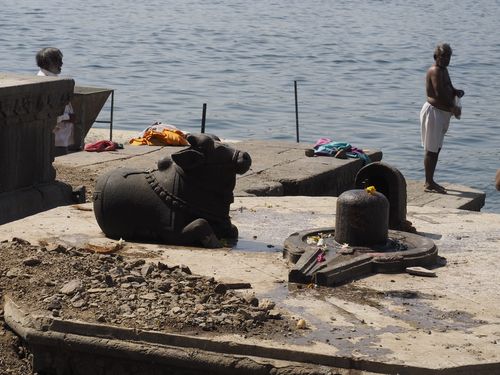
Temples integrated into the riverfront are positioned either directly beside the stairways or on elevated terraces connected to them. Their placement reinforces the ritual relationship between sacred buildings and access to the Narmada. Some shrines are embedded within retaining structures, while others stand independently on projecting platforms facing the river.
Passageways and stair connections between the palace zone and the ghats establish functional continuity between royal, religious, and public spaces. This vertical integration remains one of the defining characteristics of the Maheshwar riverfront. The combination of fortified architecture, ritual structures, and open circulation terraces creates a dense and visually stratified composition extending across multiple levels.
Materials, decorative treatment, and preservation
Stone remains the principal construction material throughout the ghats and associated retaining walls. Its extensive use contributes to structural stability under conditions of humidity, erosion, and seasonal flooding. The surfaces generally display restrained decoration concentrated on column capitals, balustrades, temple entrances, and selected pavilion elements rather than across the entire riverfront.
Architectural interventions carried out during the twentieth and early twenty-first centuries primarily focused on stabilizing staircases, repairing damaged retaining walls, and consolidating sections weakened by river erosion. Despite these restorations, the overall configuration of the ghats continues to reflect the eighteenth-century urban program established during the Holkar period.