

 Français (France)
  Nederlands (nl-NL)
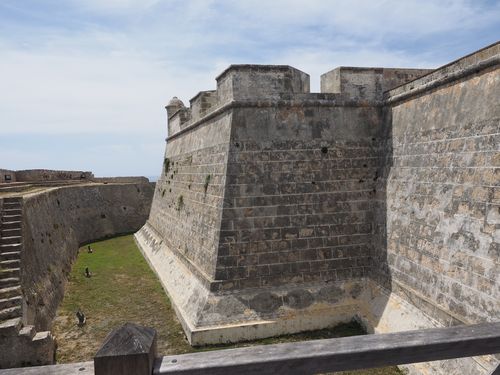
 The Castillo del Moro, also known as the Castle of San Pedro de la Roca, is a fortress located in Santiago de Cuba on the southeastern coast of the island. It forms part of a defensive complex designed to protect the bay and the city from maritime threats. The site is inscribed on the UNESCO World Heritage List under the official name San Pedro de la Roca Castle, Santiago de Cuba, in recognition of its significance within the colonial fortification system of the Caribbean. Today, the monument represents an important heritage landmark and a key component of Santiago de Cuba’s cultural landscape.

Santiago de Cuba • Castillo del Moro
Santiago de Cuba • Castillo del Moro

Santiago de Cuba • Castillo del Moro
Monument profile
Castillo del Moro
Monument category: Fort
Monument family: Fort, Fortifications or Citadel
Monument genre: Military
Geographic location: Santiago de Cuba • Cuba
Construction period: 17th century AD
This monument in Santiago de Cuba is inscribed on the UNESCO World Heritage List under the name San Pedro de la Roca Castle, Santiago de Cuba since 1997.See the UNESCO monuments featured on this site
• Links to •
• List of videos about Bay of Pigs, Baracoa, Santiago de Cuba on this site •
Some historical places • Cuba
Santiago, historical city • Cuba
• References •
UNESCO: San Pedro de la Roca Castle, Santiago de Cuba
History of the Castillo del Moro (Castle of San Pedro de la Roca), Santiago de Cuba
The Castillo del Moro, officially known as the Castle of San Pedro de la Roca, stands at the entrance of the bay of Santiago de Cuba, on the southeastern coast of the island. It represents one of the most significant military constructions of the Spanish colonial period in the Caribbean and reflects the broader geopolitical, economic, and military dynamics that shaped the Atlantic world from the sixteenth century onward.
Political and social context of construction
The construction of the Castillo de San Pedro de la Roca was driven by the strategic imperatives of the Spanish Empire during a period marked by intense rivalry among European powers. From the sixteenth century, Spain relied heavily on its Caribbean ports to secure maritime routes linking the Americas to Europe. Santiago de Cuba, although less prominent than Havana, was a key military and commercial hub controlling access to the eastern Caribbean and serving as a defensive anchor for Spain’s colonial holdings.
The city and its bay were exposed to repeated threats from pirates, privateers, and rival imperial forces, particularly from France, England, and the Netherlands. These incursions were not merely acts of piracy but part of a broader struggle for control over trade routes, resources, and territorial influence. The fortification of Santiago de Cuba responded to the need to protect the local population, safeguard imperial commerce, and assert Spanish authority in a contested maritime zone.
The initiative for building the fortress came from colonial administrators acting under royal authority. Their ambitions were both practical and symbolic: to create a defensive structure capable of resisting naval attacks and to project the power of the Spanish Crown. The construction of such fortifications also reinforced social hierarchies within the colony, mobilizing labor, resources, and technical expertise under imperial control.
Major historical events affecting the site
Throughout its history, the Castillo del Moro played a strategic role in the defense of Santiago de Cuba, even if it was never subjected to prolonged sieges comparable to those experienced by other major fortresses. Its presence acted as a deterrent, shaping the military balance in the region and limiting the vulnerability of the city to direct assaults.
Natural disasters, including earthquakes and hurricanes, repeatedly damaged the structure, necessitating repairs and reconstructions. These events contributed to the gradual transformation of the fortress, as successive phases of restoration incorporated new defensive concepts and materials.
Political changes within Spain and the wider Atlantic world also influenced the site’s function. Administrative reforms, shifts in colonial priorities, and evolving military technologies reduced the strategic importance of certain coastal fortifications. Over time, the Castillo del Moro lost its central role in active defense and entered periods of partial neglect.
During the nineteenth century, as colonial rule weakened and geopolitical conditions changed, the fortress was increasingly repurposed or left unused. Its military relevance declined, but its physical presence remained a dominant feature of the bay.
Global historical context
The construction of the Castillo de San Pedro de la Roca forms part of a global pattern of monumental fortification during the early modern period. Across Europe, the Mediterranean, and the Atlantic world, states invested heavily in coastal defenses to protect trade networks and strategic ports. Advances in artillery and naval warfare required new architectural responses, leading to the development of bastioned fortifications and integrated defensive systems.
In the Caribbean, these developments were closely linked to colonial expansion and competition. Fortresses such as the Castillo del Moro illustrate how European military theories were adapted to new environments, where geography, climate, and logistical constraints shaped local solutions. The site thus reflects a broader movement in which military architecture became a key instrument of imperial governance.
Transformations over time
The Castillo del Moro underwent multiple architectural and functional transformations over the centuries. Initially conceived as a purely defensive installation, it was modified to accommodate changing military requirements and environmental conditions. Repairs and reinforcements altered its appearance, creating a layered structure that reflects successive historical phases.
Periods of decline alternated with renewed interest in preservation. In the twentieth century, growing awareness of cultural heritage led to systematic restoration efforts aimed at stabilizing the structure and preserving its historical integrity. These interventions marked a shift from military utility to cultural and educational value.
Urban development in and around Santiago de Cuba also changed the relationship between the fortress and the city. Once isolated and strictly military, the site became integrated into a broader cultural landscape, accessible to residents and visitors alike.
Contemporary role and cultural significance
Today, the Castillo del Moro is widely recognized as a symbol of Santiago de Cuba’s historical identity. It serves as a cultural landmark, offering insight into the city’s colonial past and its strategic importance in the Caribbean. The site functions as a museum and educational space, contributing to public understanding of regional history.
While not associated with specific religious practices, the fortress plays a role in civic life and cultural tourism. It features prominently in representations of the city and serves as a focal point for heritage-related activities. Its visibility and historical associations reinforce its significance at both local and national levels.
Conservation status and modern challenges
The Castle of San Pedro de la Roca is inscribed on the UNESCO World Heritage List, a designation that acknowledges its outstanding universal value as an example of Spanish-American military architecture. This status entails responsibilities related to conservation, management, and monitoring.
The site faces ongoing challenges, including coastal erosion, high humidity, salt exposure, and the effects of climate change. Tourism adds further pressure, requiring careful regulation to balance accessibility with preservation. Conservation policies implemented by Cuban authorities aim to address these issues through maintenance, restoration, and controlled use of the site.
Conclusion
The Castillo del Moro stands as a powerful testament to the military, political, and social forces that shaped the Caribbean during the colonial era. Its history reflects the ambitions of empire, the realities of conflict, and the long-term processes of adaptation and preservation. From a strategic fortress to a protected heritage site, it embodies the complex legacy of colonial fortification and remains a key reference point in the historical landscape of Cuba.
Architecture of the Castillo del Moro (Castle of San Pedro de la Roca), Santiago de Cuba
The Castillo del Moro, officially known as the Castle of San Pedro de la Roca, stands at the entrance to the bay of Santiago de Cuba and represents one of the most accomplished examples of Spanish colonial military architecture in the Caribbean. Its architectural significance lies not in monumental decoration but in the coherence of its defensive conception and in the adaptation of European fortification principles to a steep coastal site, a tropical maritime climate, and the realities of early modern artillery warfare. Rather than forming a single compact structure, the fortress is conceived as a layered architectural system in which terrain, construction, and military function are inseparable.
Technological and architectural innovations of the period
The Castillo del Moro reflects the major transformation of military architecture that occurred from the sixteenth century onward, when the spread of gunpowder artillery rendered medieval vertical fortifications increasingly obsolete. High walls and towers were replaced by lower, thicker masonry capable of absorbing cannon fire and supporting heavy artillery. The fortress follows this logic through massive walls, protected firing positions, and carefully calculated platforms.
One of the most distinctive innovations of the site is its topographic integration. Instead of imposing a regular or symmetrical plan, the design exploits the natural rock promontory. Defensive structures are arranged in a sequence of terraces descending toward the sea, creating a system of defense in depth. Each level is positioned to cover specific angles of approach, while also supporting adjacent platforms. This vertical organization allows the fortress to control the bay entrance effectively while minimizing structural vulnerability.
Climatic considerations are also embedded in the architectural design. The tropical environment required solutions to limit humidity and heat accumulation. Open circulation routes, partially exposed corridors, and interior voids facilitate natural ventilation. Thick masonry walls provide thermal inertia, reducing temperature fluctuations inside enclosed spaces. Drainage systems, including sloped surfaces and channels, guide heavy rainfall away from critical zones such as circulation paths and storage areas.
Materials and construction methods
The fortress was constructed primarily from local stone, particularly limestone, which was readily available in the region and well suited to heavy masonry construction. Stone offered durability, resistance to fire, and sufficient mass to withstand artillery impacts. Wall thickness in strategic sectors reaches several meters, a characteristic feature of artillery fortifications of the period.
Masonry units were bonded using lime-based mortars, composed mainly of lime and sand. These mortars provided sufficient cohesion while remaining flexible enough to accommodate minor structural movement. In a coastal environment marked by humidity and salt exposure, such mortars also allowed walls to release moisture more effectively than rigid binding materials.
Wood was used in a more limited capacity, primarily for floors, internal partitions, scaffolding, and temporary roofing. Given its susceptibility to decay, insects, and fire, timber was avoided in structurally critical elements. Construction techniques therefore emphasized vaulting, solid masonry, and stone-supported platforms to ensure long-term stability.
Architectural and artistic influences
The Castillo del Moro belongs to the tradition of Spanish military engineering shaped by Renaissance theories of fortification, particularly those developed in Italy. These theories emphasized geometry, calculated angles of fire, and the integration of multiple defensive elements into a unified system. Such principles are evident in the positioning of artillery platforms, the elimination of blind spots, and the careful control of access routes.
At the same time, the fortress departs from European models through its strong dependence on the natural landscape. The irregular terraced layout reflects the constraints of the cliffside site and demonstrates how imported architectural concepts were adapted to Caribbean geography. This adaptation gives the monument its distinctive character within the broader context of colonial fortifications.
Ornamentation is deliberately minimal. Decorative features are secondary to defensive function and are limited to occasional inscriptions or symbolic elements integrated into gateways or walls. The architectural expression relies on proportion, mass, and functional clarity rather than stylistic display.
Spatial organization and structural layout
Architecturally, the Castillo del Moro functions as a multi-level defensive complex rather than a single enclosed building. Access routes are narrow and carefully controlled, designed to slow movement and expose potential attackers. Circulation between levels is achieved through ramps, stairways, and passages embedded in the masonry, allowing the movement of personnel and equipment while maintaining defensive integrity.
The complex includes several distinct functional zones. Upper platforms serve as primary artillery positions with wide visibility over the sea and bay. Intermediate levels support secondary batteries and observation points, while lower terraces house storage spaces and service areas. Historically, protected rooms were reserved for supplies and ammunition, often reinforced with thicker walls and placed away from direct exposure.
Structural design emphasizes redundancy and mutual support. Angled walls and parapets deflect projectiles, while firing openings are positioned to provide overlapping fields of fire. No single platform operates independently; each contributes to the overall defensive system.
Notable design elements and absences
As a coastal artillery fortress, the Castillo del Moro lacks architectural features associated with religious or ceremonial buildings. There are no domes, colonnades, or decorative façades intended for display. Instead, the defining elements are utilitarian: embrasures, parapets, retaining walls, and terraced platforms that combine structural, circulatory, and defensive functions.
The absence of elaborate ornamentation reflects the priorities of early modern military architecture, in which resources were directed toward durability, firepower, and logistical efficiency rather than visual representation.
Dimensions, figures, and architectural facts
The fortress occupies a large footprint distributed across multiple terraces connected by internal circulation routes. The vertical difference between lower works and upper batteries is a defining architectural feature, enhancing visibility and defensive reach. Wall thickness and platform dimensions were calculated to support heavy artillery and resist prolonged exposure to fire.
An important architectural characteristic is the layered construction history visible in the masonry. Repairs, reinforcements, and reconstructions introduced variations in building techniques over time, creating a stratified structure that reflects evolving military and environmental challenges.
International recognition and conservation issues
The architectural coherence of the Castillo del Moro contributes directly to its international recognition. It is regarded as an outstanding example of the adaptation of European artillery fortification principles to a Caribbean coastal environment.
Conservation challenges are closely linked to materials and exposure. Salt-laden air, high humidity, and intense rainfall accelerate stone erosion and mortar deterioration. Effective preservation requires continuous maintenance of drainage systems, careful repointing with compatible materials, and controlled visitor access to limit wear on platforms and circulation routes.
Architectural significance in summary
Architecturally, the Castillo del Moro is an engineered response to the demands of coastal defense, artillery warfare, and construction on steep terrain. Its value lies in the clarity of its defensive logic, the robustness of its masonry, and the sophistication of its adaptation to place. As a terraced fortress integrated into the landscape, it remains a key reference for understanding Spanish colonial military architecture in the Caribbean.