

 Français (France)
  Nederlands (nl-NL)
 The Moncada Barracks, located in Santiago de Cuba, is one of Cuba’s most recognized historic sites because of its strong symbolic role in the country’s modern history. Built in the early twentieth century, this military complex once held strategic importance within the national armed forces. Today, the site is mainly associated with remembrance and historical education. Part of the complex has been converted into a museum, welcoming visitors interested in understanding key moments of modern Cuban political history. Its presence in the city also makes it an important cultural landmark within Santiago de Cuba.
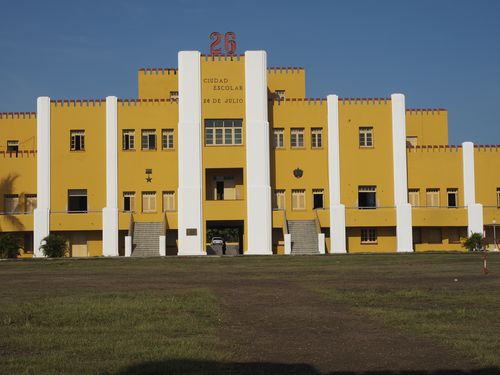
Santiago de Cuba • Moncada Barracks

Santiago de Cuba • Moncada Barracks

Santiago de Cuba • Moncada Barracks
Monument profile
Moncada Barracks
Monument category: Barraks
Monument family: Fort, Fortifications or Citadel
Monument genre: Military
Geographic location: Santiago de Cuba • Cuba
Construction period: 20th century AD
• Links to •
• List of videos about Bay of Pigs, Baracoa, Santiago de Cuba on this site •
Some historical places • Cuba
Santiago, historical city • Cuba
Moncada Barracks in Santiago de Cuba: Historical Development of a Military and Memorial Complex
Construction and Original Military Role
The Moncada Barracks was built in the first decades of the twentieth century in Santiago de Cuba, during the republican period that followed Cuban independence. The new state sought to consolidate its military institutions, and the eastern part of the island required a major permanent garrison. The complex was named after Guillermo Moncada, a general of the independence wars.
Its location in Santiago de Cuba reflected the city’s strategic importance. As the principal urban centre of eastern Cuba, Santiago controlled maritime routes, regional communications, and military logistics. The barracks became one of the largest military installations in the country, second only to Columbia Barracks in Havana. It contained troop quarters, administrative offices, storage areas, and training grounds, functioning as both a command centre and a regional security base.
The Assault of 26 July 1953
The historical significance of the Moncada Barracks is closely linked to the armed assault carried out on 26 July 1953 by a group led by Fidel Castro. The attackers intended to seize weapons, occupy the installation, and trigger an uprising against the government of Fulgencio Batista. Moncada was selected because of its symbolic and operational importance in eastern Cuba.
The attack failed within hours. Several participants were killed during the fighting or executed after capture. Fidel Castro was arrested soon afterward and later defended himself at trial in the speech known as History Will Absolve Me. Although unsuccessful militarily, the assault transformed the barracks into a central reference point of the Cuban revolutionary movement. Castro’s organization later adopted the name “26th of July Movement.”
Reassignment after 1959
After the Cuban Revolution triumphed in January 1959, the complex underwent a major change of purpose. Part of the barracks was converted into a school complex, reflecting the new government’s policy of turning former military spaces toward civilian and educational uses. Other sectors were dedicated to commemorating the events of 1953.
A museum was established within the site to present the attack, its participants, and the revolutionary interpretation of the episode. Through this reassignment, the former garrison lost its original military role and became an institutional space connected to education, political memory, and public ceremony.
Present Role and Preservation
Today the Moncada Barracks remains one of Santiago de Cuba’s best-known historical landmarks. It receives visitors, student groups, and official delegations, especially during annual commemorations on 26 July, now a major national date in Cuba.
The site retains a dual identity. Architecturally, it preserves the scale and appearance of a large early twentieth-century military compound. Symbolically, it is presented as the starting point of the revolutionary process that reshaped the Cuban state. Its continued maintenance reflects both heritage concerns and the political importance attached to the location.
Global Historical Context
When the barracks was constructed in the early twentieth century, Europe was marked by imperial rivalries that would lead to the First World War. The United States was expanding its influence in the Caribbean after the Spanish-American War of 1898. In Asia, Japan emerged as a major power after defeating Russia in 1905. The 1953 assault on Moncada took place during the early Cold War, when political tensions were intensifying worldwide.
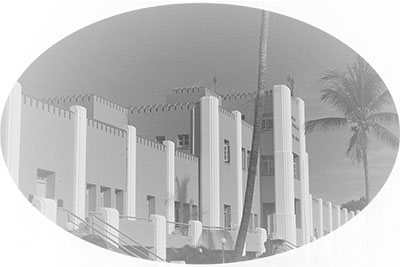
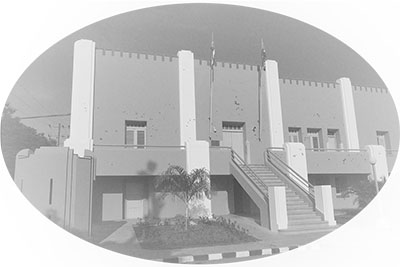
Architectural Configuration of the Moncada Barracks in Santiago de Cuba
Urban Setting and Overall Layout
The Moncada Barracks occupies an extensive urban site in Santiago de Cuba, positioned to command open approaches while remaining connected to the city’s principal circulation routes. Its placement reflects strategic military planning: visibility, rapid troop movement, and internal control were prioritized over scenic or ceremonial concerns. The complex was conceived as a coordinated ensemble rather than a single structure, with multiple wings arranged around service zones and open courtyards.
The plan relies on strong axial organization and repetitive alignment. Long rectangular blocks define clear edges and create enclosed or semi-enclosed internal spaces. This arrangement simplified circulation between sectors and allowed different military functions to be distributed within a controlled perimeter. Open grounds in front of the principal façade further reinforced surveillance and provided unobstructed access.
The barracks is notable for its horizontal spread rather than vertical emphasis. Its mass is distributed across broad frontage and multiple connected volumes, producing an impression of scale through width and continuity.
Façade Composition and Visual Identity
The principal façade is among the most recognizable features of the complex. It is organized symmetrically around a dominant central section framed by tall vertical piers that rise above adjacent rooflines. These projecting white elements divide the composition into clear bays and create a strong rhythm across the front elevation.
Wall surfaces are finished in a saturated yellow tone, contrasted by white structural frames and red detailing along the parapet line. This chromatic treatment gives the building an immediately identifiable presence within the cityscape. The parapets incorporate repeated crenellation-like projections, adding a disciplined decorative edge without altering the overall austerity of the composition.
Window openings are rectangular and regularly spaced, with practical proportions suited to ventilation and daylight. Their repeated placement reinforces the administrative and institutional character of the façade. Entrances are concentrated within the central section, where stairs and recessed openings emphasize hierarchy and controlled access.
Structure, Materials, and Climatic Response
The barracks was built during a period when masonry construction remained common while reinforced concrete was increasingly adopted for floors, framing elements, and circulation components. The combination of load-bearing walls and more modern structural materials provided durability for intensive institutional use.
Thick exterior walls helped moderate interior temperatures in Santiago de Cuba’s hot climate. Numerous windows and aligned openings encouraged cross-ventilation, an essential feature before widespread mechanical cooling. The internal courtyards also contributed to air movement and daylight penetration.
Exterior finishes were designed for resilience and maintenance efficiency. Rendered wall surfaces could be renewed periodically, while robust staircases, hard paving, and straightforward joinery suited a heavily used military environment. Roof forms are generally simple and practical, hidden in places behind parapets that preserve the clean horizontal silhouette.
Internal Spatial Organization
The internal arrangement followed a clear functional hierarchy. Administrative rooms and command areas were positioned in the most accessible and representative sectors, especially near principal entrances. Barracks rooms, storage areas, and support spaces occupied more repetitive wings where efficient subdivision was possible.
Long corridors connected successive rooms and facilitated supervision. Staircases placed at strategic points linked upper levels while preserving orderly circulation patterns. The central axis of the main façade likely corresponded to the most significant internal route, connecting entrance, circulation core, and principal offices.
Courtyards and open service zones played an operational role beyond simple circulation. They provided assembly space, drill areas, light, and orientation points within a large complex. This combination of enclosed wings and open internal voids was central to the functioning of the site.
Alterations and Present Condition
Following the Cuban Revolution, sections of the former barracks were converted to educational and museum use. These changes introduced new internal partitions, exhibition spaces, and updated utilities while leaving much of the external composition legible. The building’s military origin remains visible in its disciplined symmetry, controlled access points, and repetitive planning.
Conservation challenges are linked to climate exposure, ageing finishes, and the maintenance demands of a large institutional compound. Periodic work on coatings, drainage systems, windows, and structural surfaces is necessary in Santiago’s humid tropical conditions.
Today the Moncada Barracks presents three readable architectural layers: the original military complex, later civic adaptation, and contemporary memorial site.