

 Français (France)
  Nederlands (nl-NL)
 The Biblioteca Provincial Rubén Martínez Villena, located in Sancti Spíritus, Cuba, is one of the province’s main cultural institutions. It is named after Rubén Martínez Villena, an important Cuban intellectual of the twentieth century. The library serves as a centre for public reading, document preservation and access to information for a wide range of users. It welcomes students, researchers, regular readers and visitors interested in local cultural life. The institution also supports educational, literary and community activities. In a city with a strong historical identity, it remains an important place for learning and the promotion of written heritage.
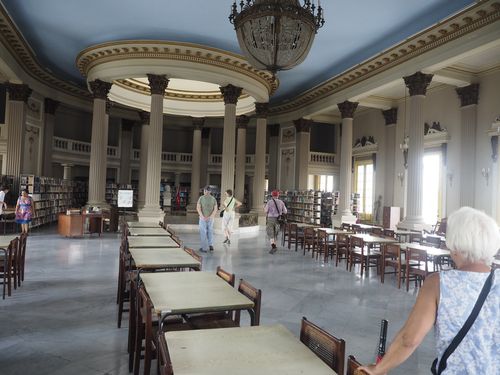
Sancti Spiritus • Biblioteca Provincial Rubén Martínez Villena

Sancti Spiritus • Biblioteca Provincial Rubén Martínez Villena
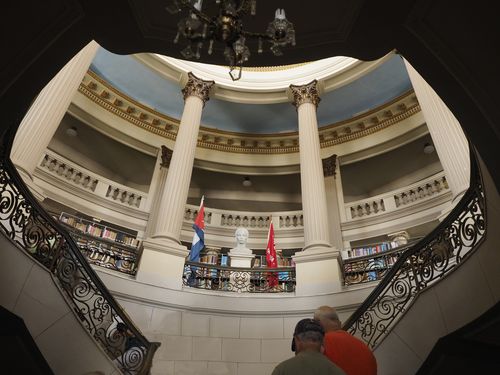
Sancti Spiritus • Biblioteca Provincial Rubén Martínez Villena
Monument profile
Biblioteca Provincial Rubén Martínez Villena
Monument category: Library
Monument family: Monument for cultural purposes
Monument genre: Cultural or scientific
Geographic location: Sancti Spiritus • Cuba
Construction period: 20th century AD
• Links to •
• List of videos about Sancti Spiritus on this site •
Sancti Spiritus, oldest European colony • Cuba
The Biblioteca Provincial Rubén Martínez Villena in the Cultural History of Sancti Spíritus
Establishment of the Institution and Public Role
The Biblioteca Provincial Rubén Martínez Villena in Sancti Spíritus emerged within the twentieth-century development of Cuban cultural institutions. Housed in the historic urban fabric of one of Cuba’s oldest colonial cities, the library became part of a civic landscape that combined administrative, educational and residential functions.
Its creation answered the need for a permanent provincial centre dedicated to reading, documentation and access to knowledge. Rather than serving only as a book repository, the institution was intended to support schools, independent readers and the wider intellectual life of the province.
The decision to name the library after Rubén Martínez Villena gave it a symbolic identity linked to a prominent Cuban poet, lawyer and political thinker of the early twentieth century. The institution therefore combined practical educational functions with commemorative purpose.
Expansion after the Cuban Revolution
Following the Cuban Revolution of 1959, public libraries were integrated into a broader programme of literacy, education and cultural access. The Biblioteca Provincial Rubén Martínez Villena strengthened its role during this period as a centre for public reading and provincial learning.
The expansion of schooling and national literacy campaigns increased demand for books, study spaces and organised collections. In Sancti Spíritus, the library became an important reference point for students, teachers and regular readers. Its collections likely included general literature, Cuban publications and materials connected with local history.
The institution also participated in cultural programming. Lectures, book presentations, reading initiatives and educational activities transformed the building into an active civic space rather than a passive archive.
Provincial Memory and Documentary Function
A major role of provincial libraries in Cuba has been the preservation of regional documentary heritage. The Biblioteca Provincial Rubén Martínez Villena formed part of this network by safeguarding publications connected with Sancti Spíritus and its surrounding province.
Local newspapers, historical studies, literary works and printed records gave the institution value beyond everyday lending services. Researchers and residents could consult materials relevant to the history of the city, one of the earliest Spanish foundations in Cuba.
Its location within the historic centre reinforced this mission. The building linked written memory with the preserved urban environment of Sancti Spíritus, where streets, churches, houses and public institutions reflect several centuries of civic continuity.
Recent Adaptations and Present Significance
Like many libraries worldwide, the institution has had to adapt to changing technologies and new expectations of users. Traditional catalogues and print-based consultation have increasingly been complemented by digital access, computer services and broader community programming.
Despite these changes, the core identity of the library remains stable. It continues to serve as a public reading centre, educational resource and repository of provincial memory. For Sancti Spíritus, it remains one of the principal cultural institutions open to daily civic use.
The historic centre of Sancti Spíritus is recognised as an important heritage area within Cuba, but the library itself is not individually inscribed on the UNESCO World Heritage List.
Global Historical Context
The main development of provincial libraries in Cuba during the twentieth century took place in a world marked by expanding public education and mass literacy. After 1945, many countries invested in cultural infrastructure and public access to knowledge. The Cold War period also gave education and information strong political importance. During the same decades, libraries worldwide increasingly became centres for community life as well as reading.
Architectural Configuration of the Biblioteca Provincial Rubén Martínez Villena in Sancti Spíritus
Urban Position and Relationship with the Historic Centre
The Biblioteca Provincial Rubén Martínez Villena stands within the historic fabric of Sancti Spíritus, one of Cuba’s oldest colonial cities. Its architectural significance is closely linked to this compact urban setting of narrow streets, low-rise buildings and civic spaces. The library forms part of a continuous streetscape shaped by administrative, residential and cultural uses rather than by monumental isolation.
Its location allows the building to function as an accessible public institution integrated into daily circulation. Instead of being separated behind gardens or plazas, it participates directly in the alignment of façades typical of older Cuban town centres. This gives the structure a clearly urban character.
The scale of the building remains consistent with surrounding constructions. It does not dominate through height, but contributes through proportion, rhythm and permanence, a common trait of institutional buildings inserted into historic street patterns.
Exterior Form, Façade Composition and Volumes
The building presents a compact massing adapted to a dense parcel. Its principal façade is organised horizontally, with a clear base, wall plane and roofline. This measured composition conveys stability and civic dignity without requiring monumental dimensions.
Openings are arranged in a regular pattern balancing daylight with the solidity of masonry walls. Doors and windows often follow axial or near-symmetrical placement, creating visual order suited to a public institution. Protective grilles or shutters, where present, add texture while answering climatic and security needs.
The façade likely uses restrained decorative elements rather than lavish ornament. Mouldings, cornices, framed openings or modest pilasters would be consistent with Cuban civic architecture influenced by both colonial and republican traditions. These details distinguish the structure from ordinary domestic buildings while preserving harmony with the surrounding streetscape.
Roof forms are usually discreet from street level. Pitched roofs concealed behind parapets, or simple sloped coverings, help maintain the continuity of the urban frontage.
Interior Organisation and Functional Layout
As a provincial library, the internal plan is shaped by public use, storage needs and controlled circulation. Entrance areas generally serve as transition zones between the street and quieter reading spaces. In a tropical city, this threshold also helps reduce heat, dust and noise.
Reading rooms are normally the most important interior spaces. They require broader spans, generous ceiling height or well-distributed openings to provide comfort and natural light. Their arrangement tends to favour calm movement and visual clarity rather than complex subdivision.
Book storage adds another layer of organisation. Shelving areas, archives or reference sections require floors able to support concentrated loads and layouts allowing efficient retrieval. Administrative offices and service rooms are often placed in secondary zones, leaving the best-lit spaces for readers.
If the building originated as a residence or civic house later converted into a library, the plan may combine original room divisions with later functional changes. This often creates a sequence of connected rooms rather than one large hall.
Materials, Climate Response and Architectural Character
The principal construction materials are likely masonry walls of brick, stone or rendered block finished with plaster or stucco. Such walls provide durability and thermal mass, helping moderate interior temperatures. Their thickness also improves acoustic separation from the street.
Timber joinery is often significant in Cuban historic architecture. Doors, shutters, window frames and sometimes roof structures rely on wood, combining practicality with craftsmanship. High openings and operable shutters improve ventilation in the warm climate.
Floors may use ceramic tile, stone or terrazzo chosen for durability and easy maintenance. These materials suit public interiors exposed to frequent use.
Natural ventilation remains a key architectural feature. Tall ceilings, transom openings, shaded windows and cross-breezes can greatly improve comfort. Part of the building’s architectural quality therefore lies in environmental adaptation rather than decorative display.
Alterations, Conservation and Present Use
As library needs evolved, the building likely underwent adjustments including new shelving systems, lighting upgrades, electrical networks and reading equipment. Such interventions must be integrated carefully within older structures, especially where historic walls or joinery survive.
Conservation issues in Sancti Spíritus include humidity, roof maintenance, water infiltration and wear caused by regular public use. Books and documents also require environmental control, making preservation both architectural and institutional.
Today the building combines two identities: a historic urban structure and an active cultural facility. Its significance lies not in monumental scale, but in the successful adaptation of a traditional Cuban building type to public educational use within the historic centre of Sancti Spíritus.