

 Français (France)
  Nederlands (nl-NL)
 Of Hindu tradition, (with additional Jain influence), the Tomara dynasty ruled for approximately 424 years, ± between 736 and 1160 over all or part of Central India and North India, during the Classical Period and the Medieval Period.
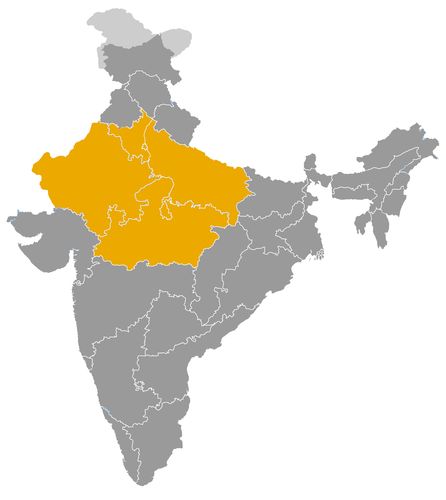
This map illustrates the maximum territory that the Tomara Dynasty had reached at its height, covering the current regions of Delhi (NTC), Haryana, Madhya Pradesh, Rajasthan and Uttar Pradesh in India. Its main purpose is to provide a visual aid to understand the geographical extent of this dynasty. However, it's important to note that the contemporary borders of these regions may not necessarily coincide with the historical territories.
The Tomara dynasty and its role in the early history of Delhi
A regional dynasty in northern India
The Tomara dynasty, also known as the Tomar dynasty, occupies an important place in the early medieval history of northern India. Its power was centred mainly on the region of present day Delhi and parts of Haryana. Although the Tomaras did not create a large empire comparable to the Gurjara Pratiharas, the Chahamanas or the later Delhi Sultanate, their historical role was significant because they helped establish Delhi, or Dhillika, as a durable political and urban centre.
The chronology of the dynasty remains partly uncertain. It is based on inscriptions, numismatic evidence, literary traditions and later historical reconstructions. Despite these uncertainties, the Tomaras are generally regarded as one of the earliest ruling houses associated with the political development of Delhi before the rise of the Chahamanas and the establishment of the Delhi Sultanate.
The political formation of Dhillika
The political importance of the Tomaras lies above all in their association with Dhillika, an early name connected with Delhi. The dynasty ruled in a strategic zone between the northwestern routes, the plains of Haryana, the Rajasthan region and the upper Gangetic basin. This location gave the Tomara territory a value greater than its territorial extent.
The early rulers traditionally associated with the dynasty appear to have consolidated a local base of power in a period when northern India was divided among several regional lineages. The Tomaras may at times have operated within the wider political framework of the Gurjara Pratiharas, but they gradually developed a stronger regional identity around Delhi.
Their power was based on fortification, control of routes, rural revenues and the authority of a warrior elite. In this respect, they represent the type of regional Rajput polity that became increasingly important in northern India between the decline of large imperial formations and the rise of new military states.
Anangapala II and the development of Lal Kot
The most famous Tomara ruler is Anangapala II, traditionally linked with the foundation or development of Lal Kot, one of the earliest fortified nuclei of Delhi. Although the exact details of his reign and building activity are debated, his association with the early urban history of Delhi is central to the memory of the dynasty.
Lal Kot was more than a military enclosure. It symbolised the consolidation of royal authority in a strategic landscape. The site allowed control over routes linking the northwest, the Gangetic plain and Rajasthan. It also provided a defended centre from which local territory, markets and agrarian resources could be administered.
The later history of Delhi was built upon this early foundation. The Chahamanas expanded and transformed the fortified area, and the sultans of Delhi later made the city one of the great capitals of the subcontinent. The Tomaras therefore played a foundational role in a process whose consequences far exceeded their own political lifespan.
Economic foundations in land and regional routes
The economic role of the Tomara dynasty was tied to the resources of the Delhi and Haryana region. Their power probably rested on revenue from cultivated land, village networks, local markets and movement along regional trade routes. The territory they controlled was situated at a crossroads between several economic zones of northern India.
Agricultural income would have supported the court, military retainers, fortification works and religious patronage. At the same time, the control of routes gave the dynasty access to taxes, tolls and exchange networks. Merchants, pastoral groups, warriors and officials moved through the same corridor that made Delhi strategically important.
The Tomara economy was not based on maritime trade or on the resources of a vast empire. Its strength came from the combination of agrarian revenue and the control of a nodal region. This explains why a relatively limited kingdom could have a lasting historical impact.
Cultural memory, fortifications and religious patronage
The cultural contribution of the Tomaras is closely linked to the early monumental and sacred landscape of Delhi. Their name is associated with Lal Kot and with traditions surrounding the Iron Pillar of Delhi, which later became embedded in narratives about royal power, legitimacy and the antiquity of the city.
As Hindu rulers of northern India, the Tomaras were part of a cultural world in which temples, sacred sites, Brahmanical traditions and martial lineages played important roles. Their patronage is less extensively documented than that of larger dynasties, but their presence contributed to the religious and cultural geography of early medieval Delhi.
The memory of the Tomaras was later preserved in Rajput genealogical and regional traditions. This memory helped give Delhi a pre Sultanate historical identity, linking the city not only to Islamic dynasties and imperial capitals, but also to earlier Hindu and Rajput phases.
Relations with neighbouring dynasties
The Tomaras were shaped by their relations with more powerful neighbours. In their earlier phase, they may have been connected to the Gurjara Pratihara sphere of influence. As Pratihara power declined, regional dynasties gained more autonomy, and Delhi became increasingly valuable.
The most important rivals of the Tomaras were the Chahamanas of Shakambhari, often known as the Chauhans. Based in Rajasthan and Ajmer, the Chahamanas expanded toward Delhi and eventually brought the Tomara domain under their control. This transition marked the end of Tomara autonomy but not the end of Delhi’s importance.
The region was also exposed to military pressures from the northwest. This geographical vulnerability would become decisive in the following centuries, when Turkish and Afghan powers entered northern India and Delhi became the centre of a new sultanate.
A limited kingdom with a lasting historical role
The Tomara dynasty did not leave the legacy of a vast empire, but its place in Indian history is substantial. Its rulers helped consolidate Delhi as a fortified and strategic centre, controlled an important corridor of northern India and contributed to the urban development that later dynasties would expand.
Their political influence was regional, their economic base was agrarian and route based, and their cultural role was tied to the early memory of Delhi. For this reason, the Tomaras should be understood as a formative dynasty. Their importance lies less in the size of their kingdom than in their contribution to the emergence of Delhi as one of the central places in the history of India.
The geographical extent of the Tomara dynasty in northern India
A regional power centred on early Delhi
The Tomara dynasty, also known as the Tomar dynasty, controlled a limited but strategically important territory in northern India. Its power was centred on Dhillika, an early name associated with Delhi, and extended into parts of present day Haryana and neighbouring areas of the western Indo Gangetic plain. Unlike the large imperial formations of the Gurjara Pratiharas, the Chahamanas or the later Delhi Sultanate, the Tomaras did not rule a vast empire. Their importance lay instead in the location of their domain.
The region controlled by the Tomaras occupied a crucial position between the Punjab, Rajasthan, Haryana and the upper Gangetic basin. This made their territory a corridor for armies, merchants, pastoral groups and political influence. The dynasty’s geographical role was therefore greater than its territorial size suggests.
Dhillika and Lal Kot as the political heartland
The principal centre of Tomara authority was Dhillika, which later became part of the historical development of Delhi. The dynasty is especially associated with Anangapala II, traditionally linked with the foundation or enlargement of Lal Kot. This fortified settlement became one of the earliest urban and military nuclei of Delhi.
Lal Kot gave the Tomaras a defensible centre from which they could control surrounding villages, routes and agricultural lands. Its location near the Aravalli ridge and the plains of northern India made it well suited for a regional ruling house. The fortification protected the political core of the dynasty and helped establish Delhi as a permanent centre of power.
The Tomara domain around Delhi was not limited to a single city. It probably included a network of rural settlements, revenue producing lands, market points and religious sites. These territories formed the material base of the dynasty’s rule and supported its military and political activities.
Haryana and the western Indo Gangetic plain
The Tomaras were closely connected with the plains of Haryana. This region lay between Delhi, the Punjab and Rajasthan, and it offered both agricultural resources and strategic mobility. Control over parts of Haryana allowed the dynasty to monitor routes coming from the northwest and moving toward the Gangetic plain.
The plains provided grain, revenue and manpower. They also exposed the dynasty to external pressure. Open terrain made military movement easier for rival powers, and the Tomaras had to defend their position against neighbouring dynasties and wider political currents. Their control over Haryana was therefore both an advantage and a vulnerability.
The geographical importance of this area explains why later powers also sought to dominate it. Delhi and Haryana formed a natural bridge between western India, northern India and the Ganges region. The Tomaras were among the early medieval dynasties that benefited from this position.
Relations with the Gurjara Pratiharas
In the earlier phase of their history, the Tomaras seem to have operated within or near the wider political sphere of the Gurjara Pratiharas. The Pratiharas were a major power in northern and western India, and smaller regional dynasties often functioned within their political framework.
The Tomaras may have acted at times as subordinate chiefs, allies or regional rulers under broader Pratihara influence. This relationship would have allowed them to maintain local authority while participating in a larger political order. As Pratihara power declined, the Tomaras appear to have gained greater autonomy around Delhi.
This evolution reflects a wider pattern in early medieval India. As large imperial structures weakened, regional dynasties consolidated their own territories and became more visible in local politics. The Tomaras benefited from this process by strengthening their position in Dhillika.
Rivalry with the Chahamanas of Shakambhari
The most significant geographical pressure on the Tomaras came from the Chahamanas of Shakambhari, often known as the Chauhans. Based in Rajasthan, especially around Ajmer and related centres, the Chahamanas expanded toward Delhi and the surrounding plains. This brought them into direct competition with the Tomaras.
For the Chahamanas, control of Delhi opened access to the northern plains and increased their political prestige. For the Tomaras, Delhi was the core of their sovereignty. The rivalry therefore concerned fortifications, road networks, agrarian resources and the strategic passage between Rajasthan and the Ganges region.
Eventually, the Chahamanas established dominance over Delhi, and the Tomaras lost their independent position. This transition did not diminish the importance of the region. On the contrary, it confirmed that Delhi had become one of the key political prizes of northern India.
Exposure to northwestern military movements
The Tomara territory was also affected by its position on routes leading from the northwest into northern India. Movements from the Punjab, the Indus region and beyond could reach the Delhi area through corridors that passed near or through the Tomara sphere.
This geographical exposure made Delhi valuable but difficult to defend. Before the establishment of the Delhi Sultanate, northern India was already affected by raids, campaigns and shifting power from the northwest. The Tomaras lived in a region that would later become central to the struggles between Rajput dynasties, Turkish military powers and emerging sultanates.
Their limited territorial base could not easily withstand larger geopolitical changes. Yet their fortified centre and regional control helped prepare the urban and strategic framework later used by other powers.
A limited territory with lasting historical importance
The geographical extent of the Tomara dynasty was modest, centred mainly on Delhi, Dhillika, Lal Kot and parts of Haryana. Its influence reached across a strategic zone linking Rajasthan, Punjab and the upper Gangetic plain. The dynasty did not create a large territorial empire, but it controlled a region of exceptional long term importance.
This geography shaped all its relations with neighbouring dynasties. The Gurjara Pratiharas provided an early wider political context, the Chahamanas became the principal rivals for Delhi, and northwestern military movements exposed the region to future transformation. The Tomaras’ legacy therefore lies not in the size of their kingdom, but in their role in making Delhi a fortified, political and strategic centre in the history of India.
La dynastie Tomara, aussi appelée Tomar, régna principalement sur des parties de l’actuelle Delhi et de l’Haryana. Sa chronologie est difficile à établir avec certitude, car elle combine inscriptions, monnaies et traditions médiévales tardives. Les dates de règne sont donc indicatives et peuvent varier selon les reconstructions historiques.
- Anangapala I (vers 736–754) • Fondateur traditionnel de la puissance Tomara à Dhillika, il est associé à l’établissement ancien du pouvoir dynastique dans la région de Delhi.
- Vasudeva (vers 754–773) • Il aurait succédé à Anangapala I et maintenu l’autorité Tomara dans le territoire de Delhi et de l’Haryana.
- Gangeya (vers 773–794) • Son règne appartient à la phase ancienne et mal documentée de la dynastie Tomara.
- Prithvipala (vers 794–814) • Il est mentionné dans des traditions dynastiques comme un souverain de la première période Tomara.
- Jayadeva (vers 814–834) • Il aurait gouverné durant une période où les Tomara étaient liés aux équilibres politiques du nord de l’Inde.
- Nirapala (vers 834–849) • Son règne est connu surtout par des traditions postérieures et reste historiquement peu documenté.
- Udiraja (vers 849–875) • Il appartient à la phase d’affirmation régionale progressive des Tomara.
- Vijayapala (vers 875–897) • Il aurait poursuivi la consolidation du pouvoir familial dans la région de Dhillika.
- Biksha (vers 897–919) • Son règne est placé dans une période où les Tomara semblent avoir été liés au cadre politique des Gurjara Pratihara.
- Rikshapala (vers 919–940) • Il aurait gouverné à une époque de transition entre dépendance régionale et autonomie croissante.
- Sukhapala (vers 940–961) • Son règne est associé à la montée progressive d’un pouvoir Tomara plus autonome autour de Delhi.
- Gopala (vers 961–979) • Il aurait renforcé la continuité dynastique dans la région de Delhi et de l’Haryana.
- Sallakshanapala (vers 979–1005) • Il appartient à la phase où les Tomara s’affirmèrent comme pouvoir régional indépendant.
- Jayapala (vers 1005–1021) • Il aurait maintenu l’autorité Tomara avant la grande phase d’expansion urbaine de Delhi.
- Kumara Pala (vers 1021–1051) • Il précéda Anangapala II dans une période de consolidation territoriale.
- Anangapala II (vers 1051–1081) • Souverain le plus célèbre de la dynastie, il est traditionnellement associé à la fondation ou au développement de Dhillika et de Lal Kot.
- Vijayapala II (vers 1081–1105) • Il aurait poursuivi l’autorité Tomara après Anangapala II dans un contexte de rivalités régionales croissantes.
- Mahipala (vers 1105–1130) • Il est associé au développement de Delhi et à l’expansion ou au maintien de positions dans le nord de l’Inde.
- Akrpala (vers 1130–1150) • Il aurait régné durant la phase de pression croissante des Chahamanas de Shakambhari.
- Madanapala (vers 1150–1152) • Dernier souverain Tomara généralement placé avant la domination chahamana, il marque la fin de l’autonomie dynastique à Delhi.