

 Français (France)
  Nederlands (nl-NL)
 Thanboddhay Pagoda in Monywa, Myanmar, is a large Buddhist complex known for its abundance of statues, imagery and decorative elements. Built in the 20th century, it stands out for its colourful aesthetic and symbolic density, reflecting local interpretations of Buddhist devotion and teaching. The site draws pilgrims who come to meditate, make offerings or attend ceremonies, as well as travellers fascinated by its distinctive visual style. With its scale and extensive iconography, the pagoda is considered both a major spiritual landmark and an unusual cultural attraction within the Sagaing region.
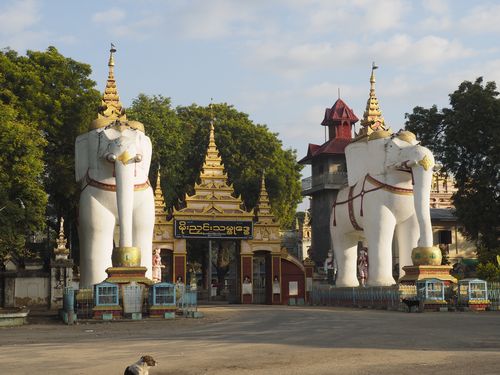
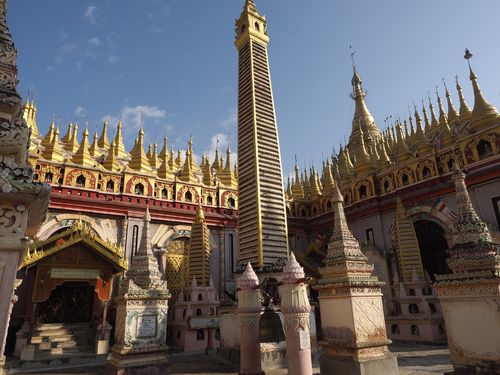
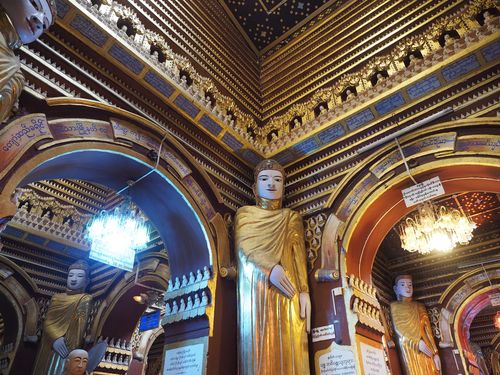
Monument profile
Thanboddhay Pagoda
Monument category: Pagoda
Monument family: Pagoda or stupa
Monument genre: Religious
Cultural heritage: Buddhist
Geographic location: Monywa • Myanmar
Construction period: 20th century AD
• Links to •
• List of videos about Monywa on this site •
Monywa, Thanboddhay pagoda • Myanmar
Monywa, Buddhas and more Buddhas • Myanmar
History of the Thanboddhay Pagoda: devotional ambition, wartime resilience and modern identity
The Thanboddhay Pagoda in Monywa, Myanmar, is a monumental expression of twentieth-century Buddhist devotion. Unlike the ancient imperial stupas of Bagan or Mandalay, it is a recent creation, conceived during a period of political upheaval and social uncertainty. Its history reflects the aspirations of a religious leader, the anxieties of a nation under colonial rule and war, and the desire of lay communities to shape a modern spiritual landmark grounded in traditional belief.
Origins, leadership and intent
The driving force behind the construction was a revered monk who envisioned a sanctuary capable of educating devotees through visual experience. Rather than relying on royal patronage, the project was funded by donations from followers across the region. This funding model reveals its social meaning: the pagoda was not a prestige monument for an individual ruler but a communal undertaking reflecting collective merit-making and lay involvement.
The chosen site was believed to carry spiritual memory, associated with earlier monastic presence. By selecting this location, the founder anchored the new monument in a perceived sacred landscape, while presenting it as a renewed expression of Buddhist continuity.
The pagoda’s overarching ambition was didactic. Its immense number of images and its internal organisation served the idea that devotion, repetition and immersion could facilitate learning. The construction thus articulated a spiritual programme as much as an architectural one.
Chronology and wartime significance
Construction began in 1939, on the eve of the Second World War. The project was launched during the final decade of colonialisation, when Burmese nationalism and Buddhist identity were intertwined. As fighting engulfed the region, the pagoda and its grounds became a refuge for civilians. The site therefore acquired meaning beyond symbolism: it functioned as a shelter and a space of psychological resilience.
Despite war, the building effort was not abandoned. Donations continued, volunteers worked onsite and the unfinished structure became a locus of prayer and protection. The completion of the pagoda in the early 1950s coincided with the country’s political transition toward independence. Its final consecration was interpreted locally as both a religious achievement and a sign of renewal after conflict.
Position in global and regional context
During the mid-twentieth century, new religious monuments emerged across Asia. Thailand, Sri Lanka, Japan and parts of China saw rebuilding programmes, expansions of monasteries and new structures intended for mass pilgrimage. Thanboddhay fits within this larger pattern: a modern creation using older formal languages but pursuing more immersive, visually saturated environments suited to popular devotion.
Whereas traditional Burmese pagodas emphasised singularity—a stupa as cosmic axis—Thanboddhay multiplied images and ornamental layers. This approach echoed contemporaneous developments elsewhere, such as the proliferation of iconography in Sri Lankan temple renovation or Thai mural revival movements. The pagoda therefore represents a regional shift toward spectacle, scale and accessible symbolism in Buddhist architecture.
Transformations and adaptations
Since its opening, the pagoda has undergone continual embellishment. Additional statues, stupas and painted surfaces have appeared over time, often funded by pilgrims seeking merit. The result is an evolving monument: its original forms have not been frozen but extended in response to devotional impulses.
The surrounding area also changed. Monywa expanded, and infrastructure around the pagoda grew. Market stalls, shelters, reception halls and administrative spaces were added, turning the complex into a multifunctional hub. It remains principally religious but also serves social, commercial and ceremonial functions.
Uses, practices and cultural meaning
Thanboddhay is central to the religious life of the region. Pilgrims come to meditate, to recite texts, to offer donations and to participate in seasonal festivals. The pagoda works as a visual scripture: thousands of Buddha statues line walls and niches, suggesting multiplicity of teachings and accessibility of enlightenment.
Its monumental density is interpreted by many Burmese as a statement of faith in abundance. Rather than an elite temple for a scholarly community, the pagoda represents a devotional landscape shaped by everyday believers. Public narratives emphasise humility, compassion and collective contribution, linking spiritual merit with architectural construction.
Beyond devotion, the pagoda became an emblem of identity for Monywa. Locally, it is presented as the city’s signature landmark, and nationally it is cited as proof that new sacred spaces can attain symbolic authority alongside ancient monuments.
Contemporary significance and tourism
In recent decades, the pagoda has attracted growing numbers of domestic and international visitors. Its unconventional appearance—saturated colours, repeated stupas and singular iconographic scale—has made it visually distinctive. Photography disseminated through tourism networks helped fix it in the national imagination.
This popularity produces tensions. Increased foot traffic strains the site; ornamental layers require regular repainting; internal surfaces accumulate wear. Managing visitors while preserving spiritual atmosphere has become an ongoing challenge for resident clergy and caretakers.
Conservation issues and debates
The monument’s fragility stems largely from its material vocabulary. Layers of paint, plaster and lightweight decorative components suffer under heat, rainfall and dust. Something of its architecture presumes continual maintenance: it was built as a living, adaptable environment rather than an immutable monument. The cycle of donation and repair is therefore constitutive of the pagoda’s meaning.
Urban encroachment, noise and pollution alter the surroundings. Measures have been taken to protect key structures, improve circulation and regulate vendors, but comprehensive conservation frameworks are difficult to implement without altering the monument’s lived character.
Discussion occasionally emerges around potential heritage inscription. Advocates point to its cultural significance and exceptional iconographic abundance; critics warn that rigid protection could stifle ritual flexibility and transform the sanctuary into a controlled exhibit. These debates illustrate the underlying paradox: Thanboddhay is valued because it is dynamic, evolving and communally owned, yet those same qualities complicate preservation.
Conclusion
The history of the Thanboddhay Pagoda exemplifies a distinct trajectory in Myanmar’s religious heritage. Conceived during a period of anxiety and transformation, it became a material refuge during wartime, then a statement of renewal after independence. Its construction outside royal patronage signalled a shift toward communal agency in sacred building. Its evolution through embellishment and use reflects a living monument shaped by practice rather than decree.
Today, Thanboddhay is at once a pilgrimage site, a civic emblem, a cultural spectacle and a fragile environment. It represents a modern expression of Buddhism—popular, immersive and visually overwhelming—whose historical meaning lies in the convergence of belief, community and aspiration.
Architecture of Thanboddhay Pagoda: density, repetition and modern Buddhist space
Thanboddhay Pagoda in Monywa is one of the most distinctive religious complexes in Myanmar, not because of a single dominant stupa, but through an overwhelming accumulation of volumes, colours and images. Built mainly in the mid-20ᵉ century, it translates a traditional Theravada vocabulary into an architecture of density, where every surface is mobilised for teaching and devotion. Its design combines conventional techniques in brick and concrete with a highly original spatial and iconographic programme.
Overall concept and architectural intent
The architectural concept of Thanboddhay departs from the isolated stupa model that characterises many classical Burmese sites. Instead, it is organised as a compact, rectilinear mass crowned by a central structure and surrounded by hundreds of smaller stupas arranged on terraces. The main block houses halls of worship and circulation corridors, while the outer layers form a kind of three-dimensional frame, punctuated by minor towers, spires and finials.
This composition creates an impression of a temple-palace rather than a single shrine. The eye is drawn from the horizontal spread of the base to the vertical thrust of the central mass, passing through successive belts of ornamented architecture. The idea is not only to mark a sacred centre, but to create an immersive environment in which the visitor is constantly confronted with symbols and images associated with the Buddha and his teaching.
Structural system, materials and techniques
Thanboddhay is a modern structure in technical terms. Its load-bearing system is largely composed of brick masonry and reinforced concrete, employed to form thick walls, pillars, floors and roofs that can support complex geometries and dense decoration. Concrete allows extended spans for roofed halls and galleries, while brick provides mass and thermal inertia.
The external surfaces are coated with plaster, sculpted and painted. This layered construction has several advantages: it gives a robust structural core, offers a smooth substrate for detailed ornament, and facilitates periodic renewal of finishes without altering the main fabric. Inside, walls are similarly plastered and then recessed with regular rows of niches designed to house small Buddha images. The niches are integral to the wall thickness, meaning that the structural and devotional functions are conceived together.
The use of these materials reflects the period of construction. Traditional timber structures would have been vulnerable to termites and fire, and more expensive to maintain at this scale. Brick and concrete made it possible to extend the complex both horizontally and vertically, and to carry the weight of tens or hundreds of thousands of small statues distributed throughout the building.
Spatial organisation and circulation
Spatially, the pagoda is organised as a sequence of courts, halls and corridors. Visitors enter from a forecourt that acts as a buffer between the urban environment and the sacred precinct. From this external platform, monumental portals lead into interior courtyards and then into the main worship halls.
The ground level is structured around large prayer halls where principal Buddha images are installed on raised platforms. From these central spaces, side aisles and corridors extend outward, each lined with niches containing rows of small statues. The experience of moving through the building is thus closely tied to the repeated encounter with these images, creating a rhythm of steps and glances.
Vertical circulation is ensured by staircases leading to upper galleries and terraces. The terraces are edged by rows of small stupas and miniature pavilions, offering viewpoints over the main structure and the surrounding landscape. In architectural terms, the complex functions like a layered shell: an inner core of halls, surrounded by corridors, then by terraces and minor stupas, all integrated in a continuous sequence.
Attention is given to ventilation and light. High openings, screened windows and occasional courtyards allow natural air circulation, essential in a hot climate. Light often enters indirectly, filtered through painted surfaces, so that the interior remains relatively cool while still bright enough to reveal the iconographic programmes.
Ornamentation, iconography and stylistic influences
The most striking feature of Thanboddhay is the density of its ornamentation. Almost every wall, pillar and surface is occupied by images, mouldings, painted motifs or small stupas. The exterior facades combine pilasters, cornices, friezes, pointed and curving pediments, as well as a multitude of small towers. This repertoire draws on Burmese pagoda traditions but is applied here with unusual intensity.
Inside, the repetition of Buddha statues in niches is the dominant feature. The figures vary in size and posture but are arranged in highly regular grids, sometimes covering entire walls from floor to ceiling. This repetitive scheme can be read as a visual metaphor for the countless manifestations of the Dhamma and the innumerable beings who can attain awakening. It also serves a didactic purpose: the visitor is literally surrounded by reminders of the Buddha at each step.
Stylistically, the pagoda combines traditional forms—guardian lions, lotus motifs, tiered spires—with a chromatic palette that is more vivid than in many older monuments. Strong tones of pink, orange, red, blue and gold are used in combination, producing a striking, almost graphic effect. This use of colour reflects both the availability of modern pigments and a contemporary taste for saturation and contrast in popular religious architecture.
Influences from other Buddhist cultures are subtle but present. Certain stupa forms and decorative details recall motifs found in Sri Lanka or Thailand, suggesting that the designers were aware of broader Theravada aesthetics. However, the overall composition remains firmly rooted in Myanmar’s own architectural language.
Structural particularities, dimensions and notable facts
Thanboddhay is not among the tallest pagodas in Myanmar, but it is remarkable for its footprint and volumetric complexity. The central structure rises over a broad base that occupies a significant portion of the site, and the cluster of secondary stupas gives the impression of a dense urban fabric at miniature scale.
One of the most frequently cited characteristics of the pagoda is the reported number of Buddha images—often described as several hundred thousand. Whatever the exact figure, the sheer quantity implies considerable organisational skill in designing and constructing the walls and niches to accommodate them. This mass repetition required not only religious motivation but also precise planning and standardisation of elements.
Another particularity is the presence of elevated viewing points or towers from which visitors can observe the entire complex. These vantage points demonstrate that the composition was conceived to be read both from within, through processional movement, and from above, as a geometric pattern of stupas and volumes.
International recognition and conservation challenges
Architecturally, Thanboddhay has contributed to the global image of modern Myanmar Buddhism. Its distinctive silhouette and richly patterned facades are frequently reproduced in travel literature and photography, identifying it as a unique example of twentieth-century religious architecture in the country.
This recognition, however, comes with conservation issues. The combination of painted plaster and exposed decorative elements makes the monument vulnerable to weathering. Heavy monsoon rains, strong sunlight, dust and increasing pollution gradually erode the finishes. Because much of the pagoda’s impact depends on its colours and the legibility of small details, maintaining these surfaces is critical.
The building’s design anticipates regular maintenance: plaster and paint can be renewed, damaged ornaments replaced, and statues restored. Yet the scale of the complex makes this an ongoing effort. Growing visitor numbers introduce additional stresses on floors, staircases and galleries. Managing these flows while preserving a sense of reverence is a constant concern for those responsible for the site.
Although not inscribed on the World Heritage List, Thanboddhay holds significant national importance. Any future protective status would need to balance stricter conservation protocols with the building’s character as a living, evolving place of worship.
Conclusion
The architecture of Thanboddhay Pagoda stands at the intersection of tradition and innovation. It employs familiar regional forms and techniques—brick, concrete, plaster, stupas and iconographic programmes—yet pushes them toward a new scale of visual and spatial intensity. Its design is less about singular monumental gesture than about immersive repetition, inviting visitors into a total environment shaped by countless images and layered volumes.
As a product of the twentieth century, the pagoda demonstrates how modern construction methods can serve vernacular religious aims. As a living complex, it shows how architecture, devotion and community participation continue to reshape one another over time.