

 Français (France)
  Nederlands (nl-NL)
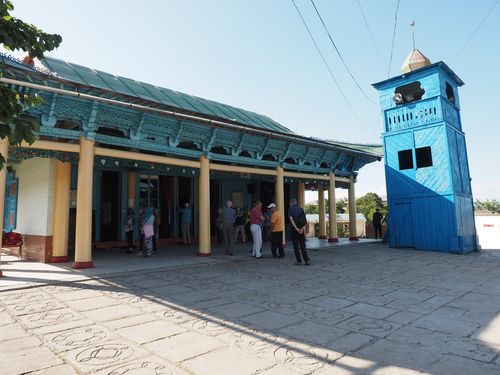
 The Dungan Mosque of Karakol, located in Karakol, Kyrgyzstan, is a religious building erected in the early twentieth century for the Dungan community, a Muslim population of Chinese origin settled in Central Asia. It stands as an important expression of the region’s cultural and religious diversity. The mosque remains active and serves as a place of worship for daily prayers and major Islamic celebrations. It also functions as a cultural landmark, reflecting the historical presence and continuity of the Dungan community within the broader social landscape of eastern Kyrgyzstan.
Monument profile
Dungan Mosque in Karakol
Monument category: Mosque
Monument family: Mosque, Minaret or Madrasa
Monument genre: Religious
Cultural heritage: Islamic
Geographic location: Karakol • Kyrgyzstan
Construction period: 20th century AD
• Links to •
• List of videos about Bishkek, Chuy Valley, Karakol, Issyk Kul lake on this site •
Kyrgyzstan • a republic in the heart of Central Asia
Dungan Mosque of Karakol
Historical Development of a Dungan Muslim Landmark in Central Asia
Located in Karakol, in eastern Kyrgyzstan, the Dungan Mosque stands as a significant historical monument reflecting migration, imperial governance, religious continuity, and post-Soviet cultural identity. Constructed between 1907 and 1910, the mosque embodies the collective aspirations of the Dungan community, a Muslim population of Hui origin that settled in Central Asia after fleeing late nineteenth-century unrest in Qing China.
Political and Social Context of Construction
The origins of the mosque are closely linked to the Dungan migrations that followed the suppression of the Hui uprisings in northwestern China between 1862 and 1877. After the defeat of rebel forces by the Qing dynasty, thousands of Hui Muslims crossed into territories controlled by the Russian Empire. The Semirechye region, including the Issyk-Kul basin, became one of the principal settlement areas for these refugees.
Karakol, founded in 1869 as a Russian military and administrative center, developed into a multiethnic urban environment. Russian settlers, Kyrgyz pastoral communities, Tatars, Uzbeks, and Dungans coexisted within an imperial framework that combined colonial oversight with limited communal autonomy. By the early twentieth century, Russian authorities had consolidated administrative control over Turkestan. Their policy toward Muslim populations was primarily pragmatic: religious institutions were tolerated if they contributed to social stability and did not promote political dissent.
Within this framework, the Dungan community sought to formalize its religious and social structures. The construction of a mosque symbolized permanence and institutional recognition. It provided a focal point for worship, education, and communal decision-making. Although no single sovereign patron initiated the project, local Dungan leaders and merchants played a decisive role in financing and organizing construction. The absence of overt rivalry surrounding its construction reflects the relative accommodation that characterized Russian governance in this frontier region during the period.
Global Context at the Time of Construction
The mosque was erected during a period of significant global transformation. The Russian Empire was expanding infrastructural and administrative networks in Central Asia, while the Qing dynasty in China faced mounting instability that culminated in the 1911 revolution. Across the Muslim world, imperial pressures and reform movements were reshaping religious and political institutions.
The Dungan Mosque can be situated within a broader pattern of minority communities constructing religious buildings to assert continuity amid imperial restructuring. In various parts of Eurasia, diasporic Muslim groups invested in mosques not only as places of worship but also as instruments of communal cohesion. The Karakol mosque thus formed part of a transregional phenomenon in which religious architecture served as a stabilizing force during periods of geopolitical transition.
Major Historical Events and Political Transformations
The Russian Revolution of 1917 and the subsequent establishment of Soviet authority transformed the political landscape of Central Asia. The incorporation of Kyrgyz territories into the Soviet system brought sweeping changes in governance, economic organization, and religious policy. During the 1920s and 1930s, Soviet anti-religious campaigns targeted mosques, churches, and other places of worship across the region.
Like many Islamic institutions, the Dungan Mosque experienced periods of closure and functional transformation. It was reportedly repurposed for secular uses during phases of intensified state atheism. While some religious buildings in Central Asia were demolished, the Karakol mosque survived, in part due to its distinct architectural character and its integration into the urban fabric.
The later Soviet decades witnessed a moderated approach to cultural heritage. By the mid-twentieth century, recognition of historically significant structures increased, even when their religious functions remained restricted. This shift allowed the mosque to be preserved as a cultural monument, though its religious role was limited until the late Soviet period.
Following the dissolution of the Soviet Union in 1991, Kyrgyzstan’s independence initiated a process of religious revival. The mosque was restored to active religious use, reflecting broader changes in state policy toward Islam and minority heritage.
Transformations and Urban Evolution
Over more than a century, the mosque has undergone structural maintenance and selective restoration. Modifications were implemented to stabilize foundations, protect wooden elements, and accommodate renewed religious activity. While the core structure remains intact, conservation interventions have aimed to balance historical authenticity with functional requirements.
The urban environment surrounding the mosque has evolved considerably. Karakol transitioned from a military outpost to a provincial administrative center and later to a tourism-oriented city. Urban expansion altered the immediate spatial context of the monument, yet it continues to function as a recognizable landmark within the cityscape.
Changes in infrastructure, road development, and nearby construction have influenced access patterns and visibility. Nevertheless, the mosque retains its historical orientation and communal significance.
Contemporary Role and Cultural Significance
Today, the Dungan Mosque operates both as a place of worship and as a symbol of Dungan heritage within Kyrgyzstan’s multicultural society. It hosts daily prayers and Islamic celebrations while also attracting visitors interested in the historical presence of the Dungan community.
In the broader national narrative, the mosque represents the coexistence of diverse ethnic and religious traditions. Kyrgyzstan’s post-independence identity incorporates elements of pluralism, and the preservation of minority heritage sites contributes to this framework. The mosque serves as a tangible reminder of the migratory histories that have shaped the region.
Conservation Status and Modern Challenges
The building is protected at the national level as a monument of historical and cultural importance. Although it is not inscribed on the UNESCO World Heritage List, it is frequently cited as one of Kyrgyzstan’s notable architectural landmarks.
Conservation challenges primarily relate to environmental factors. The region’s continental climate, characterized by cold winters and seasonal humidity fluctuations, affects wooden structures. Preventing moisture infiltration, insect damage, and structural fatigue requires ongoing monitoring and maintenance.
Urbanization and increased tourism also pose management challenges. Visitor flow must be balanced with the building’s primary religious function. Restoration policies emphasize preserving original materials and traditional construction techniques while ensuring structural safety.
The Dungan Mosque of Karakol thus reflects more than a century of political transition, communal adaptation, and cultural resilience. From its origins within the Russian imperial frontier to its role in contemporary Kyrgyz society, it embodies the intersection of migration history, state policy, and religious continuity in Central Asia.
Architectural Analysis of a Sino–Central Asian Islamic Structure
Constructed between 1907 and 1910 in Karakol, the Dungan Mosque represents a rare architectural synthesis in Central Asia: a fully wooden Islamic place of worship designed and executed according to Chinese structural traditions. Its architectural significance lies not in monumental scale but in the precision of its carpentry, the adaptation of East Asian construction techniques to an Islamic liturgical program, and the successful integration of a timber structure into the climatic conditions of the Issyk-Kul basin.
Technological and Architectural Innovations
The defining innovation of the mosque is its structural system. The entire superstructure was assembled without the use of metal nails. Instead, builders employed traditional Chinese carpentry techniques based on interlocking wooden joints—mortise-and-tenon connections, dowels, scarf joints, and layered bracket systems. This method allows controlled flexibility within the structure, enabling it to absorb minor seismic movements and thermal expansion without structural failure.
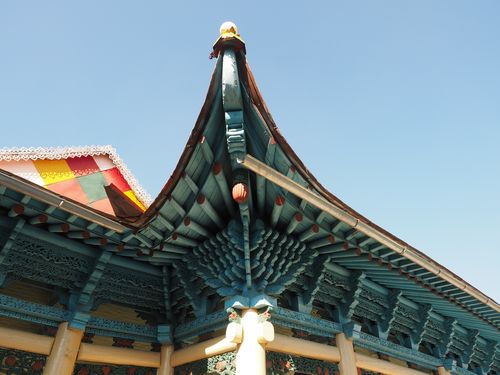
The load-bearing system consists of a post-and-beam frame. Vertical wooden columns transfer weight to a masonry foundation, while horizontal beams distribute loads toward the outer walls. Above this frame, a complex bracket system supports the tiered roof. These brackets, similar to East Asian dougong systems, function both structurally and decoratively. They redistribute roof weight and create projecting eaves that shield the walls from precipitation.
The decision to construct a mosque entirely of timber was exceptional in Central Asia at the beginning of the twentieth century. Islamic architecture in the region traditionally relied on fired brick and adobe. The Dungan Mosque introduced a building logic rooted in woodcraft rather than masonry engineering. This choice reflects technical continuity with Hui Chinese traditions while simultaneously adapting to local environmental conditions.
Ventilation and climate control were integrated into the design. Elevated foundations prevent ground moisture from affecting structural timber. Generous window openings provide cross-ventilation, particularly during summer months. Wide overhanging eaves protect façades from rain and snow, limiting deterioration. These features demonstrate a deliberate response to the continental climate characterized by cold winters and moderate seasonal humidity variations.
Materials and Construction Methods
Wood constitutes the primary construction material. Local timber, selected for durability and workability, was shaped and assembled using hand tools. The absence of iron fasteners reduces corrosion risk and eliminates points of structural weakness associated with metal expansion. The flexibility of wood allows for minor settlement without cracking.
The foundations are composed of stone and brick. This masonry base isolates the timber frame from soil moisture and provides structural stability. The combination of a mineral foundation and a wooden superstructure creates a hybrid system balancing durability and elasticity.
The roof structure consists of layered beams and rafters supporting sloping surfaces. Originally covered with lightweight materials, the roof design emphasizes drainage and snow displacement. Its multi-tiered configuration reduces structural load concentration. Each tier diminishes in size, distributing weight progressively downward.
Decorative elements were executed directly on wooden surfaces. Painted finishes protect timber while enhancing visual articulation. The use of mineral pigments and layered varnishes contributed to weather resistance. The preservation of painted ornament required periodic maintenance, demonstrating an awareness of material vulnerability.
For its time, constructing a building of approximately thirty meters in length using exclusively interlocking timber techniques required precise calculation of proportions. Structural equilibrium depends on exact alignment of columns and brackets. The achievement illustrates advanced mastery of carpentry geometry.
Architectural and Artistic Influences
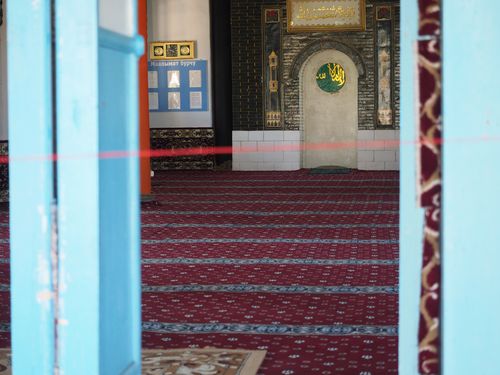
The mosque’s architectural language derives predominantly from Chinese building traditions. Its silhouette—characterized by layered roofs with upward-curving eaves—resembles temple architecture of northwestern China. However, its internal spatial orientation conforms strictly to Islamic requirements. The qibla wall defines the liturgical axis, and the prayer hall is arranged as an unobstructed rectangular space facilitating congregational worship.
This duality produces a hybrid architectural identity. The exterior may visually evoke a pagoda-like form, yet the functional organization remains unequivocally Islamic. The absence of a dominant central dome distinguishes it from typical Central Asian mosques of the same period.
Decorative programs combine geometric and vegetal motifs. Floral patterns reflect East Asian aesthetics, while arabesques correspond to Islamic ornamental traditions. The color scheme—red, green, yellow, and blue—aligns with Chinese symbolic palettes rather than the predominantly turquoise and brick tones associated with Central Asian Islamic monuments.
Carved columns display stylized vegetal forms rather than figurative imagery, respecting Islamic aniconism. The articulation of brackets and beams transforms structural elements into ornamental components. Decoration is inseparable from construction, reinforcing the unity between engineering and aesthetics.
Spatial Organization and Structural Features
The mosque’s principal space is a rectangular prayer hall capable of accommodating approximately one thousand worshippers. Interior support is provided by a regular grid of carved wooden columns. These columns define circulation pathways while preserving visual continuity toward the mihrab.
The entrance portico functions as a transitional zone between exterior and interior. Covered galleries along the perimeter protect walls and allow overflow during large gatherings. The hierarchical roof composition accentuates the central volume while maintaining horizontal emphasis.
A minaret was added later and differs stylistically from the primary structure. It introduces a vertical marker without dominating the composition. Unlike monumental minarets of brick-built mosques, this element remains modest in scale.
The building measures roughly 30 meters in length and 15 meters in width. The maximum height at the roof ridge approaches 12 meters. The ratio between width and height enhances structural stability and prevents excessive wind pressure on the roof surfaces.
One notable structural characteristic is the layered bracket system beneath the eaves. Each bracket tier transfers load inward while creating shadow lines that accentuate depth. This articulation also limits direct solar exposure to the walls.
Statistical and Anecdotal Aspects
The mosque’s construction reportedly involved several dozen skilled artisans working over a three-year period. Oral tradition attributes the design to a master builder trained in Chinese carpentry techniques. The precision of joinery without metal reinforcement remains one of the most cited technical achievements.
It is frequently stated that no nails were used in the primary structural framework. While minor metallic elements may have appeared in later repairs, the original system relied exclusively on wooden joints.
The integration of polychrome decoration required specialized pigment preparation. Some colors faded over time due to ultraviolet exposure, prompting restoration campaigns in the late twentieth and early twenty-first centuries.
International Recognition and Conservation Challenges
Architecturally, the mosque contributes to global awareness of cross-cultural building traditions. It is recognized nationally as a protected historical monument. Although not inscribed on the UNESCO World Heritage List, it is often highlighted in discussions of Central Asian heritage.
Conservation challenges are primarily material. Timber is susceptible to moisture, fungal growth, and insect infestation. Seasonal freeze-thaw cycles stress both wooden and masonry components. Preservation requires continuous inspection of joints and protective coatings.
Urban expansion in Karakol has altered the building’s immediate surroundings. Increased tourism necessitates management strategies balancing visitor access with religious function. Protective policies prioritize maintaining original structural systems rather than replacing them with modern materials.
The Dungan Mosque of Karakol stands as an exceptional example of wooden Islamic architecture in Central Asia. Its architectural significance resides in its structural ingenuity, its synthesis of Chinese carpentry with Islamic spatial requirements, and its endurance within a changing urban and political environment.