

 Français (France)
  Nederlands (nl-NL)
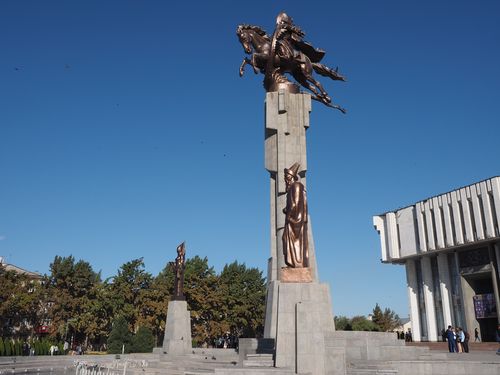
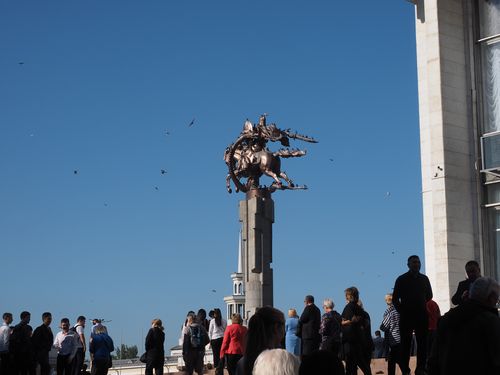
 The Manas statue in Bishkek, the capital of Kyrgyzstan, is a prominent monument honoring the epic hero Manas, a central figure in Kyrgyz oral tradition. Unveiled in 2011 to mark the country’s twentieth anniversary of independence, the statue depicts Manas on horseback, raising a sword as a symbol of protection and national unity. It is located on Ala-Too Square, a major site for public gatherings and official ceremonies. The statue replaced a former monument to Lenin and reflects efforts to strengthen Kyrgyz national identity through significant historical and cultural figures.

Bishkek • Manas Statue
Bishkek • Manas Statue
Bishkek • Manas Statue
Monument profile
Manas Statue
Monument category: Memorial monument
Monument family: Monument for cultural purposes
Monument genre: Cultural or scientific
Geographic location: Bishkek, Chuy Valley, Karakol, Issyk Kul lake • Kyrgyzstan
Construction period: 21th century AD
• Links to •
• List of videos about Bishkek, Chuy Valley, Karakol, Issyk Kul lake on this site •
Kyrgyzstan • a republic in the heart of Central Asia
The Manas Statue in Bishkek: A Monumental Symbol of Kyrgyz National Identity
The Manas Statue, erected in 2011 on Ala-Too Square in Bishkek, Kyrgyzstan, stands as a powerful emblem of the country’s national identity in the post-Soviet era. Far more than a simple commemorative monument, it reflects a deliberate effort by the Kyrgyz state to root its national narrative in an indigenous cultural heritage, symbolized by the legendary figure of Manas. This equestrian statue, depicting the epic hero with sword raised, encapsulates political aspirations, social transitions, and cultural assertions at a pivotal moment in the country’s modern history.
Political and Social Context of Construction
The construction of the Manas Statue was initiated in the context of the 20th anniversary of Kyrgyzstan’s independence from the Soviet Union, declared on August 31, 1991. In the two decades following independence, Kyrgyzstan underwent a tumultuous process of political restructuring, economic liberalization, and identity formation. The early post-Soviet years were marked by social unrest, economic instability, and a search for new symbols to unify the nation.
Manas, the central figure of an eponymous oral epic considered one of the longest in the world, emerged as the perfect embodiment of Kyrgyz heroism, unity, and endurance. His story—of battles, alliances, and the forging of a Kyrgyz nation—resonated with contemporary concerns over national cohesion and political legitimacy. In this light, the decision to erect a statue of Manas on the most prominent square in the country was both a cultural affirmation and a political gesture.
The project was championed by then-President Roza Otunbayeva, the first woman to lead the nation and a transitional figure following the 2010 revolution that had ousted President Kurmanbek Bakiyev. Otunbayeva’s administration viewed the monument as part of a broader strategy to redefine the public space of the capital, remove vestiges of Soviet domination, and promote symbols with deep roots in local traditions.
The statue replaced a monument of Vladimir Lenin, which had stood on Ala-Too Square (formerly Lenin Square) since Soviet times. The removal of Lenin's statue in 2003 and its relocation to a less prominent location set the stage for a symbolic transformation of the national narrative, shifting the visual rhetoric of power from Soviet legacy to indigenous identity.
Historical Events Associated with the Site
Ala-Too Square has been the epicenter of numerous major political events in Kyrgyzstan's recent history. It was the main site of mass protests and regime changes during the Tulip Revolution in 2005 and the April Revolution in 2010. These events, both of which resulted in the ousting of authoritarian presidents, underscored the square’s role as a place of popular sovereignty and civic expression.
While the Manas Statue itself was erected after these pivotal moments, its placement in this historically charged location reinforces its symbolic role as a unifier. By placing a national cultural hero at the heart of a space associated with democratic struggle, the state sought to bridge tradition and modern political aspiration.
Global Context of Monumental Construction
The Manas Statue is part of a broader global trend of monumental nation-building in the early 21st century, particularly in post-colonial and post-imperial contexts. Similar projects include the giant statue of Genghis Khan in Mongolia (completed in 2008), the Motherland Monument in Kazakhstan, and the proliferation of national monuments in post-Soviet states such as Uzbekistan and Azerbaijan.
These initiatives reflect an international movement to assert sovereignty through monumental symbolism, often rooted in epic traditions or founding myths. The Manas Statue thus aligns with a wave of culturally anchored constructions that aim to reconfigure public space as an expression of national pride and continuity, especially in states emerging from a shared imperial legacy.
Transformations and Changes Over Time
Since its inauguration in 2011, the Manas Statue has not undergone any major architectural modifications. However, its surrounding environment has evolved. Urban planning initiatives have transformed Ala-Too Square into a more pedestrian-friendly space, integrating gardens, fountains, and public amenities that enhance the monument’s accessibility and visual impact.
Lighting installations have been added to highlight the statue’s silhouette during nighttime hours, and surveillance systems were implemented to ensure its protection in a high-traffic public area. The statue remains untouched by vandalism or political re-appropriation, indicating a broad acceptance across the political spectrum.
In terms of function, the statue has moved beyond its initial commemorative purpose. It now serves as a site for national celebrations, cultural performances, and even peaceful demonstrations. It has become a meeting point for locals and a must-see for tourists, symbolizing its integration into the social fabric of the capital.
Contemporary Role and Cultural Significance
In modern Kyrgyz society, the Manas Statue plays a pivotal role in shaping and reinforcing national identity. Manas, as a cultural figure, represents not only a heroic past but also a vision of unity, leadership, and moral strength. These values are frequently invoked in political discourse, educational programs, and public ceremonies.
The statue is central to events marking Independence Day on August 31 and Manas Day, celebrated annually to honor the epic’s cultural importance. These events include public readings of the Manas Epic by manaschi (traditional storytellers), musical performances, and displays of traditional Kyrgyz sports and attire.
Moreover, the statue contributes to the branding of Bishkek as a cultural capital, used in promotional materials and tourism campaigns. It is featured on postcards, government websites, and educational posters, further embedding its image in the collective consciousness.
Conservation Status and Preservation Challenges
The Manas Statue is in good structural condition, largely due to the use of durable materials such as bronze and granite and the implementation of modern engineering techniques during its construction. Routine maintenance by the city of Bishkek includes cleaning, anti-corrosion treatment, and structural inspection.
However, challenges remain. The statue is exposed to harsh weather fluctuations, including freezing winters and hot, dry summers, which can affect the expansion and contraction of its metal components. Air pollution, particularly in the winter months due to coal heating, poses a long-term threat to the bronze surface. Urban expansion and traffic congestion around Ala-Too Square also increase the risks of environmental degradation.
Currently, the monument does not benefit from international heritage status, such as inclusion on the UNESCO World Heritage List. Nevertheless, it is recognized as a national cultural asset, protected under Kyrgyzstan’s legislation on historical monuments. Discussions have occasionally emerged about establishing a broader heritage zone encompassing Ala-Too Square, which would provide additional safeguards and recognition.
Architectural Analysis of the Manas Statue in Bishkek, Kyrgyzstan
The Manas Statue, unveiled in 2011 on Ala-Too Square in the heart of Bishkek, Kyrgyzstan, is not only a cultural and political symbol but also a significant achievement of contemporary monumental architecture in Central Asia. Designed to commemorate the 20th anniversary of Kyrgyz independence, the statue integrates modern construction technologies with traditional artistic forms to create a powerful visual and spatial landmark. The monument’s architectural and structural features, choice of materials, stylistic influences, and integration into the urban fabric all contribute to its enduring significance.
Technological and Architectural Innovations of the Period
The construction of the Manas Statue reflects the application of 21st-century technologies within a context deeply rooted in historical tradition. The use of Computer-Aided Design (CAD) allowed sculptors and engineers to conceptualize a dynamic equestrian figure with precise anatomical proportions and controlled weight distribution. This digital modeling facilitated the creation of a sculpture that balances visual drama with structural integrity.
To ensure the monument’s stability in a region prone to seismic activity, advanced earthquake-resistant engineering was employed. The statue is anchored to a reinforced concrete foundation designed to absorb lateral forces and prevent torsional stress. The internal metal framework of the statue—composed of corrosion-resistant stainless steel—supports the bronze exterior and guarantees durability against strong winds and seasonal temperature shifts. A passive ventilation system was discreetly incorporated into the pedestal, allowing moisture and heat to dissipate naturally and minimizing the risk of internal condensation that could accelerate structural degradation.
Urbanistically, the placement of the statue was calculated to maximize visibility from key approaches to Ala-Too Square. Its axial alignment with the surrounding government buildings and the national flagpole further integrates it into the symbolic center of the capital. The statue serves not only as a cultural marker but also as a spatial organizer, redefining pedestrian circulation and the visual hierarchy of the square.
Materials and Construction Methods
The statue itself is cast in bronze, chosen for its longevity, resistance to corrosion, and aesthetic qualities. Bronze also allows for high-resolution detailing, essential for capturing the intricate elements of Manas’s armor, facial expression, and the musculature of the horse. The casting process was based on the lost-wax technique, adapted for monumental scale. The statue was produced in segments—each section molded, cast, and then assembled on-site using precision welding.
The internal support system is a steel armature, engineered to sustain both static weight and dynamic stresses such as wind and seismic motion. Special care was taken to isolate the bronze shell from direct contact with the steel frame to prevent galvanic corrosion.
The pedestal is constructed from polished red granite, quarried locally to highlight national materials and to harmonize with regional aesthetic preferences. Granite’s natural density and low porosity make it ideal for outdoor monuments exposed to extreme weather conditions. The stone base also contributes to the overall mass of the structure, lowering the center of gravity and increasing stability.
The surrounding pavement was repaved with non-slip stone tiles, forming geometric patterns that echo Kyrgyz textile designs. This subtle integration of cultural motifs into architectural features underscores the monument’s symbolic richness.
Architectural and Artistic Influences
The design of the Manas Statue blends nomadic heritage, Soviet monumentalism, and classical equestrian statuary. The statue’s form—a warrior on horseback brandishing a sword—is a direct reference to traditional depictions of Central Asian and Eurasian military leaders, such as Tamerlane or Genghis Khan, while also resonating with equestrian monuments found across Europe and Russia.
The stylistic execution, however, diverges from the rigid symmetry and didactic realism characteristic of Soviet-era sculpture. Instead, the Manas figure exhibits dynamic movement, with flowing garments, a raised sword, and a forward-leaning posture that suggest action rather than static commemoration. This motion, frozen in bronze, reflects a shift toward more expressive and individualized forms in post-Soviet public art.
Ornamentation on the figure draws heavily from Kyrgyz visual culture. Manas’s attire is adorned with motifs that reference yurt patterns, animal horns, and sun symbols, all of which hold cultural and spiritual meaning. These design choices not only anchor the figure within a local tradition but also distinguish it from generic heroic statuary.
The influence of classical equestrian monuments is apparent in the elevated pose of the horse, whose raised foreleg indicates readiness for battle. However, unlike the Roman tradition where such poses often denote death or survival of the rider, in this case, the posture is symbolic of heroism and national unity, tailored to the Kyrgyz mythological context.
Organization and Spatial Layout
The monument reaches a total height of 17 meters, with the statue alone measuring approximately 7 meters, and the pedestal rising an additional 10 meters. The dimensions are carefully calibrated to ensure both prominence and integration within the existing skyline of the square.
The pedestal features a square base with slightly beveled edges, evoking stability and monumentality. Its sides are embellished with bas-reliefs and engraved panels, each depicting scenes from the Manas epic or traditional Kyrgyz motifs. These decorative elements not only provide narrative context but also create tactile surfaces that engage viewers physically and visually.
The statue is oriented northeast, symbolizing progress and the awakening of the nation, a deliberate contrast to the west-facing Lenin statue it replaced. The orientation also frames it within the urban axis of Ala-Too Square, ensuring uninterrupted sightlines for visitors approaching from the main avenue.
The surrounding site is designed without railings or barriers, reflecting a democratic openness and allowing people to gather closely around the monument. Steps and ramps facilitate access from all directions, reinforcing the statue’s role as an inclusive civic landmark.
Notable Statistics and Anecdotes
In terms of scale and complexity, the Manas Statue ranks among the largest equestrian monuments in Central Asia. Its sword alone measures over 3 meters in length, symbolizing the protective power of Manas over the nation.
The entire construction process—from commission to completion—was completed in under 24 months, an ambitious timeline made possible through collaboration between Kyrgyz artists and regional foundries, including specialists from Kazakhstan and Russia.
A popular local anecdote suggests that a time capsule was sealed inside the pedestal, containing a copy of the Kyrgyz constitution and excerpts from the Manas epic. Although never officially confirmed, the rumor contributes to the monument’s mythos and public intrigue.
International Recognition and Conservation Challenges
Although not yet part of any UNESCO World Heritage listing, the Manas Statue is officially designated as a national cultural asset. It is considered a key element in the symbolic topography of Bishkek and plays an important role in national representation.
Its architectural integrity remains strong, thanks to regular maintenance conducted by the Bishkek municipality. This includes seasonal cleaning, inspection of weld joints, and anti-corrosion treatments. However, urban pollution, particularly smog from coal heating in winter, poses a long-term risk to the bronze patina.
Moreover, the seismic vulnerability of the region remains a structural concern, necessitating ongoing monitoring of the pedestal and support frame. The absence of protective canopies or drainage systems exposes the granite base to rainwater and freezing conditions, which could lead to gradual erosion over decades.
Plans to enhance the monument’s protection include proposals for a wider cultural heritage zone around Ala-Too Square and the integration of the statue into national educational programs and international cultural itineraries.
Conclusion
The Manas Statue is not only a monumental sculpture but also a multilayered architectural and cultural achievement. It synthesizes modern engineering, traditional craftsmanship, and symbolic narrative into a single edifice that reflects the aspirations and identity of a young nation. Its design, materials, and urban integration make it a defining feature of Bishkek’s cityscape and a lasting tribute to Kyrgyz heritage.