

 Français (France)
  Nederlands (nl-NL)
 The Tonnara of Vendicari, located within the Vendicari Nature Reserve in Sicily, Italy, is a former tuna fishery. Established in the 17th century, it was primarily used for catching and processing tuna, a key economic activity in the area at that time. With the decline of the tuna industry in the 20th century, the tonnara was abandoned. Today, it is part of a protected area that attracts visitors for both its historical heritage and its rich wildlife and vegetation. The main building, now in ruins, showcases the industrial architecture of its era and is a point of interest for both history and nature enthusiasts.

Vendicari • Tonnara of Vendicari

Vendicari • Tonnara of Vendicari
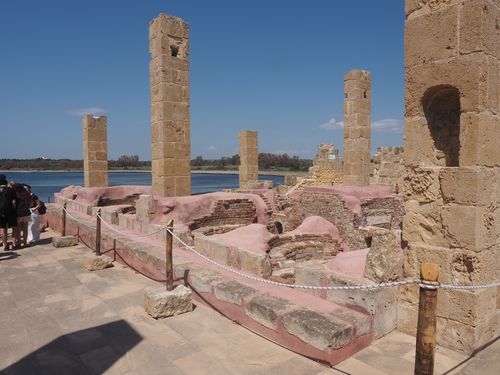
Vendicari • Tonnara of Vendicari
Monument profile
Tonnara of Vendicari
Monument category: Factory
Monument family: Civil engineering structures (bridges, wells, etc.) and factories
Monument genre: Economic
Geographic location: Vendicari, Marzamemi • Sicily • Italy
Construction period: 15th century AD
• Links to •
• List of videos about Vendicari, Marzamemi on this site •
Vendicari and Marzamemi, Sicily • Italy
History of the Tonnara di Vendicari
Political and Social Context of Construction
The Tonnara di Vendicari, located in the Vendicari Nature Reserve in Sicily, Italy, was constructed in the 17th century. This period was marked by intense socio-political dynamics in Sicily, under Spanish rule as part of the broader Spanish Empire. The construction of the tonnara was driven by the economic imperative to exploit the rich tuna fisheries of the Mediterranean, reflecting the broader ambitions of the Spanish crown to bolster economic returns from its territories. The tonnara was also a strategic asset, situated on the maritime routes crucial for trade and military movements. The establishment of such a facility was influenced by the rivalries and alliances typical of the Mediterranean maritime powers, often leading to conflicts and necessitated fortified structures that could withstand attacks and serve dual purposes—both commercial and defensive.
Major Historical Events Impacting the Site
Throughout its operational history, the Tonnara di Vendicari faced numerous upheavals. These included pirate raids and naval skirmishes which were common in the Mediterranean, impacting its production and operations. The changing political landscape, especially during the transitions between Spanish, Austrian, and eventually Italian rule, influenced its management and state of repair. Post-Italian unification in the 19th century, a decline in traditional tuna fishing practices led to the gradual abandonment of the facility, with significant implications for the local economy and community.
Global Context at the Time of Construction
During the 17th century, similar facilities were being constructed across the Mediterranean as part of a broader trend towards exploiting marine resources and expanding maritime commercial networks. The tonnara was part of a wider architectural and economic movement that included the development of fish processing facilities from the Atlantic coasts of Spain and Portugal to the coasts of North Africa.
Transformations of the Monument
Originally built for the industrial processing of tuna, the architecture of the Tonnara di Vendicari included features such as large storage rooms, processing areas, and lookout towers for spotting schools of tuna. Over the centuries, it underwent modifications that adapted its structures to changing fishing technologies and the declining profitability of tuna fisheries. The 20th century saw its complete abandonment, after which the structure fell into ruin. Restoration efforts began late in the century, focusing on preserving it as a cultural and historical artifact rather than reinstating its original function.
The Monument's Role and Cultural Significance Today
Today, the Tonnara di Vendicari is an important historical site within the Vendicari Nature Reserve, attracting tourists and scholars interested in the history of Mediterranean maritime industries. It serves as a poignant reminder of the human interaction with the Mediterranean sea and its resources. Locally and nationally, it is a symbol of cultural heritage, reflecting the historical fishing practices and the socio-economic conditions of its operational periods. No religious or social celebrations are directly associated with the site today, but it plays a significant role in the cultural tourism of the region.
Current Conservation Status and Modern Preservation Challenges
The Tonnara di Vendicari faces several modern preservation challenges, including environmental threats from coastal erosion and climate change, pressures from tourism, and the need for sustainable management practices within the reserve. The site is not a UNESCO World Heritage Site, but it is protected under Italian and European Union conservation statutes which aim to maintain its historical integrity and ensure its survival for future generations.
Architectural Analysis of the Tonnara di Vendicari
Technological and Architectural Innovations
The Tonnara di Vendicari, located in the Vendicari Nature Reserve in Sicily, represents a significant architectural achievement of the 17th century. Its construction utilized advanced masonry techniques reflective of the era's architectural prowess. Key to its design were innovations in structural stability and ventilation, critical for its primary use in tuna processing. The builders integrated features that optimized air flow to cool the storage areas naturally, essential for preserving the freshness of the catch in the pre-refrigeration age. The use of locally quarried stone provided not only durability against the harsh coastal environment but also contributed to the thermal mass, which helped maintain stable indoor temperatures.
Materials and Construction Methods
The primary materials used in the Tonnara di Vendicari were stone and wood, chosen for their availability and durability. Stone was the main structural component, providing robustness to the walls and foundations, while wood was utilized for beams and roofing structures. These materials were not only practical but also aesthetically pleasing, giving the building a rustic yet formidable appearance. The construction techniques were innovative for the time, involving complex stonemasonry skills that ensured the building could withstand the coastal elements and the test of time.
Architectural and Artistic Influences
The architecture of the Tonnara di Vendicari showcases a blend of local Sicilian and broader Mediterranean influences. The design incorporates elements typical of coastal industrial structures of the period, such as thick walls and small windows, which were strategic for security and temperature control. Artistic influences can be seen in the subtle decorations and the utilitarian yet elegant simplicity of the building's façade, reflecting the functional nature of its use while still conforming to the aesthetic standards of the period.
Organization and Structure
The spatial arrangement of the Tonnara di Vendicari was primarily dictated by its industrial function. The main building was accompanied by several smaller structures, including storage areas and workers' quarters, organized to facilitate the efficient flow of materials and personnel. Notable design elements include the large arches and robust columns that supported the infrastructure while providing the necessary space for processing and storage of the tuna. The integration of these elements into the building's design was not only practical but also enhanced its architectural integrity.
Notable Statistics and Anecdotes
The Tonnara di Vendicari covers an impressive area, reflecting its importance in the local economy as one of the primary tuna processing facilities in Sicily. A notable aspect of its construction is the attention to detail in the craftsmanship, with each stone carefully shaped and placed. While there are no specific legends about its construction, the tonnara is steeped in the oral histories of the local communities, often linked to tales of the hard lives of the tuna fishermen who once worked there.
International Recognition and Conservation Challenges
While the Tonnara di Vendicari is not listed as a UNESCO World Heritage Site, it is recognized within Italy and by conservationists globally for its historical and architectural significance. The current conservation efforts focus on maintaining the structural integrity of the building in the face of challenges such as coastal erosion and the impacts of climate change. The preservation of the tonnara is crucial, not only as a cultural and historical artifact but also as a part of the heritage of Sicilian maritime architecture.
The Tonnara di Vendicari remains a testament to the ingenuity of its original builders and the enduring value of preserving historical structures. Its architecture offers insight into the technological advancements of the time and the socio-economic context of Sicily's maritime industries. Today, it stands as a cultural landmark, attracting visitors interested in the architectural and historical narratives of the Mediterranean region.