

 Français (France)
  Nederlands (nl-NL)
 The Church of Our Lady of the Immaculate Conception, located in Old Goa in the Indian state of Goa, is a prominent religious monument from the Portuguese period. It reflects the enduring establishment of Catholicism in the region and the historical importance of Goa within the wider colonial framework in Asia. Dedicated to the Immaculate Conception, the church remains an active place of worship and a significant landmark. Owing to its visibility and continued use, it plays an important role in local religious life and in Goa’s cultural heritage.
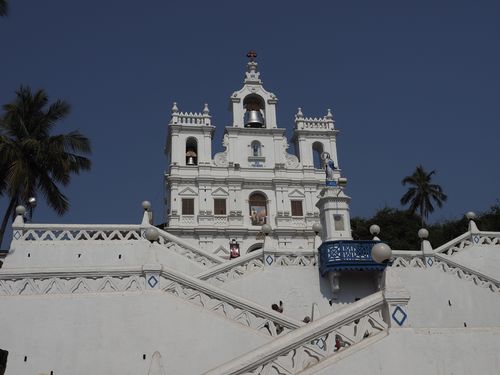
Old Goa City • Our Lady of the Immaculate Conception
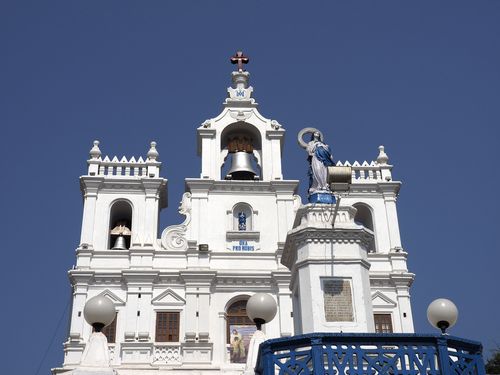
Old Goa City • Our Lady of the Immaculate Conception
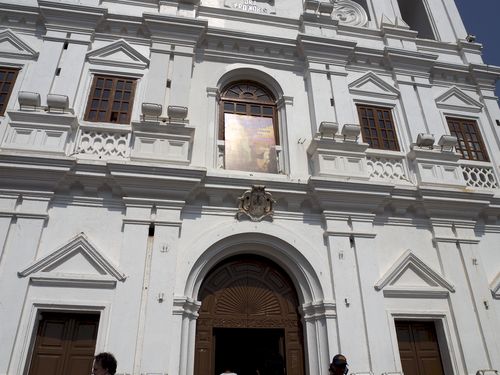
Old Goa City • Our Lady of the Immaculate Conception
Monument profile
Our Lady of the Immaculate Conception
Monument category: Basilica
Monument family: Church, cathedral, basilica, chapel
Monument genre: Religious
Cultural heritage: Christian
Geographic location: Old Goa City, Panaji, Chandor, Candolim • Goa • India
Construction period: 17th century AD
This monument in Old Goa City is inscribed on the UNESCO World Heritage List since 1986 and is part of the serial property "Churches and Convents of Goa".See the UNESCO monuments featured on this site
• Links to •
• List of videos about Old Goa City, Panaji, Chandor, Candolim on this site •
Goa • A piece of Portugal in India
History of the Church of Our Lady of the Immaculate Conception, Old Goa
The Church of Our Lady of the Immaculate Conception in Old Goa forms part of the wider historical landscape shaped by the Portuguese presence in India from the early sixteenth century onward. Its development reflects the political ambitions of the Portuguese Crown, the consolidation of Catholic institutions in Asia, and the gradual transformation of Goa from imperial capital to heritage site. The church’s history is inseparable from the rise and decline of Old Goa itself.
Political and Social Context of Construction
Following the conquest of Goa in 1510 by Afonso de Albuquerque, the city became the capital of the Estado da Índia, the administrative and ecclesiastical centre of Portuguese territories in Asia. The establishment of churches was both a spiritual and political priority. Religious architecture symbolised Christian sovereignty, reinforced colonial authority, and structured urban space according to European models.
Devotion to the Immaculate Conception held particular importance in Portuguese religious culture. By the seventeenth century, the Immaculate Conception was proclaimed patroness of Portugal, strengthening the ideological association between the monarchy and Marian devotion. The dedication of a church in Old Goa to this title was therefore consistent with broader imperial religious policy.
Socially, the church served a mixed population composed of Portuguese settlers, Luso-Indian families, merchants, converts, and local communities integrated into the colonial framework. It functioned as a parish church, providing baptisms, marriages, funerals, and liturgical celebrations that structured daily life. Confraternities and lay brotherhoods contributed to its maintenance, reflecting the integration of civic and religious authority.
The construction and subsequent enlargements were supported by colonial officials, ecclesiastical authorities, and private benefactors. Rivalries among religious orders and the desire of parishes to assert their prominence within the urban hierarchy also influenced the development of the building.
Major Historical Events
During the sixteenth and seventeenth centuries, Old Goa flourished as a commercial and missionary hub. Although the church itself was not the site of military engagements, it stood within a city periodically threatened by Dutch naval forces and regional political instability. Defensive measures implemented across Goa shaped the broader urban environment in which the church operated.
In the eighteenth century, epidemics and environmental challenges severely affected Old Goa’s population. Recurrent outbreaks of disease led to demographic decline and the gradual relocation of administrative functions to Panaji. As the political centre shifted, the church’s immediate urban surroundings changed, and its prominence within civic life diminished.
The nineteenth century brought liberal reforms in Portugal that altered the relationship between Church and state. Ecclesiastical properties were reorganised, and the institutional framework governing parishes evolved. After the integration of Goa into the Republic of India in 1961, the church continued to function as a place of Catholic worship under Indian jurisdiction. Political sovereignty changed, but religious continuity remained.
Over time, maintenance campaigns addressed structural deterioration caused by climate and age. These interventions formed part of broader efforts to preserve Old Goa’s ecclesiastical monuments.
Global Context at the Time of Construction
The church’s development occurred during the era of the Catholic Reformation. Following the Council of Trent (1545–1563), parish organisation and doctrinal clarity became central priorities. Churches were designed to emphasise visibility of the altar, clarity of preaching, and reinforcement of sacramental practice.
Globally, European empires were constructing monumental religious buildings in colonial cities across the Americas, Africa, and Asia. Old Goa emerged as one of the principal Christian centres east of the Cape of Good Hope. The Church of Our Lady of the Immaculate Conception formed part of a network of Marian dedications that extended throughout the Portuguese world.
Thus, the monument belongs to a broader movement of ecclesiastical urbanism in which religious buildings articulated imperial identity, missionary ambition, and theological orthodoxy.
Transformations and Urban Evolution
The church underwent phases of enlargement and remodelling, reflecting both demographic growth and evolving aesthetic preferences. Adjustments to the façade and interior arrangements enhanced its visual prominence and accommodated liturgical developments.
As Old Goa declined in population, the church’s function shifted from that of a central parish in a thriving capital to one of several historic monuments in a city defined increasingly by memory rather than administration. Urban contraction altered the surrounding built environment, leaving ecclesiastical structures as primary visual markers of the past.
Restoration efforts during the late nineteenth and twentieth centuries addressed damage caused by monsoon rains, humidity, and biological growth. Conservation policies gradually aligned with emerging heritage standards.
Contemporary Role and Cultural Significance
Today, the church remains an active place of worship. The Feast of the Immaculate Conception, celebrated on 8 December, continues to draw congregants and visitors. Liturgical services reinforce its role within the Catholic community of Goa.
Beyond religious practice, the monument contributes to regional identity. Goa’s cultural landscape reflects centuries of interaction between South Asian traditions and Portuguese influence. The church embodies this layered history and serves as a visible reminder of the territory’s colonial past.
Nationally, it forms part of India’s diverse architectural heritage, representing a chapter in the subcontinent’s engagement with European maritime expansion. Its presence within the ensemble of Old Goa enhances its historical resonance.
Conservation Status and Modern Challenges
The tropical climate remains a principal conservation challenge. Heavy rainfall, humidity, and temperature fluctuations accelerate material decay. Continuous maintenance is necessary to prevent structural weakening and surface deterioration.
Tourism constitutes both an opportunity and a risk. While visitor interest supports awareness and funding for preservation, excessive foot traffic can strain historic fabric. Management strategies seek to balance accessibility with protection.
The church stands within the broader group of monuments of Old Goa recognised as a UNESCO World Heritage Site. This designation underscores its universal historical significance and entails adherence to international conservation standards.
Conclusion
The history of the Church of Our Lady of the Immaculate Conception in Old Goa reflects the ambitions of the Portuguese empire, the consolidation of Catholic institutions in Asia, and the gradual transformation of Goa’s urban landscape. Constructed in a context of imperial expansion and religious affirmation, it adapted to demographic shifts, political transitions, and environmental pressures. Today, it remains both a functioning parish church and a key element of Goa’s historical identity, linking early modern global dynamics with contemporary cultural heritage.
Architecture of the Church of Our Lady of the Immaculate Conception, Old Goa
The Church of Our Lady of the Immaculate Conception in Old Goa represents a significant example of Portuguese colonial ecclesiastical architecture in South Asia. Its present form reflects successive building campaigns between the sixteenth and seventeenth centuries, combining European liturgical principles with local construction practices and climatic adaptation. The monument stands as both an architectural statement of Catholic orthodoxy and a technical response to the environmental conditions of the Konkan coast.
Technological and Architectural Innovations
The church follows a longitudinal plan centred on a single nave terminating in a chancel. This arrangement corresponds to post-Tridentine liturgical reforms, which required unobstructed visibility toward the high altar and emphasised congregational participation through preaching and sacramental clarity. The spatial configuration eliminates structural fragmentation, reinforcing axial focus.
Load-bearing walls of considerable thickness ensure structural stability, particularly under the stress of monsoon rains and fluctuating humidity. The masonry system, based on carefully bonded blocks, distributes vertical loads efficiently while resisting lateral pressure from high winds. The façade is organised into clearly articulated horizontal registers and vertical divisions, producing structural coherence alongside visual hierarchy.
A major innovation lies in the monumental staircase leading to the main entrance. Designed as a multi-tiered, symmetrical composition, it addresses both topographical constraints and ceremonial function. The elevation of the church above street level reduces exposure to flooding while creating a visual axis that enhances monumentality. The stepped configuration distributes weight across the slope and stabilises the platform supporting the façade.
Ventilation is achieved through high-set windows and lateral openings, allowing cross-breezes to circulate within the nave. This passive climatic control mitigates interior heat accumulation and reduces moisture retention. The integration of such features demonstrates adaptation of European models to tropical conditions.
Materials and Construction Methods
The primary construction material is laterite stone, locally abundant and workable when freshly quarried. Once exposed to air, laterite hardens significantly, providing durable structural mass. Its thermal properties contribute to interior temperature regulation. Exterior surfaces are often coated with lime plaster, offering protection against erosion and enhancing reflectivity under strong sunlight.
Lime mortar, produced from local shell deposits, binds masonry elements while accommodating slight structural movement caused by humidity variations. Timber components, particularly in roofing frameworks and interior fittings, employ dense tropical hardwoods resistant to insects and decay. Roof pitches are calibrated to accelerate rainwater runoff during monsoon seasons.
Construction techniques combined Portuguese masonry knowledge with the expertise of local craftsmen. Artisans familiar with regional materials adapted imported design principles to available resources. The resulting hybrid method ensured both structural resilience and economic feasibility.
Architectural and Artistic Influences
The façade exhibits characteristics associated with late Renaissance and early Baroque Portuguese architecture. Its tripartite division, framed by pilasters and crowned by a central pediment, reflects European compositional logic. The vertical emphasis created by twin bell towers balances the horizontal layering of cornices.
Baroque sensibilities are expressed in the dramatic approach via the staircase and in interior ornamentation. Gilded retables, carved columns, and sculptural niches articulate devotional space while reinforcing hierarchical order. The decorative vocabulary draws on Iberian models yet incorporates local craftsmanship evident in wood carving and detailing.
The architectural language illustrates a synthesis rather than replication. European stylistic frameworks were translated through regional materials and artisanal interpretation. This interplay produces a monument that is recognisably Portuguese in conception yet geographically specific in execution.
Spatial Organisation and Structural Composition
Internally, the church is organised around a rectangular nave leading toward an elevated chancel. Side altars align along the nave walls, allowing multiple devotional focal points without disrupting axial orientation. The high altar occupies the dominant position, framed by architectural ornament that accentuates verticality.
The façade is symmetrically structured, divided into superimposed tiers. Each level is articulated by pilasters and horizontal mouldings, creating proportional balance. The bell towers flank the central body, reinforcing stability and marking the skyline.
The staircase constitutes a defining architectural element. Its multiple flights converge at intermediate landings, forming a geometric pattern visible from a distance. Beyond its ceremonial function, it distributes structural load and protects the main entrance from ground-level moisture.
Structural differentiation between nave, chancel, and tower bases is achieved through varied wall thickness and reinforced corner bonding. These measures enhance resistance to settlement and seismic activity.
Dimensions and Notable Features
The façade spans several tens of metres in width, with towers rising prominently above the nave roofline. The staircase consists of multiple symmetrical flights comprising a substantial number of steps, contributing to the vertical drama of the approach.
One of the church’s most notable elements is its principal bell, historically regarded as significant in scale within the region. Its placement required reinforced tower construction and precise load calculation to maintain equilibrium.
Architectural modifications over time subtly altered proportions, particularly in façade articulation. These adjustments reflect evolving aesthetic priorities while maintaining structural integrity.
International Recognition and Conservation
The church forms part of the group of monuments in Old Goa recognised as a UNESCO World Heritage Site. Its architectural value lies in demonstrating the transmission of European ecclesiastical forms into an Asian colonial setting while incorporating local adaptation.
Conservation challenges derive primarily from climatic exposure. Heavy rainfall, humidity, and biological growth accelerate surface degradation. Periodic restoration campaigns address plaster erosion, timber deterioration, and masonry stabilisation.
Urban integration presents additional considerations. Although Old Goa no longer functions as a dense administrative centre, visitor numbers require regulated access to prevent structural stress. Preservation strategies emphasise material authenticity and reversible intervention techniques.
Architectural Significance
The Church of Our Lady of the Immaculate Conception stands as a coherent synthesis of structural pragmatism and symbolic expression. Its engineering solutions respond directly to environmental constraints, while its façade composition communicates religious authority and imperial presence. The combination of laterite masonry, lime finishing, climatic ventilation, and monumental stair design exemplifies adaptive colonial architecture.
Through proportional harmony, material adaptation, and stylistic hybridity, the building illustrates how early modern ecclesiastical architecture could transcend geographic origin while remaining technically grounded in local context. Its enduring structural stability and recognisable silhouette confirm its status as one of Old Goa’s defining architectural landmarks.