

 Français (France)
  Nederlands (nl-NL)
 Fort Aguada is a military structure located in Goa, in the Indian state of Goa. Built during the Portuguese period, it formed part of the defensive system designed to protect maritime access to the region and secure commercial routes. Its strategic position allowed for effective surveillance of naval movements and strengthened territorial control. Over time, the fort has retained historical importance as a testimony to European colonial presence along India’s western coast. Today, it stands as a significant heritage site and an important landmark in the maritime history of Goa.
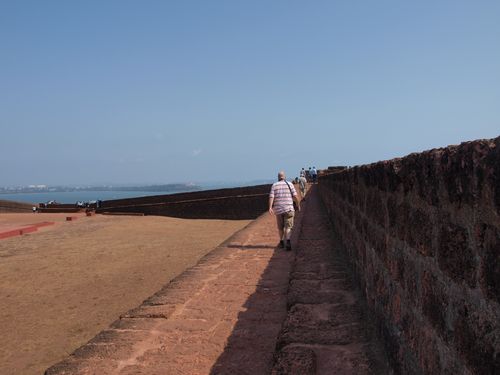
Goa • Fort Aguada
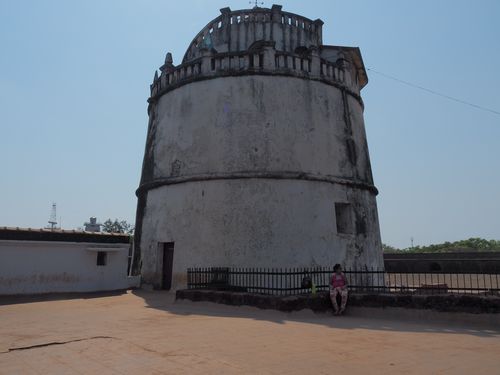
Goa • Fort Aguada
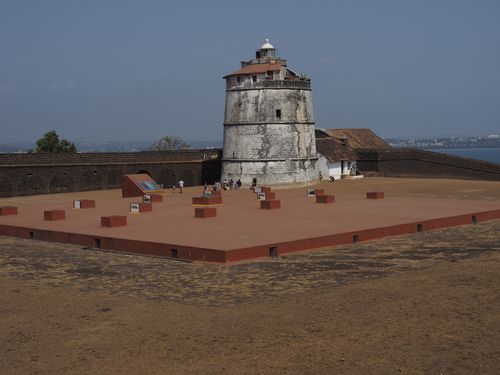
Goa • Fort Aguada
Monument profile
Fort Aguada
Monument category: Fort
Monument family: Fort, Fortifications or Citadel
Monument genre: Military
Geographic location: Goa • Goa • India
Construction period: 17th century AD
• Links to •
• List of videos about Old Goa City, Panaji, Chandor, Candolim on this site •
Goa • A piece of Portugal in India
History of Fort Aguada, Goa
Fort Aguada, located on the western coast of Goa overlooking the Arabian Sea and the mouth of the Mandovi River, stands as one of the most significant military constructions of the Portuguese Estado da Índia in the early seventeenth century. Built between 1609 and 1612, the fort was conceived as a strategic response to shifting geopolitical realities in the Indian Ocean and reflects broader transformations in maritime warfare, colonial administration, and global trade networks.
Political and Social Context of Construction
The construction of Fort Aguada took place during a period of mounting tension in the Indian Ocean. By the beginning of the seventeenth century, Portugal’s once-dominant maritime supremacy was being challenged by emerging European powers, particularly the Dutch Republic and, to a lesser extent, England. The Dutch East India Company sought to displace Portuguese influence in Asian trade, targeting key strongholds along established sea routes.
Goa, serving as the capital of Portuguese India, was both an administrative and ecclesiastical center. Its security was essential for maintaining Portuguese authority across the region. The Mandovi River provided access to the interior and to the urban core of Old Goa. Any hostile fleet entering this estuary posed a direct threat to colonial governance and commerce.
The decision to construct Fort Aguada was driven by the need to reinforce coastal defenses and protect the capital from naval assault. The fort formed part of a broader defensive system that included other coastal batteries and fortifications. The initiative reflected the ambitions of the Portuguese Crown to preserve its Asian empire and secure maritime trade routes linking Lisbon to India and beyond.
Socially, the fort influenced the surrounding population through the establishment of a permanent garrison. Soldiers, administrators, and laborers were integrated into the local environment, shaping patterns of settlement and economic activity. The fort also symbolized imperial authority, projecting power and control over both maritime and terrestrial domains.
Major Historical Events
Although Fort Aguada did not experience prolonged sieges comparable to European fortresses, it played a deterrent role during periods of heightened conflict. Dutch naval forces attempted to challenge Portuguese positions along the western coast of India in the seventeenth century. The presence of Aguada and its artillery contributed to the defense of Goa and discouraged direct assaults on the river entrance.
Over time, the strategic importance of the fort evolved. As Portuguese power gradually declined and regional threats shifted, Aguada’s military function diminished. Nevertheless, it remained part of the defensive network protecting Goa.
In the eighteenth and nineteenth centuries, the fort underwent functional changes. Portions of the complex were adapted for use as a prison, particularly during periods of political unrest. The transition from active fortification to custodial facility reflected broader shifts in colonial priorities.
The annexation of Goa by India in 1961 marked a decisive turning point. Portuguese colonial rule ended, and Fort Aguada passed under Indian administration. The fort ceased to serve any military function and entered a new phase centered on heritage management and public access.
Global Context
The early seventeenth century witnessed widespread innovation in fortification design across Europe and its overseas territories. The development of bastioned systems capable of resisting artillery fire transformed military architecture. Fort Aguada belongs to this global movement, representing the transplantation of European defensive principles into Asian contexts.
Simultaneously, European maritime empires were expanding their networks across Africa, Asia, and the Americas. Strategic coastal fortresses were constructed to secure harbors and trade routes. In this sense, Aguada forms part of a transcontinental system of fortified nodes designed to sustain long-distance commerce and imperial administration.
The fort’s construction coincided with intense commercial competition in the Indian Ocean, linking it directly to global economic transformations driven by mercantile capitalism and colonial expansion.
Transformations Over Time
Throughout its history, Fort Aguada underwent modifications reflecting changing needs. Structural repairs were carried out to maintain the integrity of walls and platforms. Later additions, including a lighthouse in the nineteenth century, signaled an adaptation from purely military purposes to navigational assistance.
The decline of Old Goa due to epidemics and administrative relocation altered the urban environment around the fort. As the colonial capital shifted toward Panaji, the fort’s relationship to urban space evolved. In the twentieth century, urban growth and tourism reshaped the coastal landscape, integrating the site into a broader cultural and recreational zone.
Periods of neglect alternated with restoration efforts. Conservation initiatives aimed at stabilizing masonry and preventing structural deterioration became increasingly important as the fort’s historical value gained recognition.
Contemporary Role and Cultural Significance
Today, Fort Aguada is regarded as a prominent historical landmark in Goa. It attracts visitors interested in colonial history and maritime heritage. The site functions as a symbol of Goa’s layered past, reflecting centuries of interaction between European and Indian worlds.
The fort contributes to regional identity by embodying the memory of Portuguese rule and the transformation of Goa into a distinctive cultural landscape. While it does not host major religious ceremonies, it forms part of the broader heritage circuit that shapes local tourism and public historical awareness.
Conservation Status and Modern Challenges
Fort Aguada is protected under Indian heritage legislation and maintained by relevant governmental authorities. The principal conservation challenges stem from environmental exposure. Coastal winds, saline humidity, heavy monsoon rains, and biological growth affect the laterite masonry.
Tourism introduces additional pressures, including foot traffic and infrastructural demands. Preservation policies aim to balance public accessibility with structural stability. Interventions typically focus on consolidation, drainage improvement, and monitoring of erosion.
Although not individually inscribed as a UNESCO World Heritage site, the fort exists within a region internationally recognized for its historical monuments. Its architectural and historical significance contributes to the broader cultural profile of Goa on the global stage.
Conclusion
Fort Aguada emerged from the geopolitical imperatives of early modern maritime rivalry. Conceived as a defensive bastion protecting the Portuguese capital in Asia, it embodied strategic ambition and technical adaptation to local conditions. Over the centuries, it transitioned from military stronghold to prison and ultimately to protected heritage monument. Its history reflects the broader dynamics of empire, trade, and political transformation that shaped Goa and connected it to global developments in the early modern world.
Architecture of Fort Aguada, Goa
Fort Aguada represents one of the most accomplished examples of early seventeenth-century Portuguese military architecture in Asia. Constructed between 1609 and 1612 on a laterite promontory commanding the Arabian Sea and the entrance to the Mandovi River, the fort combines European bastioned fortification principles with adaptations to the coastal environment of western India. Its architectural configuration reflects contemporary advances in artillery warfare, hydraulic engineering, and site planning.
Technological and Defensive Innovations
The design of Fort Aguada corresponds to the evolution of early modern fortification systems shaped by the widespread use of gunpowder artillery. Instead of relying on high, thin medieval walls, the fort employs comparatively low but massive ramparts designed to absorb and deflect cannon fire. The angular bastions project outward, allowing flanking fire along the curtain walls and minimizing blind zones. This configuration ensured that attackers approaching either from the sea or from land would remain under continuous crossfire.
The integration of natural topography constitutes a major architectural strategy. The fort occupies a commanding elevation, eliminating the need for extensive artificial earthworks. The sloping terrain enhances defensive depth while also reinforcing structural stability. The ramparts follow the contours of the promontory, distributing structural loads efficiently and reducing exposure to direct wave impact.
A dual-level arrangement distinguishes the complex. The upper fortification housed heavy artillery and served as the primary defensive platform. A lower defensive line closer to sea level strengthened maritime control. This hierarchical organization created a layered defense system capable of responding to naval threats while maintaining surveillance over the river entrance.
Materials and Construction Methods
Laterite stone, abundant in Goa, forms the primary construction material. Extracted in blocks that harden upon exposure to air, laterite offered both practicality and durability. Its relatively light weight during quarrying facilitated transport and shaping, while its hardened state provided structural strength. Thick laterite walls, sometimes several meters wide, ensured resistance against artillery impact.
The masonry was bonded with lime mortar, a technique common in Portuguese colonial construction. Lime mortar provided flexibility and breathability, allowing moisture evaporation in the humid coastal climate. This combination of laterite and lime mortar created a resilient fabric capable of withstanding monsoon rains and saline air.
The fort’s surfaces display minimal decorative treatment, consistent with its military function. Architectural expression is restrained, prioritizing functionality. Platforms for artillery were carefully leveled and reinforced to bear the weight and recoil of cannons. Parapets include embrasures positioned to maximize firing range while protecting gunners.
Hydraulic Infrastructure and Self-Sufficiency
One of the most distinctive architectural features of Fort Aguada is its large freshwater reservoir. The name “Aguada” derives from the Portuguese word for water supply. The cistern was designed to store a substantial quantity of potable water, ensuring autonomy during potential sieges. This hydraulic system demonstrates advanced planning and engineering capacity.
The reservoir’s construction involved waterproof lime plastering and careful grading to channel rainwater into storage chambers. Such infrastructure underscores the strategic importance of self-sufficiency in early modern fortifications, especially in coastal environments where freshwater access could be compromised during conflict.
Spatial Organization and Internal Layout
The fort’s plan is irregular, shaped by the natural contours of the headland. Bastions punctuate the perimeter at strategic angles. Access points are controlled through limited gateways, reinforcing defensibility. Internal circulation relies on ramps and stepped passages designed to accommodate the movement of troops and artillery.
The central courtyard areas once housed barracks, storage facilities, and administrative spaces. While many internal structures have deteriorated, their foundations reveal a functional arrangement centered on military efficiency rather than monumental display.
A later addition, the lighthouse constructed in the nineteenth century, illustrates the adaptability of the site. Although not part of the original design, it integrates architecturally within the defensive enclosure, marking the fort’s evolution from military bastion to navigational landmark.
Climatic Adaptation and Environmental Response
Fort Aguada’s architecture responds directly to the coastal climate. The thickness of the laterite walls provides thermal mass, moderating interior temperature fluctuations. Openings are limited in number and strategically positioned to balance ventilation with defensive needs.
Drainage channels are integrated into terraces and ramparts to manage monsoon rainfall. Elevated positioning reduces vulnerability to storm surges and coastal erosion. The fort’s alignment maximizes visibility over maritime approaches while minimizing direct exposure to prevailing winds.
Architectural Influences and Cultural Synthesis
The fort exemplifies the diffusion of the bastioned system, often associated with Renaissance military engineering in Europe. Portuguese architects applied principles derived from Italian and Iberian models to colonial contexts. However, the execution in Goa reflects adaptation rather than replication.
Local materials, climatic conditions, and labor practices shaped the final form. The absence of ornamental sculptural programs contrasts with contemporary religious architecture in Goa, emphasizing the utilitarian ethos of military construction. Nevertheless, the fort’s scale and commanding silhouette contribute to a distinct visual identity within the Goan landscape.
Dimensions and Notable Features
The fortification extends across a substantial area of the headland, encompassing several hectares. The ramparts vary in height but maintain considerable thickness, providing structural mass necessary for artillery resistance. Bastions are proportioned to accommodate multiple cannons.
The freshwater reservoir ranks among the largest of its kind constructed by the Portuguese in Asia during the period. Its capacity allowed not only the garrison but also passing ships to replenish supplies, reinforcing the fort’s logistical significance.
The later lighthouse structure, though smaller in scale than European counterparts, represents an early example of integrated maritime signaling within a fortified complex.
Conservation and Heritage Significance
Today, Fort Aguada is protected under Indian heritage legislation and maintained as a historical monument. Although not individually inscribed as a UNESCO World Heritage site, it forms part of the broader historical environment of Goa, recognized internationally for its colonial-era architecture.
Conservation challenges include erosion of laterite surfaces due to saline exposure, biological growth, and the impact of heavy rainfall. Tourism introduces additional pressures, particularly in high-traffic zones along the ramparts. Restoration efforts focus on structural consolidation, mortar stabilization, and drainage maintenance.
Architectural Significance
Fort Aguada stands as a coherent example of early modern coastal fortification adapted to South Asian conditions. Its architecture integrates European defensive theory with local materials and environmental considerations. The combination of bastioned geometry, hydraulic infrastructure, and topographic integration demonstrates a high level of technical competence.
As a military structure conceived for artillery warfare and maritime surveillance, the fort reflects both global architectural currents and regional adaptation. Its enduring fabric attests to the effectiveness of its construction methods and to the strategic foresight embedded in its design.