

 Français (France)
  Nederlands (nl-NL)
 The Rock Garden of Nek Chand is located in Chandigarh, the planned capital of the Indian states of Punjab and Haryana. This large artistic landscape is composed of sculptural installations, courtyards and pathways arranged across an extensive garden environment. Created by the self-taught artist Nek Chand, the site features a wide variety of human, animal and decorative figures displayed throughout a sequence of interconnected spaces. Today the Rock Garden is one of the most recognized cultural attractions in Chandigarh and receives a large number of visitors. It represents the personal artistic vision of its creator and has gained recognition both in India and internationally.
Monument profile
Rock Garden by Nek Chand
Monument category: Architectural modernism
Monument family: Modern architecture
Monument genre: Cultural or scientific
Geographic location: Chandigarh • Punjab •
Construction period: 20th century AD
• Links to •
• List of videos about Chandigarh on this site •
Chandigarh, city of Le Corbusier • Punjab & Haryana, India
• References •
Wikipedia EN: Rock Garden of Chandigarh
• Sources •
Online Sources
Books and Publications
- Chopra, P. (2012). "Chandigarh and Nek Chand: The Creation of a Cultural Landscape". Oxford University Press.
- Kapur, R. (2014). "Nek Chand's Rock Garden: Transforming Waste into Art". Penguin Books India.
- Mehta, A. (2010). "The Secret Sculptures of Nek Chand". HarperCollins India.
History of the Rock Garden of Nek Chand, Chandigarh
Political and Social Context of the Creation
The Rock Garden of Nek Chand emerged within the particular political and social circumstances surrounding the creation of Chandigarh, one of India’s most ambitious urban planning projects after independence. Following the partition of British India in 1947, the historical capital of the Punjab region, Lahore, became part of the newly created state of Pakistan. As a result, the Indian state of Punjab required a new administrative capital. The Indian government decided to build an entirely new city that would symbolize the aspirations of a modern, independent nation.
The planning of Chandigarh began in the early 1950s under the leadership of Prime Minister Jawaharlal Nehru, who envisioned the city as a model of modern urbanism. The Swiss-French architect Le Corbusier and a team of international planners were invited to design the city according to modernist principles emphasizing functional zoning, geometric planning and architectural innovation.
During the construction of Chandigarh, large numbers of villages and older settlements were demolished to make way for the new city. Building debris accumulated in vast quantities, including broken bricks, tiles, ceramics and construction waste. It was within this context of rapid urban transformation that Nek Chand Saini, a government road inspector, began creating what would eventually become the Rock Garden.
Around 1957, Nek Chand started collecting discarded materials from demolition sites and secretly began building a sculptural environment in a forested area along a seasonal stream on the outskirts of the developing city. His project was not commissioned by any authority; rather, it developed independently as a personal artistic undertaking. In the context of Chandigarh’s strict modernist urban planning, such an informal construction was technically illegal, as the land was designated as protected forest.
Nevertheless, Nek Chand continued to expand the garden over many years, gradually shaping a hidden landscape of sculptures, corridors and courtyards. His work reflected both the cultural memory of the villages that had disappeared during Chandigarh’s construction and a creative response to the massive quantities of discarded materials produced by the new city.
Major Historical Developments
For nearly two decades, the Rock Garden remained largely unknown to the authorities. Nek Chand worked mostly alone during his spare time, transporting materials and constructing sculptures in secrecy. By the early 1970s, the garden had grown into a substantial complex covering several acres and containing thousands of figures made from recycled materials.
In 1975, the existence of the site was discovered by government officials during inspections of the forest area. According to urban planning regulations, the entire structure was technically illegal and could have been demolished. However, the scale and originality of the project impressed many observers, including local administrators and members of the public.
Public support played a decisive role in the preservation of the garden. Rather than ordering its destruction, the authorities decided to legitimize the project. Nek Chand was appointed as the official curator of the Rock Garden and was provided with a team of workers and public funding to continue developing the site.
This decision transformed the Rock Garden from a clandestine personal creation into a recognized cultural institution. Over the following decades, new sections were constructed, including additional courtyards, galleries, waterfalls and sculptural installations. The garden expanded to cover more than forty acres, becoming one of the most distinctive artistic environments in India.
Unlike many historical monuments that experienced cycles of destruction through warfare or dynastic change, the Rock Garden developed within a modern urban context shaped by administrative decisions and civic engagement. Its preservation was not the result of traditional royal patronage but rather the outcome of public appreciation and institutional recognition.
Global Context at the Time of Creation
The creation of the Rock Garden occurred during a period of significant global transformation in architecture and art. In the decades following the Second World War, many countries were engaged in large-scale reconstruction and urban planning projects. Modernist architecture and urban design emphasized functionality, industrial materials and rational planning principles.
Chandigarh itself represented one of the most prominent examples of these ideas, embodying the aspirations of newly independent India to present a forward-looking image of national development. In contrast, Nek Chand’s work represented a more intuitive and organic response to the same historical moment.
At the same time, the mid-twentieth century saw the emergence of artistic movements that valued alternative forms of creativity outside traditional academic institutions. Environmental art, outsider art and experimental landscape design began to attract international attention. These movements often emphasized the transformation of everyday materials into artistic environments.
Although Nek Chand worked independently and without direct connection to these movements, the Rock Garden can be understood within this broader global context of experimental artistic practices that blurred the boundaries between sculpture, architecture and landscape.
Transformations of the Site
Following its official recognition in the mid-1970s, the Rock Garden underwent several phases of expansion and modification. Additional sections were developed to accommodate the growing number of visitors, and new sculptural installations were added over time.
The layout of the garden evolved gradually as new pathways, terraces and viewing platforms were constructed. Water features such as artificial waterfalls and pools were introduced to enhance the visual and atmospheric qualities of the site. These additions contributed to the transformation of the garden into a large-scale public attraction.
The surrounding urban environment also changed significantly. As Chandigarh expanded, the Rock Garden became integrated into the city’s cultural and recreational landscape. Its proximity to other important urban landmarks, including Sukhna Lake and the Capitol Complex, strengthened its role as a major tourist destination.
Cultural Role in Contemporary India
Today, the Rock Garden is widely regarded as one of the most distinctive cultural sites in India. It attracts hundreds of thousands of visitors each year, including both domestic tourists and international travelers. The garden has become an emblem of Chandigarh’s cultural identity and a symbol of creativity emerging from ordinary materials.
The site also holds an important place in the narrative of Indian contemporary art. Nek Chand’s work demonstrated how artistic expression could emerge outside institutional frameworks and gain recognition through public appreciation.
Various cultural events, exhibitions and educational programs are occasionally organized in connection with the garden, highlighting its artistic and historical significance. The sculptures themselves, representing human figures, animals and symbolic scenes, continue to inspire visitors and artists alike.
Conservation and Contemporary Challenges
The preservation of the Rock Garden presents ongoing challenges due to the nature of its materials and the scale of visitor traffic. Many sculptures are constructed from fragile recycled elements such as ceramics, glass fragments and industrial waste. Over time, these materials can deteriorate under the effects of weathering, humidity and physical contact.
Urban pollution and environmental changes also pose risks to the long-term conservation of the structures. Maintenance teams regularly carry out restoration work to repair damaged surfaces and reinforce structural elements.
The management of visitor flow is another important issue. Large numbers of tourists can place pressure on pathways, sculptures and architectural features. Conservation policies therefore aim to balance public access with the need to protect the integrity of the site.
Although the Rock Garden is not currently listed as a UNESCO World Heritage Site, it is widely recognized as a unique example of artistic landscape architecture. Its preservation remains an important cultural priority for the authorities of Chandigarh and for those who value the creative legacy of Nek Chand.
Through its unusual origin and remarkable development, the Rock Garden stands as a testament to the transformative potential of artistic imagination. What began as a private and clandestine project eventually evolved into one of the most celebrated cultural environments of modern India.
Architecture of the Rock Garden of Nek Chand, Chandigarh
Architectural conception and spatial philosophy
The Rock Garden of Nek Chand represents a unique architectural environment within modern India. Rather than a single monumental structure, it forms an extensive sculptural landscape composed of interconnected architectural spaces. Its design developed progressively over several decades and reflects an unconventional approach to architecture in which sculpture, landscape and built structures merge into a single environment.
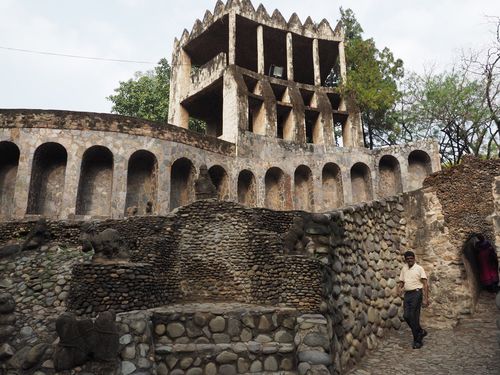
The site is characterized by a labyrinthine spatial organization. Visitors move through a sequence of narrow passages, archways, courtyards and terraces that gradually reveal different sections of the garden. This architectural strategy creates a controlled rhythm of discovery. Each space frames the next through carefully positioned openings, steps and corridors. The experience resembles a processional route in which architecture guides the movement and perception of the visitor.
Unlike many monumental complexes built according to symmetrical plans, the Rock Garden follows an organic layout that adapts to the terrain. The irregular topography of the site allowed the construction of terraces, elevated platforms and sunken courtyards. These variations in level produce a dynamic spatial composition that encourages continuous exploration.
Technological and architectural innovations
The architectural innovations of the Rock Garden are closely connected to its experimental use of materials and its unconventional construction process. Instead of relying on standard architectural components, Nek Chand developed a construction language based largely on recycled materials collected from demolition sites and industrial waste.
Walls, sculptures and architectural surfaces were created using fragments of broken ceramics, glass bangles, discarded tiles, electrical waste and fragments of concrete. These materials were embedded into mortar or concrete to form durable surfaces. The resulting walls often display mosaic-like textures that combine structural stability with decorative qualities.
This method of construction introduced an innovative form of environmental architecture long before recycling became a widely recognized architectural principle. The reuse of materials not only reduced construction costs but also created distinctive visual textures that define the aesthetic identity of the garden.
Structural stability was achieved through simple but effective building techniques. Many walls consist of rubble masonry cores reinforced with mortar and covered with decorative layers of recycled materials. In some sections, concrete frameworks provide additional strength, allowing the creation of terraces, balconies and elevated walkways.
Ventilation and thermal comfort also played a role in the architectural design. Narrow passages and shaded courtyards help reduce direct exposure to sunlight. The placement of openings and corridors promotes natural airflow, which is particularly important in the warm climate of northern India.
Materials and construction methods
The choice of materials is one of the defining architectural features of the Rock Garden. The entire site was constructed primarily from discarded or surplus materials generated during the building of Chandigarh and from urban waste.
Broken porcelain, ceramic tiles, fragments of sanitary ware, glass bottles, metal scraps and broken bangles were among the most frequently used elements. These materials were carefully arranged to create patterns and textures on walls and sculptures. The result is a form of architectural ornamentation that emerges directly from reused materials rather than from carved stone or molded plaster.
The construction process typically began with a basic masonry framework made from rubble and cement. Once the structural core was complete, the surface was covered with layers of mortar into which decorative fragments were embedded. This process allowed the creation of intricate surface patterns without requiring expensive finishing materials.
Sculptural figures were often built using internal frameworks made from metal rods or reinforced concrete. The outer surfaces were then coated with mortar and decorated with fragments of glass or ceramic. This technique provided sufficient durability to withstand weather conditions while maintaining a visually complex surface.
The use of recycled materials also introduced a distinctive chromatic palette. The varied colors of ceramic fragments, glass pieces and industrial materials produce a vibrant surface texture that changes according to light conditions throughout the day.
Artistic and architectural influences
Although the Rock Garden is an individual creation, its architectural language reflects a combination of influences drawn from regional traditions and broader artistic currents. The use of courtyards and enclosed spaces recalls spatial arrangements found in traditional South Asian architecture, where movement through successive rooms or courts structures the visitor’s experience.
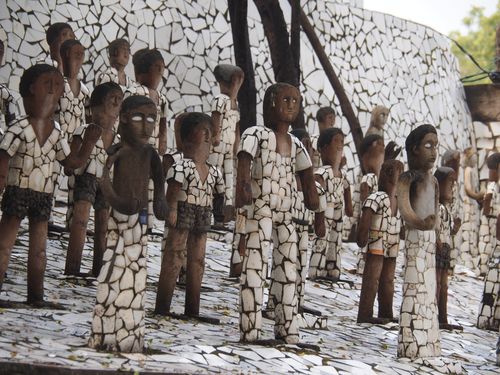
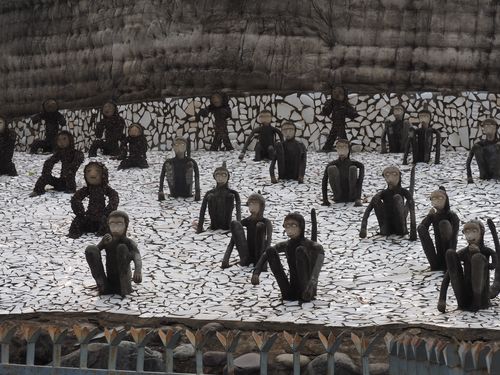
The sculptural figures distributed throughout the site also evoke elements of folk art traditions in northern India. Many figures represent human forms, animals or dancers arranged in groups that resemble processions or communal gatherings. These figures contribute to the architectural environment by transforming open courtyards into sculptural plazas.
At the same time, the garden reflects characteristics associated with environmental art and outsider art movements. These artistic approaches emphasize the creation of immersive environments and the transformation of everyday materials into artistic expressions.
The ornamental language of the Rock Garden is therefore neither purely traditional nor purely modernist. Instead, it represents a hybrid architectural vocabulary that combines vernacular creativity with experimental design.
Spatial organization and structural layout
The overall organization of the Rock Garden is based on a series of interconnected zones that guide visitors through different architectural atmospheres. The entrance areas typically consist of narrow corridors and gateways that create a sense of enclosure and anticipation. These passages lead gradually toward larger courtyards filled with sculptural installations.
The site contains numerous terraces and platforms connected by stairways and bridges. These vertical transitions allow visitors to observe the sculptures and architectural structures from multiple viewpoints. The resulting circulation network produces a constantly changing spatial perspective.
Water features also play a significant role in the architectural composition. Artificial waterfalls and small pools introduce movement and sound into the environment, contrasting with the static presence of the sculptures. These water elements also contribute to the cooling of certain sections of the garden.
Several areas of the site function as gathering spaces capable of accommodating large numbers of visitors. These open terraces and amphitheater-like courts demonstrate how the architecture evolved to support public use while maintaining its original artistic character.
Dimensions and notable architectural characteristics
The Rock Garden occupies a surface area of approximately forty acres, making it one of the largest sculptural environments in the world. Within this vast space, thousands of sculptures and architectural features have been integrated into the landscape.
The complex includes numerous corridors, chambers, courtyards and elevated walkways. Some sections contain large groups of figures arranged in geometric formations, creating striking visual compositions that extend across entire terraces.
One particularly notable characteristic is the consistent integration of sculpture and architecture. Unlike many traditional monuments where sculpture functions as decoration, the figures in the Rock Garden are structural components of the spatial design. They define the scale of courtyards, guide visual axes and contribute to the atmosphere of each section.
Another distinctive feature is the diversity of textures and patterns across the site. Walls covered with ceramic fragments, glass bangles and industrial materials create a rich visual surface that contrasts strongly with the smooth concrete surfaces typical of modernist architecture.
International significance and conservation challenges
The architectural originality of the Rock Garden has earned international recognition as an extraordinary example of environmental architecture and creative reuse of materials. Its design demonstrates how architectural space can emerge from unconventional materials and informal construction processes.
Despite its durability, the site presents significant conservation challenges. Many of the materials used in the sculptures and walls are fragile and can deteriorate under exposure to weather, humidity and pollution. Continuous maintenance is therefore necessary to preserve the structural integrity of the installations.
The large number of visitors also creates pressure on pathways, terraces and sculptures. Conservation programs aim to balance public access with the need to protect delicate surfaces and architectural features.
Today, the Rock Garden stands as one of the most remarkable architectural environments created in twentieth-century India. Through its inventive use of recycled materials, complex spatial organization and integration of sculpture and architecture, it represents a unique contribution to the global history of experimental architectural design.