

 Français (France)
  Nederlands (nl-NL)
 The Statue of Piet Hein, located in Matanzas, Cuba, commemorates Piet Hein, a naval figure linked to Caribbean colonial history. The monument reflects Dutch involvement in the region during a period shaped by maritime competition between European powers. It serves as a local historical marker and contributes to the preservation of the city’s memorial heritage. Through its presence and meaning, it forms part of a broader set of monuments recalling the interactions and conflicts that influenced the Caribbean’s historical development.
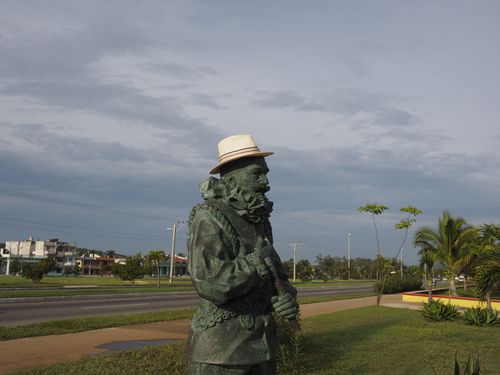
Matanzas • Statue of Piet Hein
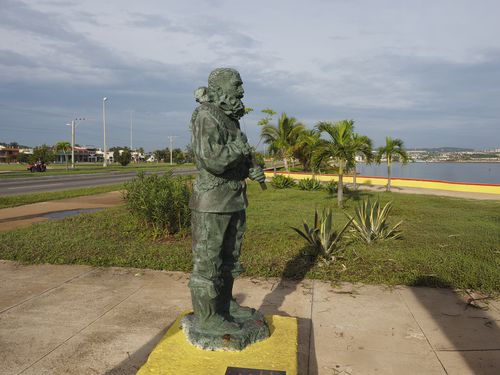
Matanzas • Statue of Piet Hein
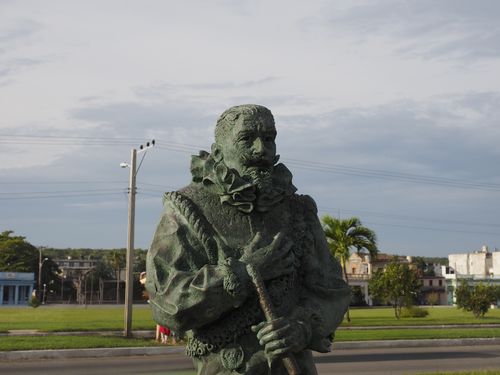
Matanzas • Statue of Piet Hein
Monument profile
Statue of Piet Hein
Monument category: Memorial monument
Monument family: Monument for cultural purposes
Monument genre: Cultural or scientific
Geographic location: Matanzas • Cuba
Construction period: 20th century AD
• Links to •
• List of videos about Bay of Pigs, Baracoa, Santiago de Cuba on this site •
Some historical places • Cuba
Piet Hein Statue in Matanzas: commemorative purpose and historical evolution
Establishment and commemorative context
The Statue of Piet Hein, located in Matanzas in Cuba, was erected as a commemorative marker linked to maritime events associated with Piet Hein, a Dutch naval officer of the seventeenth century. The monument reflects an intention to materialize a specific episode connected to naval activity in Caribbean waters and its impact on regional maritime routes.
Its installation corresponds to a broader effort to identify and preserve historical references tied to the coastal and port environment of Matanzas. The choice of Piet Hein as a subject emphasizes the historical relevance of maritime encounters affecting the surrounding area.
Commemorative function and historical meaning
The statue fulfills a commemorative role directly related to the figure it represents and to the naval operations attributed to him. It embodies a moment of confrontation linked to maritime competition and serves as a tangible reference to these events within the urban landscape.
By introducing this figure into the public space, the monument connects the history of Matanzas with external maritime developments that influenced the region. The statue functions as a point of historical reference, integrating local urban identity with broader naval history.
Continuity and limited transformations
Available documentation indicates limited structural or functional changes since the installation of the monument. The statue has retained its original commemorative purpose, with no significant alterations to its role within the urban setting.
The persistence of the monument suggests continuity in the recognition of the historical episode it represents. While interpretations may evolve over time, the physical configuration and intended function remain stable.
Present-day role and perception
Today, the statue maintains its role as an element of historical reference within Matanzas. It contributes to the construction of a localized memory linked to maritime activity and historical interactions in the Caribbean.
Its presence within the city reinforces the identification of specific sites associated with historical narratives. The monument continues to function as a visible marker of past events, integrating them into the contemporary urban environment.
Global historical context
During the seventeenth century, when Piet Hein was active, European powers expanded their naval presence in the Caribbean. The Spanish Empire controlled major trade routes. The Dutch Republic increased its maritime power and commercial reach. England and France also intensified their activities in the region. These developments formed part of a broader phase of colonial expansion and naval rivalry.
Structural composition and spatial configuration of the Piet Hein statue in Matanzas
Urban placement and spatial arrangement
The Statue of Piet Hein is positioned within the urban fabric of Matanzas in a manner that emphasizes clear visual exposure and direct frontal perception. The monument is set on a raised base that separates the sculptural element from ground level, establishing a distinct vertical hierarchy. This elevation enhances visibility and creates a controlled transition between the surrounding public space and the monument itself.
The spatial configuration is organized along a single vertical axis without lateral extensions. The base defines the footprint and anchors the structure, while the statue rises centrally above it. The absence of surrounding architectural elements concentrates attention on the relationship between the pedestal and the sculpted figure.
Volumetric composition and proportional system
The monument is composed of two primary volumes: a solid pedestal and the sculptural figure. The pedestal presents a compact geometric form, typically rectangular or square in plan, with flat and continuous surfaces. Its mass provides both structural stability and visual grounding.
The statue is proportioned to maintain a balanced relationship with the base, ensuring continuity between the lower and upper components. The vertical emphasis of the figure reinforces the monument’s height and enhances its visibility within the urban setting. The proportional system is designed to avoid visual fragmentation, creating a unified silhouette.
Materials and fabrication techniques
The sculptural element is executed in a durable metal, most commonly bronze, allowing precise modeling of forms and long-term resistance to environmental conditions. The casting process enables the reproduction of fine details while maintaining structural coherence across the entire figure. Surface patination develops over time, subtly altering the visual texture without affecting structural integrity.
The pedestal is constructed from stone or masonry, providing a stable and resistant base. The contrast between the metallic surface of the statue and the mineral texture of the base emphasizes the distinction between the two components. The connection between the sculpture and the pedestal is integrated within the structure, with no visible fixing elements.
Formal treatment and architectural features
The figure is designed with a stable and upright posture, contributing to a static and balanced composition. Sculptural details, including clothing and attributes, are integrated directly into the mass of the figure rather than applied as separate elements. The treatment of volumes prioritizes clarity of outline, ensuring legibility from multiple viewing distances.
The pedestal may incorporate engraved inscriptions on its visible faces, aligned with the overall geometry of the base. These inscriptions are embedded within the material surface and do not alter the structural configuration. Decorative features remain limited, with emphasis placed on proportion and spatial coherence rather than ornamental complexity.
Modifications and conservation aspects
Documented structural modifications to the monument are limited, indicating a stable architectural configuration since its installation. Interventions are primarily related to maintenance of exposed surfaces and preservation of materials.
The bronze figure requires periodic treatment to control oxidation and maintain surface readability. The stone base may show signs of weathering, including surface erosion or moisture-related degradation, necessitating localized conservation work. Despite these factors, the structural relationship between pedestal and statue remains intact, preserving the original compositional logic.