Français (France)
  Nederlands (nl-NL)
 Binh Tay Market, located in the Cholon district of Ho Chi Minh City, stands as one of the city’s major commercial hubs. Built in the 1920s, it offers a wide range of goods from food items to household products and textiles. Serving both local residents and wholesale traders, it reflects the city’s dynamic economic exchanges and remains a key landmark of commercial life in Vietnam’s southern metropolis.

Ho Chi Minh City • Binh Tay Market

Ho Chi Minh City • Binh Tay Market
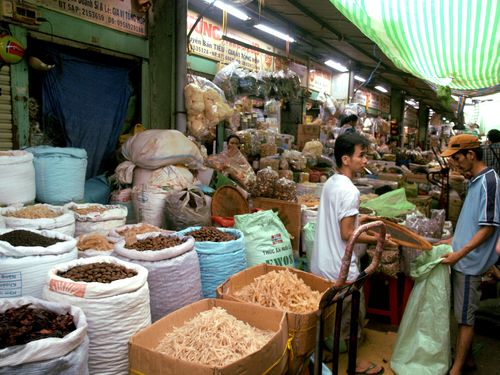
Ho Chi Minh City • Binh Tay Market
Tradition profile
Binh Tay Market
Tradition category: Local market
Tradition family: Traditional markets and fairs
Tradition genre: Trade and Local Creativity
Geographic location: Ho Chi Minh City • Vietnam
• Links to •
• List of videos about Ho Chi Minh City on this site •
Ho Chi Minh City (formerly Saigon) • Vietnam
History of the Binh Tay Market Tradition in Ho Chi Minh City
Binh Tay Market, located in the Cholon district of Ho Chi Minh City, is one of the most prominent commercial landmarks in southern Vietnam. Established in the late 1920s, it has served as both a wholesale trading hub and a cultural symbol of community life. The history of this market reflects the interplay between colonial structures, local initiatives, and broader economic transformations, and illustrates how a commercial institution can embody political, social, and cultural traditions over time.
Political and Social Context of Emergence
The origins of Binh Tay Market are closely tied to the economic rise of Cholon at the turn of the twentieth century. At that time, Saigon and Cholon were distinct urban entities: Saigon functioned as the French colonial administrative capital, while Cholon developed into a commercial hub dominated by Chinese communities (Hoa). These groups controlled significant portions of the rice trade, agricultural exports, and imported goods.
The establishment of a centralized market responded to multiple needs. Colonial authorities sought to regulate and organize commercial activities in structured spaces, ensuring both fiscal oversight and public order. Simultaneously, Chinese merchant elites aimed to create a modern venue adapted to wholesale trade, one that could reflect their influence and economic power. The most notable figure was Quach Dam, a wealthy Chinese businessman who financed the construction of Binh Tay Market, inaugurated in 1928. His initiative reflected both the autonomy of the Chinese community and its ability to align with colonial regulatory frameworks.
The market’s early development was shaped by rivalries and alliances. French authorities encouraged regulated commercial spaces, while local Vietnamese traders often competed with Chinese merchants for access and influence. Nevertheless, Binh Tay Market quickly established itself as a vital intermediary between producers in the Mekong Delta and consumers across southern Vietnam.
Major Historical Events
Binh Tay Market has undergone several turning points marked by political and social upheavals. During the colonial period, it became a key center for the redistribution of imported goods and the export of agricultural products. It symbolized Cholon’s prosperity and the central role of Chinese merchants in the colonial economy.
After the Second World War, the rise of independence movements and the eventual division of Vietnam altered the market’s role. Under the Republic of Vietnam (South Vietnam), Binh Tay continued to thrive, though it was increasingly subject to government regulation and supervision. Following reunification in 1975, the socialist economy initially limited the role of wholesale markets, favoring state-controlled distribution systems. During this period, Binh Tay experienced a relative decline, though it never lost its symbolic importance.
With the Đổi Mới reforms of the 1980s, which reintroduced market mechanisms into Vietnam’s economy, Binh Tay Market regained vitality. It reemerged as a central wholesale hub, particularly for textiles, foodstuffs, and household goods, reinforcing its place in the city’s economic landscape. The 2016 fire and subsequent restoration represented another turning point, combining preservation of heritage with modernization.
Global Context of Its Emergence
The appearance of Binh Tay Market must be seen in a global context of urban modernization in the early twentieth century. Across Asia, colonial cities such as Manila, Bangkok, and Singapore developed covered markets to regulate trade and to symbolize urban modernity. These spaces combined traditional commercial practices with Western-inspired structures aimed at improving hygiene, order, and fiscal control.
In this respect, Binh Tay Market mirrors a broader trend. It reflects the integration of local traditions—such as open-air trading and community-centered exchanges—into formalized infrastructures. Unlike the great bazaars of the Middle East, which often remained more closely linked to artisanal production, the colonial markets of Southeast Asia were designed as wholesale and redistributive centers embedded in global trading networks.
Transformations of the Tradition
Over the decades, the tradition of Binh Tay Market has been reshaped by internal and external influences. The physical infrastructure changed: its original Chinese-inspired design with French elements was adapted during renovations to meet modern needs, particularly after the fire of 2016.
The actors and practices also evolved. Initially dominated by Chinese merchants, the market gradually became more diverse, with Vietnamese traders taking an increasing role. Language practices shifted from Cantonese and Teochew to Vietnamese, though remnants of multilingual exchanges remain. The nature of goods also transformed: while rice and agricultural products once dominated, textiles, electronics, and manufactured items now constitute large segments of trade.
Periods of decline alternated with reinvention. Colonial taxation, post-independence redistribution policies, and competition with modern supermarkets each posed challenges. Yet each time, the market adapted, underscoring its resilience as a cultural and economic tradition.
Contemporary Role and Cultural Importance
Today, Binh Tay Market serves not only as an economic center but also as a cultural landmark. For residents of Ho Chi Minh City, it remains a crucial wholesale market supplying smaller vendors throughout the city and beyond. For visitors, it represents a living testimony to Cholon’s history and the enduring presence of Chinese cultural influence in Vietnam.
The tradition of the market embodies values of community, adaptability, and continuity. It illustrates the contribution of Chinese merchant families to Vietnam’s prosperity and reflects the broader integration of diverse ethnic groups within the urban fabric. Festivals such as Lunar New Year highlight the market’s ongoing symbolic role, as it becomes a focal point for purchasing goods essential to family rituals and celebrations.
Preservation and Modern Challenges
The preservation of Binh Tay Market faces significant challenges. Rapid urbanization and the spread of modern retail outlets threaten its traditional functions. Younger generations often turn away from wholesale trade, preferring alternative employment opportunities, which undermines the transmission of knowledge and practices. Globalized consumption patterns also place pressure on traditional market structures, as supermarkets and online commerce grow in influence.
Nevertheless, efforts have been made to safeguard the market. The post-2016 restoration preserved its distinctive architectural features while introducing modern facilities. Local authorities recognize it as a cultural and historical landmark, and there are ongoing discussions about extending its patrimonial status. While not yet inscribed on UNESCO’s lists, the market is often highlighted in cultural heritage initiatives at the national level.
The main challenge lies in balancing preservation with modernization. Ensuring that Binh Tay remains a functional market while protecting its symbolic and cultural significance is central to its future. Its survival depends on maintaining its role as both an economic hub and a living cultural space.
Conclusion
The history of Binh Tay Market illustrates the intersection of commerce, culture, and politics in Vietnam’s largest southern city. Born from the ambitions of a Chinese merchant within a colonial framework, it has survived wars, regime changes, and economic transformations. It continues to embody both resilience and adaptability, serving as a reminder that markets are not merely places of exchange but also enduring traditions that shape community life and urban identity.
Characteristics of the Binh Tay Market Tradition in Ho Chi Minh City
Binh Tay Market, located in the Cholon district of Ho Chi Minh City, is one of the most significant wholesale trading centers in southern Vietnam. Established in the late 1920s, it has developed into more than a marketplace: it embodies a tradition that combines economic activity, social practices, and cultural identity. An analysis of its characteristics highlights its origins, functions, symbolic dimensions, and its place in modern urban life.
Origin and Context of Emergence
The birth of Binh Tay Market can be understood in relation to the political, social, and economic conditions of early twentieth-century Saigon and Cholon. Cholon was a thriving commercial town dominated by Chinese merchant communities, particularly engaged in the rice trade and import-export activities. The creation of a centralized market was driven by two main factors: the colonial administration’s desire to regulate and modernize trade, and the local merchant elite’s intention to establish a permanent space reflecting their economic influence.
The market’s initial function was to organize wholesale commerce. It provided a structured environment where transactions could be conducted efficiently, while also serving as a symbol of the growing prosperity of Cholon. Socially, it allowed diverse groups—Chinese, Vietnamese, and colonial authorities—to interact within a shared economic framework. Religiously, the market was not tied to specific rituals, but it was closely connected to festivals and community events, ensuring its integration into the cultural life of the region.
Constitutive Elements and Practices
Binh Tay Market is defined by its spatial organization, routines, and practices. Wholesale goods are delivered early in the morning, redistributed to smaller traders, and then circulated throughout Ho Chi Minh City and beyond. The sequence of activity—arrival, unloading, negotiation, distribution—follows an established rhythm that shapes the daily life of the market.
Traditional gestures and methods remain integral. Weighing goods on scales, inspecting products by touch, and bargaining through verbal exchanges are enduring features. While the market is not associated with distinctive costumes, vendors are often recognized by their stalls, tools, and manner of conducting trade. The soundscape is equally characteristic: the calls of vendors, the movement of goods, and the multilingual exchanges in Vietnamese, Cantonese, and Teochew create an unmistakable atmosphere.
The know-how transmitted across generations extends beyond technical skills. Families pass down methods of evaluating goods, strategies of negotiation, and the ability to build trust-based networks. These intangible elements constitute the foundation of the market’s continuity.
Symbolism and Meanings
Binh Tay Market carries symbolic weight as a representation of prosperity, endurance, and cultural blending. To local residents, it symbolizes Cholon’s historical role as a commercial center and the contribution of Chinese merchant families to Vietnam’s economy. The practice of offering small discounts, sharing meals with clients, or presenting samples illustrates how economic transactions embody social values such as hospitality and reciprocity.
Colors and sounds reinforce these meanings. Red and yellow decorations, often present in stalls, are associated with prosperity and good fortune. The energetic exchanges between vendors and buyers express not only economic negotiation but also attitudes of respect, rivalry, or mutual recognition. Differences also exist between groups: Vietnamese traders emphasize direct bargaining styles, while Chinese merchants retain specific community codes, reflecting the diversity of symbolic interpretations.
Evolution and External Influences
The tradition of Binh Tay Market has undergone significant transformations. The materials and infrastructures have evolved: while the original building was influenced by Chinese design combined with colonial elements, subsequent renovations introduced modern utilities. The fire of 2016 and the subsequent restoration highlighted the tension between preserving heritage and adapting to contemporary standards.
Social dynamics within the market also changed. Initially dominated by Chinese wholesalers, the market gradually diversified to include Vietnamese and other groups. The range of goods has shifted as well, from agricultural staples like rice to textiles, household items, and manufactured products.
External influences, including colonial taxation, socialist economic policies after 1975, and globalization, altered the nature of trade. Comparisons with other Asian markets highlight both similarities and differences: like Bangkok’s wholesale centers or Singapore’s Chinatown markets, Binh Tay blends local traditions with broader economic trends, yet it remains distinctive in its wholesale orientation and its integration into Cholon’s cultural identity.
Social Organization and Community Impact
Binh Tay Market is more than an economic hub; it is a social institution. Families that have operated stalls for generations enjoy prestige and recognition, while networks of trust among traders reinforce community ties. The market provides opportunities for cooperation across ethnic boundaries, though community-based solidarity remains strong, particularly among Chinese groups.
In collective life, the market plays a role in major festivities, especially Lunar New Year, when demand surges and activity intensifies. It also serves as a site of community interaction, where relationships are forged not only between traders but also between customers and suppliers. Its importance extends beyond commerce, influencing local identity and the rhythms of everyday life in Ho Chi Minh City.
Statistics, Anecdotes, and Notable Accounts
Binh Tay Market covers several hectares and houses hundreds of stalls organized by type of merchandise—food, textiles, household goods, and more. It is estimated that thousands of people pass through the market daily, reflecting its centrality in the city’s supply chain.
One anecdote concerns its founder, Quach Dam, whose statue once stood in the central courtyard. This gesture underscored the recognition of his contribution to the city’s economic infrastructure. Popular stories also emphasize the market’s resilience, particularly its recovery after the 2016 fire, which demonstrated its enduring role in urban life.
These narratives highlight the market as not only a place of trade but also a cultural landmark deeply rooted in collective memory.
Recognition and Preservation Challenges
The preservation of the Binh Tay Market tradition faces several challenges. Urbanization, modernization of retail, and the expansion of supermarkets and online commerce pose threats to its traditional role. Younger generations often pursue different professions, leading to concerns about the transmission of knowledge and skills.
Nevertheless, local authorities have undertaken measures to safeguard the market. Its restoration after 2016 combined architectural preservation with modernization, and it has been recognized as part of Ho Chi Minh City’s cultural heritage. While not yet listed by UNESCO, discussions about further patrimonial recognition continue, reflecting the desire to balance economic function with cultural identity.
Efforts also include promoting the market as a tourist destination, ensuring its visibility and economic sustainability. Yet the risk of over-commercialization and folklorization remains, making it crucial to maintain its function as a living market rather than a static attraction.
Conclusion
The Binh Tay Market tradition in Ho Chi Minh City illustrates the ways in which commerce, culture, and community intersect. Originating in the ambitions of local merchant elites and shaped by colonial and postcolonial dynamics, it has survived political upheavals, economic reforms, and urban transformations. Today it stands as both a vital economic hub and a cultural symbol, embodying continuity and adaptability. Its future depends on preserving its social and symbolic functions while adapting to the realities of a rapidly modernizing city.
 Links to the main sections of the site