Français (France)
  Nederlands (nl-NL)
 Semana Santa of Granada is one of the major religious celebrations of Granada. Held during Holy Week, it brings together brotherhoods, processions, musicians, and residents across different parts of the city. The parades move through streets, squares, and historic routes according to an established calendar. This tradition combines Catholic devotion, urban heritage, and strong community involvement. It is also an important moment in the local cultural year, attracting both residents and visitors. The variety of routes, confraternities, and atmospheres makes Granada’s Semana Santa a significant expression of contemporary Andalusian identity.
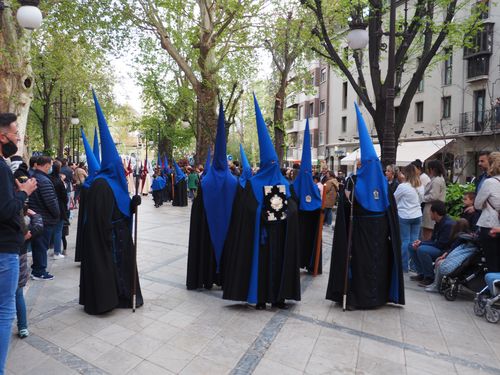
Granada • Semana Santa in Granada
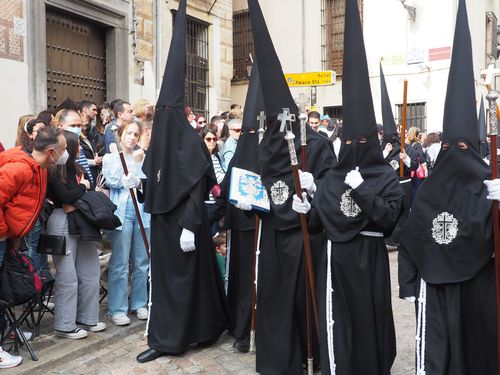
Granada • Semana Santa in Granada
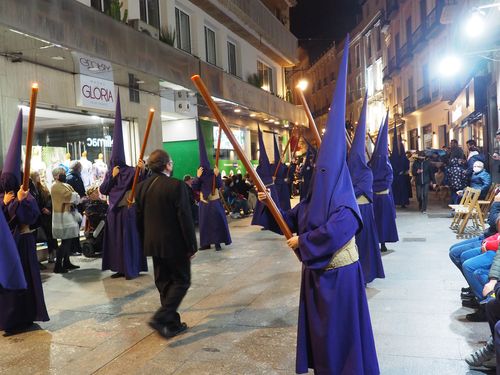
Granada • Semana Santa in Granada
Tradition profile
Semana Santa in Granada
Tradition category: Christian celebrations
Tradition family: Religious traditions
Tradition genre: Religious Festivals and Celebrations
Geographic location: Grenade • Andalusia • Spain
• Links to •
• List of videos about Toledo, Seville, Ronda, Granada, Baena on this site •
Spain • Holy Week celebrations • Andalusia and Toledo
History and Meaning of Semana Santa in Granada
Origins and Early Development
Semana Santa of Granada refers to the Holy Week celebrations held in Granada from Palm Sunday to Easter Sunday. Its present form developed from late medieval and early modern penitential traditions, when religious brotherhoods became increasingly active in Spanish urban life.
In Granada, the Christian conquest of 1492 and the incorporation of the city into the Crown of Castile reshaped the local religious landscape. New parishes, monasteries, and ecclesiastical institutions were established. Within this context, Holy Week processions became instruments of Catholic devotion, public ritual, and civic order.
Early confraternities combined worship with mutual aid and charitable activity. They organized annual processions, maintained devotional images, and created stable religious communities linked to specific churches or neighbourhoods.
Consolidation from the Sixteenth to Eighteenth Centuries
During the sixteenth and seventeenth centuries, Semana Santa in Granada became more structured. Brotherhoods adopted statutes, internal hierarchies, ceremonial rules, and regular schedules. Each confraternity developed a distinct identity connected to a church, a sacred image, or a particular devotional tradition.
Granada also possessed active artistic workshops that produced sculptures, embroidered banners, liturgical objects, and processional platforms. The images carried during Holy Week were not only objects of prayer but also visible symbols of prestige and collective investment.
Civil and religious authorities often regulated the celebrations. They supervised routes, public behaviour, and the number of participating groups. Despite such controls, the processions retained a strong popular dimension and became deeply rooted in the annual life of the city.
Crisis, Decline, and Modern Revival
Like many Iberian traditions, Granada’s Semana Santa experienced periods of interruption or decline. Economic hardship, political instability, secular reforms, and social change weakened some brotherhoods. Certain confraternities disappeared temporarily, merged with others, or reduced their activities.
The nineteenth century brought fluctuating fortunes, while the twentieth century marked a progressive revival. Existing brotherhoods were reorganized, new groups were founded, and processions regained visibility in public life. Urban expansion also brought newer districts into the ceremonial geography of Holy Week.
From the later twentieth century onward, Semana Santa increasingly acquired a cultural and heritage dimension. While remaining religious in origin, it also became a marker of family memory, neighbourhood identity, and local continuity.
Social, Religious, and Economic Role
Today, Semana Santa serves several functions at once. For believers, it remains one of the central moments of the Christian liturgical calendar, focused on the Passion, death, and Resurrection of Christ. For confraternities, it is the culmination of year-round preparation involving administration, charity, rehearsals, and maintenance of ceremonial assets.
Its social role is equally significant. Thousands of residents participate as members, musicians, volunteers, or spectators. Many families remain connected to the same brotherhood across generations, making the celebration an enduring form of civic belonging.
There is also measurable economic impact. Workshops specializing in woodwork, metalwork, embroidery, floral decoration, sculpture conservation, and musical services depend partly on Holy Week demand. Hospitality, restaurants, and retail businesses also benefit from increased activity during the season.
Contemporary Importance and Challenges
Semana Santa in Granada is now one of the principal events of the Andalusian calendar. It is especially noted for the interaction between ritual movement and the city’s urban setting, where processions cross historic streets, plazas, slopes, and monumental viewpoints.
Current challenges include balancing devotional meaning with tourism pressure, managing crowd safety, financing restoration work, and attracting younger generations to confraternity life. Organizers must also adapt to weather uncertainty, modern traffic systems, and evolving public expectations.
Its continued vitality lies in this capacity for adjustment without losing continuity. By combining inherited ritual forms with contemporary organization, Semana Santa remains one of the most enduring expressions of Granada’s collective identity.
Performance Characteristics of Semana Santa Processions in Granada
General Structure of the Celebrations
Semana Santa of Granada takes place throughout Holy Week, from Palm Sunday to Easter Sunday, with a daily schedule of processions organized across Granada. Each brotherhood follows a fixed timetable that includes departure from its church or headquarters, movement through designated streets, passage through central zones, and a final return that may occur late at night.
A procession usually opens with guiding crosses, lanterns, banners, or insignia bearers. These are followed by penitents in ordered lines, musicians, attendants, and finally the large platforms carrying sacred images. Several processions may occur on the same day in different parts of the city, creating a continuous sequence of ceremonial movement.
The pace differs according to each confraternity. Some maintain slow, silent progress, while others advance with stronger musical accompaniment and more marked rhythm.
Participants and Internal Organization
The celebration depends on a large number of participants with clearly defined roles. Brotherhood members prepare the event throughout the year and manage logistics on procession days. During the public ceremony, they serve as penitents, stewards, musicians, candle bearers, platform carriers, route marshals, or ceremonial officers.
Penitents walk in disciplined rows, often carrying candles, staffs, or symbolic objects. Platform carriers support the heavy structures from beneath or within the framework, depending on the system used. Their movement requires endurance, balance, and constant coordination.
Stewards supervise spacing, turning points, halts, and timing. They also ensure safety where crowds gather densely. Many brotherhoods include several generations of the same families, reinforcing continuity and internal cohesion.
Costumes, Objects, and Visual Symbols
One of the most recognizable elements is ceremonial dress. Penitents usually wear long tunics combined with capes, gloves, belts, and the pointed hood known as the capirote. Colours vary by brotherhood and function as immediate visual identifiers.
Certain officials wear different garments such as embroidered cloaks, liturgical vestments, or formal robes. Carriers often use practical clothing suited to physical effort, sometimes hidden beneath the platform.
Processional objects include candles, lanterns, crosses, staffs, incense burners, embroidered standards, and silver or brass insignia. Floral arrangements are placed around the sacred images and renewed according to the day or devotional theme.
Light plays a central role. Evening processions transform visually as candles and lanterns illuminate the figures and moving formations.
Music, Sound, and Atmosphere
The sound environment changes throughout the route. Some sections proceed in silence, broken only by footsteps, whispered commands, or the creaking of the platforms. Others are accompanied by brass bands, drums, cornets, or orchestral processional marches.
Music often marks changes in pace, formal entries into plazas, or emotionally charged moments. Percussion provides cadence, while brass instruments reinforce ceremonial gravity. In certain settings, spontaneous devotional singing may be directed toward a sacred image during a pause.
The acoustic effect of narrow streets, stone façades, church bells, and controlled crowd movement gives Granada’s Holy Week a distinctive urban soundscape.
Use of Urban Space and Distinctive Features
Granada offers a varied ceremonial setting. Processions cross commercial streets, historic squares, steep slopes, and older neighbourhoods. Some routes include sharp turns, narrow passages, and gradients that require highly controlled manoeuvres by the carriers.
Open plazas allow the cortege to expand and reorganize, while tighter streets impose slower movement and strict alignment. Architectural backdrops, changing elevations, and long perspectives intensify the visual impact of the procession.
What most distinguishes Granada’s Semana Santa is the combination of ritual movement with complex topography and historic scenery. The city becomes an active component of the ceremony rather than a passive backdrop.
The tradition is also notable for uniting several registers at once: penitential silence, musical solemnity, collective physical effort, elaborate costume codes, and powerful visual symbolism. This layered composition explains the enduring presence of Semana Santa in Granada’s public life.
 Links to the main sections of the site