Français (France)
  Nederlands (nl-NL)
 Tobacco cultivation in the Viñales region of Cuba is closely connected to the country’s rural and economic history. The valley landscape is characterized by small family farms, traditional drying barns, and cultivated plots adapted to the local terrain. Tobacco production remains strongly associated with the manufacture of Cuban cigars known internationally for their quality. Agricultural practices frequently combine manual labor with techniques transmitted across generations. Tobacco farming continues to play an important role in the local economy as well as in the cultural and agricultural identity of Pinar del Río Province, where cultivation methods have remained relatively stable over time.
Vinales • Tobacco Farming
Vinales • Tobacco Farming
Vinales • Tobacco Farming
Tradition profile
Tobacco Farming
Tradition category: Traditional agriculture
Tradition family: Traditional practices and lifestyle
Tradition genre: Agricultural and rural traditions
Geographic location: Vinales • Cuba
• Links to •
• List of videos about Vinales on this site •
Pinar del Rio. Vinales and surroundings • Cuba
Tobacco Cultivation in the Viñales Valley
Origins and Establishment in Western Cuba
Tobacco cultivation in the Viñales region of western Cuba developed during the Spanish colonial period and became one of the most important agricultural activities of Pinar del Río Province. The environmental conditions of the valley, including fertile soils, seasonal humidity, and tropical temperatures, favored the long-term development of tobacco farming.
Tobacco was already known and cultivated in parts of the Caribbean before Spanish colonization, but production expanded considerably between the seventeenth and nineteenth centuries as Cuba became integrated into Atlantic trade networks. The Viñales Valley progressively gained importance for the cultivation of leaves intended for cigar production.
Agricultural organization in the region remained largely based on small family farms rather than extensive plantation systems. This structure contributed to the preservation of local cultivation methods and reinforced the continuity of rural agricultural practices across generations.
Economic Development and Regional Importance
The cultivation of tobacco strongly influenced the economy and social organization of the Viñales Valley. Planting, harvesting, drying, sorting, and preparing tobacco leaves required specialized labor and practical agricultural knowledge.
During the nineteenth century, the international expansion of Cuban cigar exports increased the economic importance of western Cuba. Rural properties became associated with specific agricultural structures, particularly the wooden drying barns known as casas de tabaco, which remain characteristic elements of the valley landscape.
Following the Cuban Revolution of 1959, agricultural organization underwent major administrative changes. Despite restructuring and state control over parts of production, tobacco cultivation continued to occupy a strategic role within the Cuban economy. Viñales preserved its reputation as one of the principal regions producing leaves for premium cigars.
Transmission of Agricultural Knowledge
Tobacco farming in the valley still relies heavily on manual labor and locally transmitted techniques. Soil preparation, planting, harvesting, and drying are often carried out according to methods adapted to regional climatic conditions and the characteristics of local farmland.
Agricultural knowledge is commonly transmitted within families and rural communities. Experience remains particularly important in selecting leaves, controlling drying conditions, and organizing harvest cycles. Seasonal rhythms continue to structure much of the agricultural calendar in the region.
The significance of tobacco cultivation extends beyond economic production alone. In many rural communities of Viñales, the activity continues to influence patterns of labor organization, family participation, and local identity.
Contemporary Situation and Preservation Challenges
Today, tobacco cultivation remains one of the most recognized agricultural activities in western Cuba. International demand for Cuban cigars continues to support production despite economic difficulties affecting the agricultural sector.
The preservation of traditional cultivation methods represents an important issue for local producers. Economic constraints, changing international markets, and generational transitions gradually affect working conditions and the organization of farms.
In the Viñales Valley, tobacco cultivation is also closely linked to the preservation of the historic rural landscape. Agricultural fields, drying barns, and small-scale farms continue to shape the visual and cultural identity of the region while maintaining practices associated with long-standing forms of rural production in western Cuba.
Agricultural Practices and Working Organization in the Tobacco Plantations of Viñales
Preparation of Fields and Cultivation Cycles
Tobacco cultivation in the Viñales Valley is organized around relatively small agricultural plots distributed between cultivated land, pasture areas, and limestone hills known locally as mogotes. Before planting begins, fields are prepared through plowing carried out manually or with the assistance of oxen. Furrows are arranged in regular rows to facilitate irrigation control and field maintenance.
Young tobacco plants are initially grown in protected seedbeds before being transferred to the main fields. Farmers monitor soil moisture, sunlight exposure, and plant spacing carefully throughout the growing period. Leaves are harvested progressively according to their stage of maturity, beginning with the lower sections of the plant.
Agricultural activity follows a seasonal rhythm linked to climatic conditions. Planting, harvesting, drying, and storage are organized according to annual agricultural cycles that continue to structure daily work in many rural communities of the valley.
Tools, Manual Techniques, and Visible Agricultural Practices
Tobacco farming in Viñales continues to rely heavily on manual labor. Common tools include hoes, machetes, knives, wooden carts, and light plows. In some plantations, oxen remain an important source of traction for preparing the soil and transporting harvested material.
The transplantation of young plants requires precise spacing in order to ensure regular leaf development. Farmers also remove secondary shoots during the growing process so that the main leaves receive more nutrients and grow more evenly.
Harvesting is carried out leaf by leaf rather than by cutting entire plants at once. Workers gather the leaves in bundles and transport them manually or by cart toward drying structures. Particular care is taken to avoid tearing or crushing freshly harvested leaves.
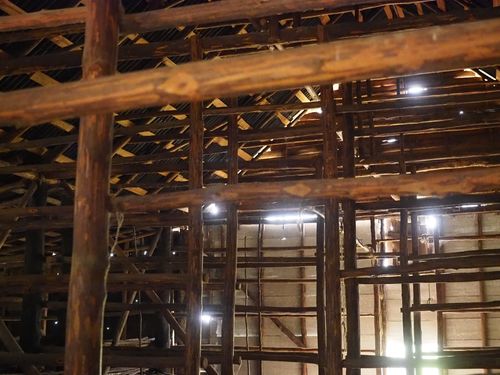
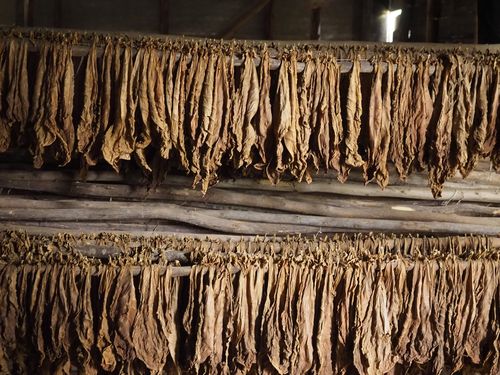
Inside the drying barns, tobacco leaves are suspended on long horizontal poles fixed beneath the roof structure. Ventilation openings can be adjusted according to humidity levels and weather conditions. The drying process gradually changes the color and texture of the leaves, which move from green tones toward darker brown shades.
Drying Barns and Rural Workspaces
The tobacco plantations of Viñales are strongly associated with wooden drying barns known as casas de tabaco. These structures are generally built from timber frames with high roofs covered by palm leaves or corrugated metal sheets. Their large interior volumes allow air circulation necessary for leaf preservation.
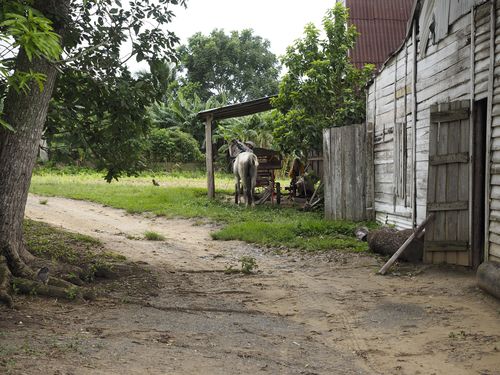
The agricultural environment combines cultivated plots, barns, storage spaces, animal enclosures, and narrow rural tracks connecting the farms. Work areas remain closely integrated into the surrounding landscape rather than separated into industrial agricultural zones.
The visual appearance of the plantations is characterized by long rows of tobacco plants, suspended leaves inside the barns, wooden structural elements, and the contrast between cultivated fields and limestone formations surrounding the valley.
Natural sounds dominate the working environment. Conversations between workers, movements of animals, cutting tools, carts, and the handling of leaves form the principal acoustic elements of plantation activity.
Participants and Organization of Labor
Tobacco cultivation usually involves multiple members of farming families. Tasks are distributed according to agricultural stages and practical experience. Some workers focus mainly on seed preparation and field maintenance, while others participate more directly in harvesting, drying, sorting, or transporting leaves.
Knowledge transmission occurs largely through observation and practical participation within family farms. Skills related to drying conditions, leaf selection, and crop maintenance are acquired gradually through repeated agricultural cycles.
Certain plantations also include demonstrations related to traditional cigar preparation techniques. These activities are generally carried out within the agricultural environment itself and remain connected to the handling and preparation of tobacco leaves.
Distinctive Characteristics of the Viñales Plantations
The tobacco plantations of Viñales are distinguished by the continued use of many manual cultivation methods and by the importance of traditional drying barns within the rural landscape. Farm sizes generally remain relatively limited compared to highly mechanized agricultural systems.
The visible transformation of tobacco leaves during drying, the organization of fields into narrow cultivated rows, and the open wooden structures of the drying barns are among the most recognizable features of the plantations.
The combination of manual agricultural labor, traditional rural buildings, and long-established cultivation methods continues to shape the agricultural identity of the Viñales Valley and contributes to the continuity of rural practices in western Cuba.
 Links to the main sections of the site