Français (France)
  Nederlands (nl-NL)
 Tangkuban Perahu is an active volcano located on the island of Java in Indonesia, near the city of Bandung. It is known for its large caldera and accessible craters, which attract both visitors and researchers. The site reflects the intense geological activity of the region, part of the Pacific Ring of Fire. Beyond its scientific significance, it also plays a role in local culture and is a notable feature of West Java’s tourism. Continuous monitoring is required, as eruptions from the volcano can still affect surrounding communities and the natural environment.
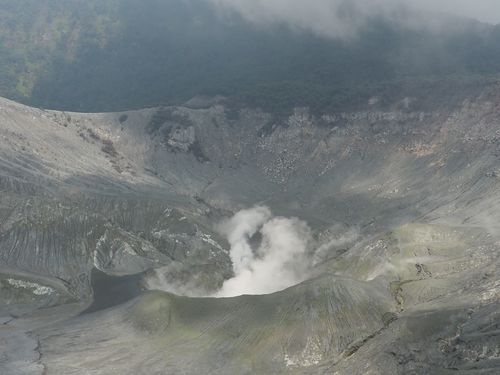
Java • Tangkuban Perahu Volcano
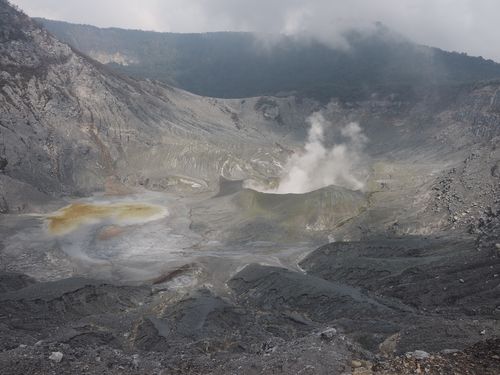
Java • Tangkuban Perahu Volcano
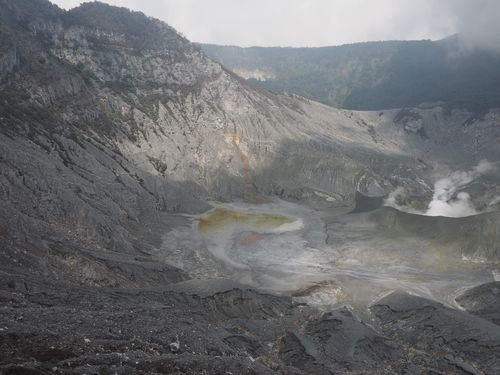
Java • Tangkuban Perahu Volcano
Natural site profile
Tangkuban Perahu Volcano
Natural site category: Vulcano
Natural site family: Volcanoes and calderas
Natural site genre: Terrestrial
Geographic location: Java • Java • Indonesia
• Links to •
• List of videos about Jakarta, Bandung on this site •
Indonesia • Java • Jakarta and Bandung
Tangkuban Perahu Volcano: From Cultural Symbol to Environmental Challenge
Early Valorisation and Cultural Significance
Tangkuban Perahu, located near Bandung in West Java, has long been embedded in the cultural and spiritual traditions of the Sundanese people. Legends surrounding its formation gave the volcano symbolic importance, transforming it into more than a geological feature. This cultural dimension contributed to its preservation, as the site was seen not only as a natural landmark but also as a reference point in local identity. Such narratives ensured that the volcano remained a place of memory and significance, similar to the way Mount Fuji in Japan became an icon through its integration into folklore and artistic traditions.
Colonial Context and Scientific Interest
The systematic valorisation of Tangkuban Perahu began during the Dutch colonial period in the nineteenth century. European scientists, fascinated by the volcanism of the Indonesian archipelago, undertook surveys and research on the mountain. Bandung, then a growing administrative and cultural hub, facilitated access to the site and encouraged its inclusion in colonial tourist itineraries. These dynamics reflected broader global trends: in the same period, the Vesuvius in Italy and Mount Etna in Sicily were popular among European travelers, while in the United States, Yellowstone’s geothermal features attracted early explorers. Tangkuban Perahu thus became part of a worldwide movement where spectacular natural sites were valued for their scientific curiosity and potential for tourism.
Post-Independence Developments and Economic Dimension
Following Indonesian independence in 1945, the volcano took on new importance within the framework of national development. Tangkuban Perahu was increasingly promoted as a tourist attraction for domestic and international visitors, reinforcing the cultural pride of the Sundanese region and contributing to the local economy. Several eruptions during the twentieth century reminded authorities of its inherent danger, leading to the establishment of monitoring systems. The balance between promoting the site as a symbol of natural wealth and mitigating its risks reflected broader global challenges, comparable to efforts in countries such as Costa Rica with the Arenal Volcano or Italy with Mount Vesuvius, where natural hazards and economic opportunities are closely intertwined.
Transformations Over Time
Over the centuries, Tangkuban Perahu has undergone significant transformations, both natural and human-induced. Successive eruptions reshaped its craters, leaving Kawah Ratu and Kawah Domas as dominant features still active today. On the human side, increased urbanisation around Bandung and the growth of mass tourism altered the environment. Facilities, trails, and commercial activities made the site more accessible but also more vulnerable to ecological degradation. These changes mirror what has occurred at other major volcanoes worldwide, such as the Mount St. Helens area in the United States, where natural cataclysm and human exploitation combine to reshape landscapes and their perception.
Global Context and Comparative Perspectives
The trajectory of Tangkuban Perahu highlights the interaction between local traditions and global processes. In colonial times, it symbolised scientific curiosity and territorial appropriation. In modern Indonesia, it embodies both cultural heritage and economic potential. On a global scale, its evolution echoes that of other sites where the management of natural wonders reflects broader political and cultural shifts. The case of Mount Fuji, elevated to UNESCO World Heritage status, illustrates how cultural and symbolic value can drive preservation. In contrast, Tangkuban Perahu has not been included in UNESCO’s lists but remains recognised as a key Indonesian natural site. Its situation demonstrates the importance of national and regional frameworks in safeguarding sites of ecological and cultural relevance, even outside international recognition.
Present Importance and Preservation Challenges
Today, Tangkuban Perahu is both a symbol of Sundanese heritage and a driver of economic activity through tourism. Ecologically, it represents a fragile system influenced by volcanic activity, biodiversity, and human pressure. Its symbolic role has been reinforced by centuries of narratives and events, but its preservation is threatened by several factors: volcanic hazards, uncontrolled tourism, urban sprawl, and environmental pollution. Climate change adds further uncertainty, as shifts in rainfall and temperature patterns affect the mountain ecosystem. The site is under continuous volcanological monitoring, but long-term conservation requires coordinated efforts between scientific institutions, local communities, and economic stakeholders.
Conclusion
Tangkuban Perahu reflects the convergence of culture, politics, and ecology in shaping the value of a natural site. From its integration into Sundanese traditions to its role in colonial science, from its post-independence valorisation to its current challenges, the volcano illustrates how natural landmarks evolve under human and environmental pressures. Its preservation depends on the ability to reconcile economic interests, cultural identity, and ecological sustainability—an equation faced by many volcanic sites around the world.
Tangkuban Perahu Volcano: A Natural Laboratory of Geology and Ecology
Unique Topography and Geological Features
Tangkuban Perahu, located in West Java near Bandung, Indonesia, is an active stratovolcano whose natural features provide a striking illustration of geological processes. Its name, meaning “upturned boat” in Sundanese, refers to its unusual silhouette shaped by past collapses and successive eruptions. The site is dominated by a large caldera and several well-defined craters, the most prominent being Kawah Ratu and Kawah Domas. These formations demonstrate volcanic activity that has been active for thousands of years and continue to emit fumaroles and hot springs. Such visible manifestations make the volcano an open-air geological laboratory, comparable in educational value to sites such as Mount Vesuvius in Italy or the geyser fields of Yellowstone in the United States.
Biodiversity and Ecological Processes
The volcanic slopes of Tangkuban Perahu are covered with dense vegetation, offering a mosaic of ecosystems adapted to challenging conditions. Acidic soils enriched by mineral deposits support a unique flora, including tree ferns, orchids, and endemic plant species. This vegetation provides habitats for birds, insects, and small mammals, illustrating processes of ecological resilience and adaptation in environments shaped by recurring disturbances. The coexistence of forests, open clearings, and sulfur-rich zones reflects a dynamic balance between destruction and renewal—a biological innovation that highlights the resilience of tropical ecosystems.
Local and Global Environmental Interactions
The volcano demonstrates the interplay between local natural factors and global environmental processes. Locally, its eruptions have created fertile soils, supporting agriculture and human settlement in the Bandung region. At the same time, its activity links it to the Pacific Ring of Fire, a global system of tectonic boundaries that influences atmospheric composition and, during major eruptions, can have climate repercussions. Although Tangkuban Perahu has not produced globally disruptive events like Krakatoa in 1883 or Tambora in 1815, it remains an example of how localized geological processes are part of broader environmental systems that shape both ecosystems and societies.
Notable Features and Anecdotes
At an elevation of about 2,084 meters, the volcano is relatively accessible compared to other active volcanoes in Indonesia. Visitors can reach the crater rims by vehicle and walk around areas where fumaroles release sulfur gases. Anecdotal accounts note that gas emissions can be so strong at times that authorities temporarily close access for safety reasons. This accessibility, coupled with its dramatic topography, makes Tangkuban Perahu both a research site and a popular tourist destination. Annual visitor numbers are significant, underlining its dual role as a natural wonder and an economic resource.
Recognition and Comparative Perspectives
Unlike other Indonesian volcanoes such as Krakatoa or Mount Bromo, Tangkuban Perahu has not been inscribed on the UNESCO World Heritage List. Nevertheless, it enjoys national recognition as an important natural attraction and is subject to ongoing monitoring by volcanological authorities. The absence of international designation does not diminish its ecological or symbolic importance but highlights the role of local and national frameworks in conservation. Comparisons with globally recognized sites such as Mount Fuji in Japan or Mount Etna in Italy show that recognition often combines natural value with cultural and symbolic significance. Tangkuban Perahu, while not yet listed, clearly shares the geological and ecological qualities that make such sites exemplary on the global stage.
Current Preservation and Challenges
Today, the preservation of Tangkuban Perahu faces multiple challenges. Intensive tourism, urban expansion around Bandung, and environmental pressures place stress on the fragile ecosystem. Continuous volcanological monitoring ensures that risks are managed, but ecological degradation and pollution remain concerns. Climate change adds further uncertainty, influencing rainfall and erosion patterns. Addressing these challenges requires coordinated management between scientific institutions, local authorities, and community stakeholders to balance conservation with accessibility and economic use.
 Links to the main sections of the site