

 Français (France)
  Nederlands (nl-NL)
 The Saigon Central Post Office is a public building located in Ho Chi Minh City, Vietnam, within the historic district of the former city of Saigon. The structure is considered one of the most recognizable urban landmarks of the city and continues to operate as a functioning postal facility. In addition to its administrative role, the building attracts visitors and contributes to the cultural landscape of the city center. The post office stands close to several major historical monuments and forms part of an ensemble of significant public buildings in the area. Today it remains both a working institution and a widely visited site.

Ho Chi Minh City • Saigon Central Post Office
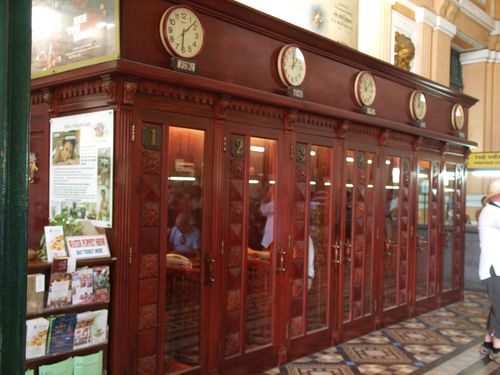
Ho Chi Minh City • Saigon Central Post Office: phone booths

Ho Chi Minh City • Saigon Central Post Office: ceiling
Monument profile
Saigon Central Post Office
Monument category: Post office
Monument family: Civil engineering structures (bridges, wells, etc.) and factories
Monument genre: Economic
Geographic location: Ho Chi Minh City • Vietnam
Construction period: 19th century AD
• Links to •
• List of videos about Ho Chi Minh City on this site •
Ho Chi Minh City (formerly Saigon) • Vietnam
History of the Saigon Central Post Office in Ho Chi Minh City
Construction and political context of the building
The Saigon Central Post Office was constructed between 1886 and 1891 during the period when the French colonial administration was reorganizing the urban structure of Saigon, then the capital of the colony of Cochinchina. The project formed part of a broader effort to establish administrative and technical infrastructure capable of supporting the colonial government’s communication systems.
The construction of the building was closely linked to the expansion of telegraphic and postal networks across French Indochina. Efficient communication between colonial authorities, commercial institutions, and the metropolitan government required centralized facilities capable of processing large volumes of correspondence and telegrams. The new post office therefore served both administrative and economic functions within the colonial system.
The building was erected in a strategic location within the administrative district that the French authorities were developing in Saigon. Its position near key institutional buildings reinforced its role within the colonial administrative network and ensured direct accessibility for both officials and the public.
Role of the building in colonial communication networks
From the time of its inauguration, the Saigon Central Post Office functioned as the principal postal and telegraphic hub for Cochinchina. The building housed facilities for sorting and distributing mail arriving from overseas as well as correspondence circulating within the colonial territory.
Telegraph services were integrated into the building, allowing rapid transmission of official communications between Saigon and other major administrative centers in Indochina. These services also connected the colony to international telegraphic networks linking Asia with Europe.
Postal operations in the building were closely connected to maritime transport routes. Mail arriving from Europe typically reached Saigon through maritime shipping lines that connected the colony with major ports in France and other parts of Asia. Once received at the port, correspondence was processed in the central post office and distributed through regional postal networks.
The building also served as a central location for administrative communications. Official documents, government instructions, and commercial correspondence passed through its facilities, reinforcing its importance within the institutional infrastructure of the colonial administration.
Transformations during the twentieth century
During the early twentieth century, the Saigon Central Post Office continued to operate as a key component of the colonial communication system. Despite political and military upheavals affecting the region, the building remained in continuous use as a postal facility.
Following the end of French colonial rule in the mid-twentieth century, the building retained its original function. Under the government of the Republic of Vietnam, the post office continued to operate as an important center for mail services in the rapidly expanding city.
After the reunification of Vietnam in 1975, the building remained part of the national postal infrastructure. Although communication technologies evolved during the late twentieth century, the post office continued to process mail and provide services to residents and visitors.
Throughout these political transitions, the building experienced relatively limited structural alteration. Its principal spaces continued to serve the same operational functions for which they had originally been designed.
Global historical context at the time of construction
The construction of the Saigon Central Post Office occurred during a period when communication networks were expanding rapidly around the world. In Europe and North America, telegraph systems and railways were transforming long-distance communication. In many colonial territories, European powers were constructing administrative and technical infrastructure designed to facilitate governance and commercial exchange. At the same time, international postal agreements were gradually creating standardized global systems for the exchange of correspondence.
Present role and preservation
Today, the Saigon Central Post Office continues to function as an operational postal facility within Ho Chi Minh City. Mail services remain active in the building, maintaining continuity with its original administrative purpose.
The structure has also become an important historical landmark within the city’s central district. Its preservation reflects recognition of its architectural and historical significance within the urban landscape.
Conservation efforts have focused on maintaining the structural integrity of the building while allowing continued use of its interior spaces. Maintenance and restoration programs have aimed to preserve the original architectural elements and ensure that the building remains functional within the contemporary urban environment.
Architecture of the Saigon Central Post Office in Ho Chi Minh City
Urban setting and spatial organization of the building
The Saigon Central Post Office occupies a prominent position in the historic administrative district of Ho Chi Minh City, directly facing Công xã Paris Square and situated beside the Saigon Notre-Dame Cathedral. The building aligns with the orthogonal street layout established during the late nineteenth-century urban planning of colonial Saigon. Its façade faces the square, creating a formal civic frontage, while the rear of the structure historically accommodated technical areas associated with postal processing and distribution.
The plan of the building is organized around a longitudinal axis dominated by a large central hall that extends from the main entrance toward the rear of the structure. This elongated hall functions as the principal circulation and service space. Public counters line both sides of the hall, allowing visitors to access postal services while maintaining clear movement through the central aisle.
Secondary spaces are arranged along the perimeter of the main volume. Administrative offices and service rooms occupy the lateral sections and the rear areas of the structure. The symmetry of the plan reinforces the clarity of circulation patterns, with the entrance portal aligned directly with the longitudinal axis of the interior hall.
The building is generally attributed to the French architect Alfred Foulhoux, who was active in the colonial urban development of Saigon at the end of the nineteenth century. The metal framework of the large interior hall, composed of exposed metal arches, has often led to an erroneous attribution to Gustave Eiffel, although historical research associates the architectural design with Foulhoux
Composition and architectural articulation of the façade
The principal façade is organized around a monumental central arch that marks the main entrance. This arch forms the visual focus of the building’s exterior composition. Its curved profile rises above the surrounding structural elements and frames the entrance portal through which visitors enter the building.
The façade is structured by a rhythmic sequence of pilasters that divide the elevation into vertical bays. Between these structural divisions, large openings allow natural light to penetrate the interior spaces. At the ground level, many of these openings take the form of arched windows that correspond to the internal height of the main hall.
Above these openings, the upper level incorporates rectangular windows set within framed architectural panels. The alignment of these windows follows the structural rhythm established by the pilasters. Cornices and horizontal moldings define the separation between levels, visually organizing the elevation into distinct horizontal layers.
At the center of the upper façade, a triangular pediment rises above the entrance arch. Within this pediment is a large circular clock that functions as a focal element visible from the square. The pediment and surrounding moldings emphasize the central axis of the building and reinforce the symmetry of the façade.
Interior structure and the central hall
The interior of the Saigon Central Post Office is dominated by an expansive central hall that extends across most of the building’s length. This hall is covered by a large vaulted roof supported by a series of exposed metal arches. These arches span the width of the interior space and create a structural framework capable of supporting the roof without the need for intermediate columns.
The metal framework forms a repeating sequence of curved structural ribs that run perpendicular to the axis of the hall. This system distributes the weight of the roof along the masonry walls that form the building’s outer structure. The absence of interior structural supports produces an open interior volume suitable for accommodating large numbers of visitors.
The ceiling structure is visually emphasized by the painted metal framework, whose green tones contrast with the lighter surfaces of the walls and roof panels. Openings positioned along the upper sections of the side walls allow daylight to enter the hall, contributing to a bright interior environment.
Along both sides of the hall, a sequence of service counters forms a continuous architectural line. These counters define the operational areas of the post office while preserving a central corridor that guides circulation between the entrance and the interior service zones.
Materials, decorative elements, and architectural features
The building combines masonry construction for its exterior walls with a metal structural system for the interior roof. The exterior walls are constructed of brick masonry covered with plastered surfaces that create a uniform façade finish. This masonry structure provides the primary load-bearing system for the building’s vertical elements.
The metal roof structure constitutes a defining architectural feature of the interior. Its use allowed the creation of a wide-span interior hall without the need for multiple columns. The exposed metal arches demonstrate the integration of industrial construction techniques within the building’s architectural design.
Several decorative elements are integrated directly into the interior surfaces of the hall. Large historical maps mounted on the side walls depict the telegraph and postal networks that existed at the time of the building’s construction. These maps form part of the interior architectural composition and visually connect the building with its communication functions.
The wooden service counters arranged along the walls also contribute to the architectural organization of the interior. Their placement follows the linear structure of the hall, reinforcing the spatial rhythm created by the structural arches.
Architectural continuity and preservation
The Saigon Central Post Office has retained most of its original architectural configuration since its completion in the late nineteenth century. The central hall, façade composition, and structural system remain largely unchanged.
Restoration work undertaken over time has focused primarily on maintaining the structural integrity of the masonry walls and metal roof framework. Conservation efforts have also addressed the preservation of decorative interior elements, including the historical maps and the architectural finishes of the hall.
Continued use of the building as a postal facility has contributed to the preservation of its interior spatial organization. The original service functions remain compatible with the design of the central hall, allowing the building to maintain both its operational role and its architectural integrity within the contemporary urban environment of Ho Chi Minh City.