

 Français (France)
  Nederlands (nl-NL)
 The Abdulaziz Khan Madrasa is an Islamic educational institution located in the historic centre of Bukhara, Uzbekistan. Built during the seventeenth century, it reflects the city’s long-standing role as a religious and intellectual centre of Central Asia. The institution was established to provide education in various fields of Islamic scholarship and learning. Over time, it remained connected to the cultural and religious life of Bukhara. Today, the madrasa forms part of the “Historic Centre of Bukhara,” a UNESCO World Heritage property inscribed in 1993.
Monument profile
Abdelaziz Khan Madrasa
Monument category: Madrasa
Monument family: Mosque, Minaret or Madrasa
Monument genre: Religious
Cultural heritage: Islamic
Geographic location: Bukhara • Uzbekistan
Construction period: 17th century AD
This monument in Bukhara is inscribed on the UNESCO World Heritage List since 1993 and is part of the serial property "Historic Centre of Bukhara".See the UNESCO monuments featured on this site
• Links to •
• List of videos about Bukhara on this site •
Bukhara, oasis on the silk road • Uzbekistan
Historical Development of the Abdulaziz Khan Madrasa in Bukhara
Foundation under the Janid Dynasty
The Abdulaziz Khan Madrasa was constructed between 1651 and 1652 in Bukhara during the reign of the Janid ruler Abdulaziz Khan. Its foundation took place during a period when Bukhara remained one of the principal religious and intellectual centres of Central Asia despite the political fragmentation that affected parts of the region.
The madrasa was erected opposite the earlier Ulugh Beg Madrasa, built in the fifteenth century. This location was deliberately chosen to create a monumental educational and religious complex within the urban fabric of the city. By commissioning a new institution facing one of Bukhara’s most respected centres of learning, Abdulaziz Khan sought to reinforce both the prestige of his dynasty and the city’s role as a centre of Islamic scholarship.
The building was designed to serve as a religious school where students could study Islamic law, theology, Qur’anic interpretation and related disciplines. Beyond its educational function, the madrasa represented a visible expression of political authority. Its construction demonstrated the ruler’s support for religious institutions and his intention to associate his reign with the intellectual traditions of Bukhara.
Educational Role and Religious Significance
Following its completion, the madrasa became part of the network of educational institutions that shaped religious life in the Khanate of Bukhara. Students from different parts of Central Asia attended the institution, where teaching was conducted according to established Islamic scholarly traditions.
Its position opposite the Ulugh Beg Madrasa contributed to the formation of an important educational district. The two institutions complemented one another and reinforced the concentration of religious learning within this section of the city. The Abdulaziz Khan Madrasa provided accommodation for students, teaching facilities and spaces devoted to religious activities.
Historical accounts indicate that the madrasa maintained an active educational role for an extended period. Its reputation was linked not only to the quality of instruction but also to the prestige of its patron and the richness of the architectural setting in which scholarly activities took place.
The institution also contributed to the transmission of religious knowledge during periods of political change. As dynasties succeeded one another, the madrasa continued to function as a place of learning and remained integrated into the religious life of Bukhara.
Political Change, Decline and Preservation
The political transformations that affected Central Asia during the nineteenth century gradually altered the conditions under which traditional educational institutions operated. Under the Emirate of Bukhara, the madrasa continued to function, although changing economic circumstances influenced the maintenance of many religious buildings.
Following the Russian expansion into Central Asia and later the establishment of Soviet authority, Islamic educational institutions faced increasing restrictions. As occurred elsewhere in the region, many madrasas lost their original functions or experienced periods of decline. The Abdulaziz Khan Madrasa was no exception.
During the Soviet period, religious activities were significantly reduced and many historic monuments were repurposed or placed under state administration. The building survived, however, largely because of its architectural and historical value. Preservation measures undertaken during the twentieth century helped prevent the loss of major structural and decorative elements.
Unlike some monuments that underwent extensive reconstruction, the madrasa retained much of its historical character. Restoration campaigns focused on stabilizing the structure and conserving its decorative features while preserving the overall appearance of the seventeenth-century building.
Global Historical Context
The construction of the Abdulaziz Khan Madrasa in the early 1650s coincided with the reign of Louis XIV in France and the consolidation of the Qing dynasty in China. In India, the Mughal Empire was approaching the period associated with the construction of the Taj Mahal and other major imperial projects. The Ottoman Empire remained a significant political power extending across southeastern Europe, North Africa and the Middle East. In England, the Commonwealth period followed the English Civil War.
Current Function and Heritage Status
Today, the Abdulaziz Khan Madrasa remains one of the most significant historical monuments of Bukhara’s old city. Although it no longer serves the educational role for which it was originally established, it continues to illustrate the importance of religious scholarship in the history of the city.
The monument forms part of the UNESCO World Heritage property “Historic Centre of Bukhara,” inscribed on the World Heritage List in 1993. This designation recognizes the historic urban fabric of Bukhara and the exceptional concentration of monuments that document its development over many centuries.
Conservation efforts continue to focus on the protection of the building’s structural integrity and decorative elements. Particular attention has been devoted to preserving features that distinguish the madrasa from earlier educational institutions in the city.
Today the Abdulaziz Khan Madrasa stands as a testimony to the cultural ambitions of the Janid rulers, the long tradition of Islamic learning in Bukhara and the continuity of the city’s historic urban landscape. Its survival through periods of political change, declining religious patronage and modern restoration campaigns has allowed it to remain an important component of Bukhara’s architectural and historical heritage.
Architectural Composition and Spatial Organization of the Abdulaziz Khan Madrasa
Urban Setting and General Layout
The Abdulaziz Khan Madrasa occupies a prominent location in the historic centre of Bukhara. It stands directly opposite the fifteenth-century Ulugh Beg Madrasa, creating one of the most significant architectural pairings within the city. The placement of the two buildings on opposite sides of a shared urban space establishes a balanced composition linking two major phases of Bukhara’s architectural history.
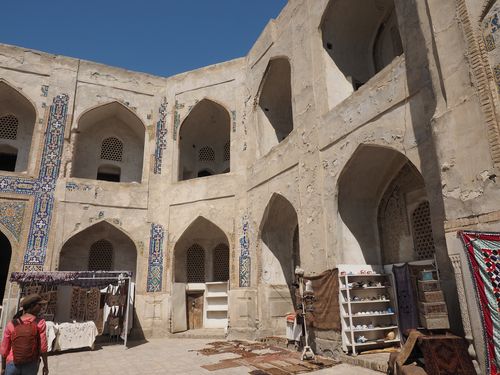
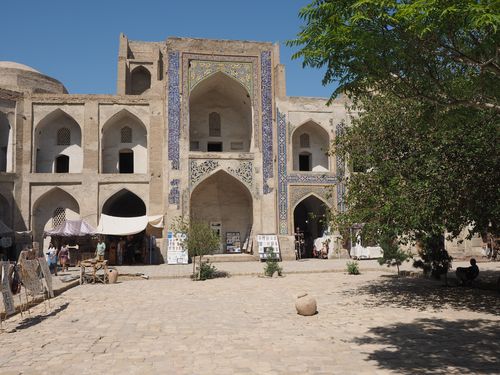
The madrasa follows a rectangular plan organized around a large central courtyard. This courtyard functions as the principal circulation space and provides access to the educational, residential and religious areas of the complex. The arrangement reflects the requirements of an institution intended to accommodate students while supporting teaching and worship.
The composition is structured around a strong central axis. Visitors enter through the monumental portal and pass directly into the courtyard, from which the main spaces are distributed. The symmetrical arrangement of rooms and architectural elements reinforces the clarity of the plan and contributes to the orderly character of the building.
The structure rises on two levels. Student cells are arranged around the courtyard on both floors, creating a regular spatial system. This configuration combines accommodation and education within a unified architectural framework.
Structural System, Construction Techniques and Building Materials
The madrasa is constructed primarily of baked brick, the dominant building material in Bukhara’s monumental architecture. Brick forms the structural core of the building and determines both its appearance and engineering characteristics. The substantial thickness of the exterior walls allows them to support the weight of vaults, domes and upper-storey rooms.
A sophisticated system of arches and vaults covers the interior spaces. Corridors, teaching halls and subsidiary rooms employ different forms of masonry roofing adapted to their dimensions and functions. These solutions distribute structural loads efficiently toward the load-bearing walls and reduce the need for internal supports.
The principal halls are covered by domes resting on carefully designed transition systems. Architectural devices such as squinches allow the transformation of square or rectangular rooms into circular dome bases. These elements are integrated directly into the masonry and demonstrate a high level of technical skill.
The structural design also accommodates an unusually extensive decorative program. Walls, portals and domed spaces were conceived not only as structural elements but also as surfaces intended for elaborate ornamentation. This relationship between architecture and decoration is one of the defining characteristics of the monument.
The foundations and supporting structures have enabled the building to withstand centuries of use despite the weight of its masonry construction.
Monumental Façade and Organization of Architectural Volumes
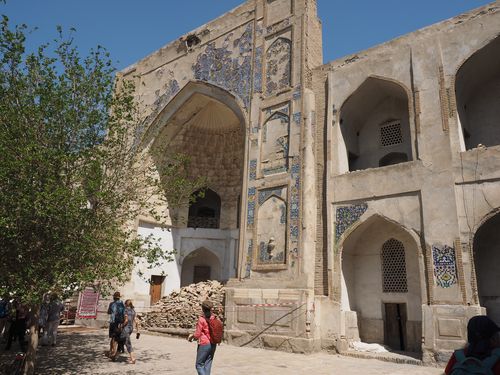
The principal façade forms the most visually striking element of the madrasa. Dominated by a monumental pishtaq, or recessed portal, it establishes the architectural identity of the entire building. The portal rises significantly above the surrounding sections and clearly marks the main entrance.
The façade is organized symmetrically around this central feature. Niches, windows and decorative openings are distributed in a carefully balanced arrangement that creates harmony between solid wall surfaces and architectural voids. The proportions of the façade emphasize verticality while preserving overall compositional stability.
Behind the entrance façade, the building is organized into a hierarchy of architectural volumes. The most important halls occupy prominent positions within the plan and are marked externally by domes. Secondary spaces are arranged around the courtyard and incorporated into smaller volumes that support the primary functions of the institution.
The silhouette of the madrasa is complex, combining multiple levels, domes, niches and projecting elements that create a varied roofline.
Decorative Program and Stylistic Characteristics
The Abdulaziz Khan Madrasa is widely recognized for the richness and diversity of its decoration. Its ornamental program represents one of the most elaborate examples of seventeenth-century architecture in Bukhara.
The main portal is covered with extensive polychrome ceramic decoration. Traditional shades of blue and turquoise are complemented by green, yellow, ochre and other colours rarely employed on such a scale in earlier monuments. This expanded colour palette distinguishes the madrasa from many other buildings in the city.
Geometric ornament covers large areas of the façade and is integrated into the architectural structure, emphasizing its main divisions.
Floral motifs are equally prominent. Vegetal designs appear in ceramic panels, decorative fields and architectural details. Their complexity reflects a growing preference for highly detailed ornamental compositions during the period in which the madrasa was constructed.
Calligraphic inscriptions form another major component of the decorative program. These inscriptions are incorporated into architectural zones and combined with geometric and floral motifs. Rather than functioning independently, they participate in the overall organization of decorative surfaces.
Interior decoration is equally elaborate. Vaults, niches and principal chambers contain painted, carved and moulded ornamental elements. The treatment of interior spaces creates a visual continuity between exterior and interior decoration.
One of the most distinctive characteristics of the monument is the contrast it presents with the Ulugh Beg Madrasa opposite. While the earlier building emphasizes restraint and geometric clarity, the Abdulaziz Khan Madrasa displays a more complex and decorative architectural language.
Architectural Conservation and Preservation
The richness of the madrasa’s decorative surfaces has required repeated conservation efforts over the centuries. Restoration campaigns undertaken during the nineteenth, twentieth and twenty-first centuries have focused on preserving masonry, domes, ceramic revetments and ornamental details.
Some decorative areas suffered deterioration due to weathering, structural movement and the natural aging of materials. Conservation work has aimed to stabilize these areas while retaining as much original material as possible.
Structural interventions have also addressed the stability of walls, vaults and domes. Particular attention has been devoted to preserving the balance between structural integrity and historical authenticity. Repairs have generally sought to reinforce existing elements rather than replace them.
The ceramic decoration has required especially careful treatment. Specialists have worked to conserve surviving decorative surfaces while preventing further deterioration caused by environmental conditions.
Today the madrasa retains most of its seventeenth-century spatial organization and a substantial portion of its original decorative program. Its monumental portal, symmetrical courtyard, two-storey student cells, domed halls and exceptionally rich ornamentation remain clearly visible.
As part of the UNESCO World Heritage property “Historic Centre of Bukhara,” inscribed in 1993, the building preserves a coherent integration of structure, space and ornament.