

 Français (France)
  Nederlands (nl-NL)
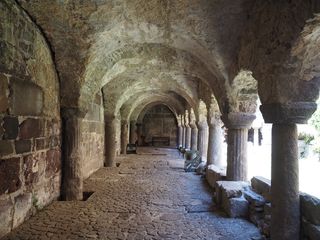
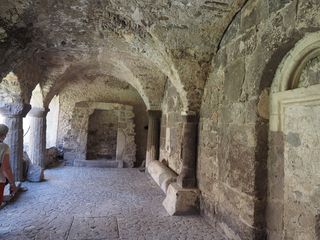
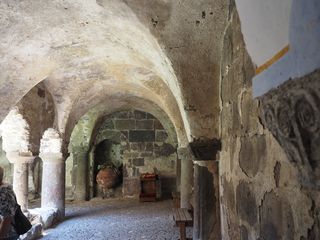
 The Benedictine Cloister of the Cathedral of Saint Bartholomew is a medieval monastic complex located in Lipari, Sicily, Italy. Built in the 11th century, it was part of the religious structures connected to the cathedral and reflects the long-standing presence of monastic life on the island. Its vaulted galleries and volcanic stone columns evoke the spiritual and cultural influence of the Benedictine community in the Aeolian archipelago. Now incorporated into the local archaeological museum, the cloister offers a tranquil setting valued for its heritage and historical significance.
Monument profile
Benedictine Cloister of the Cathedral of Saint Bartholomew
Monument category: Monastery
Monument family: Monastery
Monument genre: Religious
Cultural heritage: Christian
Geographic location: Lipari • Sicily • Italy
Construction period: 11th century AD
• Links to •
• List of videos about Lipari on this site •
Lipari • Aeolian Heritage from Antiquity to Christianity
History of the Benedictine Cloister of the Cathedral of Saint Bartholomew in Lipari
The Benedictine Cloister of the Cathedral of Saint Bartholomew is one of the most significant medieval remains of the Aeolian Islands. Built in the 11th century, it reflects the ambitions of the Norman rulers who reshaped Sicily and its surrounding islands after centuries of political upheaval. Over time, the cloister has witnessed invasions, reconstructions, and profound changes in religious and civic life, before becoming part of the Museo Archeologico Regionale Eoliano.
Political and Social Context of its Construction
The cloister was built during a pivotal era in the history of southern Italy. In the first half of the 11th century, the Normans—warriors of northern European origin—gradually gained control over territories that had long been contested by Byzantines, Arabs, and Lombards. Sicily, and the Aeolian Islands with it, emerged from a period of Islamic rule and entered a new phase of Latin Christian consolidation.
For the Norman rulers, architecture was an instrument of authority. Establishing monasteries served both political and spiritual purposes: they asserted control over newly conquered lands while strengthening ties with the Roman Church. The Benedictine order was particularly valued for its discipline and its strong links to papal power. By founding or restoring monasteries such as the one in Lipari, the Normans signaled their legitimacy and brought the islands into a larger Christian monastic network connected to Montecassino and other major abbeys.
The cloister at Lipari thus symbolized the reorganization of the Church in Sicily under Norman patronage. It also reflected the strategic importance of the Aeolian archipelago as a maritime outpost, essential to controlling routes across the Tyrrhenian Sea. Supporting a Benedictine community here reinforced both spiritual oversight and the projection of Norman influence into a zone previously vulnerable to raids.
Global Context and Monastic Movements
The creation of the cloister coincided with a broader monastic revival in medieval Europe. The 11th century was a golden age for the Benedictines, as Cluny reached the height of its influence and many reformed monasteries flourished. In the Mediterranean, similar foundations served as instruments of Christianization and territorial consolidation. Norman Sicily, exposed to Byzantine, Arab, and Latin influences, became a laboratory of cultural and architectural synthesis. The cloister at Lipari is part of this global wave of ecclesiastical building: functional, fortified when needed, and symbolically asserting Christian identity in reclaimed territories.
Major Historical Events
The cloister did not remain untouched by the turbulent history of the Aeolian Islands. One of the most traumatic episodes occurred in 1544, when the Ottoman admiral Khair ed-Din Barbarossa attacked Lipari. The population was decimated, religious buildings were looted, and monastic life suffered a severe blow. The Benedictine community never fully recovered from this devastation, and the cloister’s original vitality diminished.
During the 17th century, while the cathedral underwent significant Baroque remodeling, the cloister retained its medieval character. By then, the once-powerful Benedictine presence had been reduced to a small conventual community serving the parish. The political landscape shifted repeatedly—from Spanish to Bourbon control—but these changes offered no real revival for the monastery.
The 19th century brought further decline. The new Kingdom of Italy introduced anticlerical reforms that suppressed or secularized many monastic institutions. The cloister lost its religious function altogether and parts of the complex were repurposed for practical uses.
Transformations and Reuse
After its monastic life ended, the cloister experienced periods of neglect and pragmatic adaptation. Some arcades were closed off, and the surrounding episcopal complex was gradually absorbed into the urban fabric of Lipari’s acropolis. However, the 20th century marked a turning point. Italian authorities recognized the historical value of the site, and the Museo Archeologico Eoliano was created under the guidance of archaeologist Luigi Bernabò Brea. The cloister became a transitional space within the museum, connecting visitors to galleries that narrate the islands’ long history from prehistory to medieval times.
This adaptive reuse preserved the essential structure while integrating the cloister into a new cultural function. Its quiet courtyard now serves as a passage for reflection rather than monastic meditation.
The Cloister in Modern Cultural Identity
Today, the Benedictine Cloister is no longer an active religious space, but it holds symbolic significance for Lipari. It evokes the Christian continuity of the Aeolian Islands and their medieval past shaped by conquest and resilience. For the local community, it represents a tangible link to centuries of faith and survival amid political and maritime turmoil.
Culturally, the cloister plays a key role within the museum. It introduces visitors to the layered history of the site, bridging the ancient and medieval worlds. It also serves occasionally as a venue for cultural events, exhibitions, or small gatherings, though without liturgical functions. Its presence enhances Lipari’s image as a destination not only of natural beauty but also of historical depth.
State of Preservation and Conservation Challenges
Structurally, the cloister is in relatively stable condition, but its location on a volcanic island in a humid, salty environment poses ongoing challenges. The volcanic stone used in construction, while durable, is susceptible to slow erosion from sea air. Moisture can also weaken mortar joints. Increased tourism adds stress through constant foot traffic.
Restoration campaigns have focused on consolidating the arcades, cleaning stone surfaces, and mitigating humidity. The site enjoys protection as a cultural asset under Italian heritage law, though it is not part of the UNESCO World Heritage list. Conservation policy seeks to balance public access with the preservation of fragile medieval masonry.
Modern preservation emphasizes discreet structural reinforcement and controlled visitor flow. Maintaining the cloister as part of the museum ensures oversight and ongoing care, but challenges remain, including funding and the impact of climate-related humidity and salt crystallization.
Conclusion
The Benedictine Cloister of the Cathedral of Saint Bartholomew is far more than an architectural remnant. It embodies the ambitions of Norman rulers, the resilience of a monastic community faced with invasions, and the adaptive reuse of sacred spaces in modern cultural life. Its robust medieval construction allowed it to survive centuries of upheaval, while its transformation into a museum setting demonstrates how heritage can evolve without losing its identity. Today it stands as a quiet yet eloquent witness to the spiritual, political, and cultural history of Lipari and the wider Mediterranean.
Architecture of the Benedictine Cloister of the Cathedral of Saint Bartholomew in Lipari
The Benedictine Cloister adjoining the Cathedral of Saint Bartholomew in Lipari, Sicily, is one of the most compelling examples of medieval monastic architecture in the southern Italian islands. Built in the 11th century during the Norman consolidation of the region, it embodies both technical ingenuity and the cultural fusion that characterized Sicily at the time. Though modest in scale compared to continental abbeys, its design reflects sophisticated construction methods, regional adaptation to climate and geology, and a clear spiritual vision expressed through built form.
Technological and Architectural Innovations
The period of the cloister’s construction coincided with the Norman architectural revival in southern Italy. Builders were skilled at integrating Romanesque principles—massive masonry, rounded arches, and clear structural logic—with knowledge inherited from Byzantine and Islamic traditions. The cloister’s design demonstrates several innovations that were forward-looking for the 11th century:
- Structural stability through rounded arches: The galleries are supported by robust semicircular arches that distribute weight evenly across paired columns and thick outer walls. This approach was reliable in an area prone to seismic activity and high winds.
- Controlled light and ventilation: The architects balanced the need for serenity with practical comfort. Moderately narrow openings along the galleries allow soft daylight and cross-ventilation while shielding against the salty Tyrrhenian breeze. Such climatic adaptation was critical in a maritime environment.
- Efficient building sequence: Monastic construction often followed a pragmatic order—raising perimeter walls first, then roofing galleries to provide immediate shelter while interior works continued. This allowed the cloister to function early even as finishing proceeded.
These techniques, while rooted in established Romanesque engineering, were adapted intelligently to the island’s constraints and helped ensure the cloister’s longevity.
Materials and Construction Methods
The cloister’s architecture is inseparable from its volcanic island setting. Builders relied heavily on local basaltic lava stone, abundant, durable, and relatively easy to shape when freshly quarried. Its density and natural resistance to sea air made it a logical choice for the main walls and columns. The dark stone gives the cloister its sober, austere character.
To add refinement and articulation, lighter tuff and limestone were introduced for arches, capitals, and decorative details. These stones could be carved with more precision, enabling modest yet elegant mouldings and column bases. Mortar based on lime and pozzolanic ash—materials long used in Mediterranean construction—provided resilience against humidity and salt.
Roofing originally employed clay tiles supported by timber framing, a lightweight solution suited to a seismic zone. The use of mixed materials—dense lava for stability, softer limestone for ornament, and lightweight clay for roofing—reflects both local pragmatism and the sophisticated supply networks of Norman Sicily.
Architectural and Artistic Influences
Sicily in the Norman period was a melting pot of cultures, and the cloister at Lipari embodies this synthesis:
- Benedictine Romanesque tradition: The quadrangular plan with a central courtyard and four covered walks directly reflects the layout popularized by Montecassino and other Benedictine centers.
- Byzantine impact: Centuries of Byzantine control in southern Italy left a legacy of masonry techniques and understated decorative motifs, especially in the use of simple vegetal capitals and restrained iconography.
- Islamic and Arab-Norman heritage: While Lipari’s cloister is less ornate than Palermo’s great monuments, some arches show slightly elongated curves influenced by Islamic architecture, and the use of geometric patterns in stonework hints at Arab craftsmanship.
- Reuse of ancient elements: Several columns and capitals are believed to have been repurposed from earlier Christian or Roman buildings on the island, a practice both practical and symbolic, linking the monastery to the island’s deep past.
This blend created an architecture at once functional and symbolically charged—a space for prayer shaped by global Mediterranean exchanges.
Spatial Organization and Design
The cloister follows a rectangular plan of roughly twenty meters per side, enclosing a garden that historically served meditation and possibly medicinal plant cultivation. Four vaulted galleries frame this space, each rhythmically divided by monolithic columns and semicircular arches. One side connects directly to the cathedral, allowing monks private access to the church for liturgy, while other wings once opened onto communal rooms such as the refectory and chapter house.
The galleries provided sheltered circulation, while the open courtyard offered light and calm. The modest proportions encouraged contemplation and a sense of enclosure without grandeur—typical of Benedictine ideals focused on prayer and community rather than display.
Structural Characteristics and Notable Features
Seismic resilience was an implicit requirement. The lava stone walls are thick, and the arches distribute lateral forces efficiently. Columns are sturdy but not overly slender, prioritizing strength over decorative exuberance. The vaulting of the galleries, though simple, represents advanced medieval engineering capable of enduring earthquakes and centuries of environmental wear.
Some chapels and small ancillary rooms once opened directly from the cloister, although later alterations sealed several of these. The floor was likely stone-paved to manage humidity, and roof eaves were extended to direct rainwater into the central courtyard, an early example of integrated drainage.
Anecdotes and Symbolic Elements
According to local tradition, some of the columns and carved blocks came from older Christian sanctuaries destroyed during earlier invasions, possibly even from late Roman structures. Reuse symbolized continuity of faith after centuries of upheaval. The central garden, though simple, was said to have been planted with healing herbs used by the monastic infirmary, aligning with the Benedictine role in providing medical care.
While not grand in decoration, the cloister’s quiet proportions and play of light and shadow embody the Benedictine ideal of moderation. Its restraint contrasts with the richly decorated Baroque cathedral it adjoins, illustrating the long arc of stylistic change on the site.
International Recognition and Conservation
Though not inscribed on the UNESCO World Heritage List, the cloister is protected under Italian cultural heritage law and is considered a monument of high historical value within the Aeolian archipelago. Its integration into the Museo Archeologico Regionale Eoliano has been key to its survival, ensuring oversight, controlled visitor access, and funding for maintenance.
Conservation efforts have focused on stabilizing the medieval masonry, consolidating arches weakened by salt-laden humidity, and cleaning volcanic stone without erasing its aged patina. The island’s marine climate remains a challenge, as moisture and salt can slowly erode mortar and stone. Rising tourism adds pressure, requiring careful visitor flow management to preserve delicate details.
Conclusion
The Benedictine Cloister of the Cathedral of Saint Bartholomew stands as a masterful example of medieval monastic architecture adapted to an island environment. Its use of local volcanic stone, pragmatic yet sophisticated construction techniques, and subtle blend of Romanesque, Byzantine, and Islamic influences capture the cosmopolitan character of Norman Sicily. Though modest compared to great continental abbeys, it is a refined, resilient space where engineering meets spirituality. Today, repurposed as part of a leading archaeological museum, it continues to embody centuries of cultural exchange and remains a cornerstone of Lipari’s architectural heritage.