

 Français (France)
  Nederlands (nl-NL)
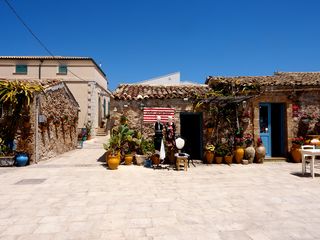
 Marzamemi is a former fishing village located on the southeastern coast of Sicily, near the Vendicari nature reserve. Historically connected to maritime trade and tuna fishing activities, the village preserves the urban character of traditional Mediterranean coastal communities. Open squares, light-colored stone buildings and former structures associated with the tonnara reflect the importance of maritime activities in this part of Sicily. Today, Marzamemi remains closely linked to the cultural identity of the Sicilian coastline and represents a well-preserved example of a historic fishing settlement in the central Mediterranean region.
Vendicari •
Vendicari •
Vendicari •
Monument profile
Monument category: Historic urban landscape
Monument family: Historic or traditional habitat
Monument genre: Residential
Geographic location: Vendicari, Marzamemi • Sicily • Italy
Construction period: 17th century AD
• Links to •
• List of videos about Vendicari, Marzamemi on this site •
Vendicari • Tonnara, nature reserve and Marzamemi
Marzamemi and the Historical Development of a Sicilian Maritime Village
Formation of a Coastal Fishing Settlement
Marzamemi developed on the southeastern coast of Sicily in close connection with tuna fishing activities organized around the local tonnara. Its position near important Mediterranean tuna migration routes favored the establishment of fishing structures and maritime facilities from the medieval period onward, although the present urban configuration is mainly associated with the early modern and modern periods.
The settlement evolved around the needs of seasonal fishing campaigns. Residential buildings, storage spaces, processing facilities and docking areas formed a compact coastal complex directly linked to maritime production. Marzamemi also became integrated into regional commercial networks through the export of processed tuna products to other Mediterranean markets. The village’s spatial organization reflected this economic specialization, with communal areas closely associated with productive activities.
Expansion under Spanish and Bourbon Sicily
The most significant phase in the historical development of Marzamemi occurred during the period of Spanish rule in Sicily. Several of the structures still visible today date from the seventeenth and eighteenth centuries, when tuna fishing represented an important economic activity along parts of the Sicilian coastline. During this period, the tonnara expanded into a more organized industrial and maritime complex.
The village gradually acquired a more structured urban layout centered on open communal spaces and buildings connected to fishing operations. Religious structures constructed near the central square also became part of the social organization of the settlement. Maritime labor shaped daily life in the village, and the annual tuna fishing season strongly influenced local economic rhythms.
Under Bourbon administration in the eighteenth and nineteenth centuries, fishing activities continued to support the local economy. Maritime trade and coastal exchanges reinforced the strategic importance of small fishing settlements such as Marzamemi within southeastern Sicily.
Decline of Traditional Fishing and Economic Transformation
During the twentieth century, the progressive decline of traditional tuna fishing systems led to major economic and social changes in Marzamemi. Industrialized fishing methods and broader transformations in Mediterranean maritime economies gradually reduced the importance of the tonnara. Several productive structures lost their original function, and parts of the complex fell into disuse.
Rather than disappearing entirely, the village progressively shifted toward tourism and heritage-related activities. The preservation of the historic urban core and former fishing structures contributed to the transformation of Marzamemi into a cultural and architectural destination associated with the maritime identity of Sicily. Restoration campaigns and adaptive reuse of older buildings helped maintain much of the historical appearance of the village.
Marzamemi in Global Historical Context
The principal expansion of Marzamemi during the seventeenth and eighteenth centuries coincided with the growth of Mediterranean maritime trade under Spanish influence. At the same time, European colonial powers were intensifying commercial exchanges across the Atlantic and Indian Oceans. Several Mediterranean ports under Ottoman control were also experiencing economic growth linked to maritime commerce. In Sicily, Spanish and later Bourbon administrations continued to develop coastal economic networks connected to fishing and regional trade.
Preservation and Contemporary Cultural Role
Today, Marzamemi preserves a significant part of its historical urban structure associated with tuna fishing activities. The former tonnara, the central square and the surrounding stone buildings continue to define the visual identity of the village. Although its economy is no longer based on industrial fishing, the settlement retains a strong connection to its maritime past.
The village now functions as an important example of a historic Sicilian coastal community shaped by Mediterranean fishing traditions. Its preserved architectural environment and former productive spaces provide insight into the organization of maritime settlements that once depended heavily on seasonal tuna fishing and regional commercial exchange.
Urban Structure and Maritime Architecture of Marzamemi
Spatial Organization of the Historic Settlement
Marzamemi is organized as a compact coastal settlement directly connected to the former tuna-processing complex and the shoreline of southeastern Sicily. The historic core developed around a central open square linked to the harbor area, religious buildings and former industrial structures associated with the tonnara. This arrangement created continuity between maritime activities, residential spaces and communal circulation areas. The village retains a low and dense urban profile in which buildings remain closely grouped around pedestrian routes opening toward the sea.
The spatial hierarchy of the settlement is defined by the relationship between enclosed streets and broader public spaces. Narrow lanes connect secondary residential areas to the central piazza, where the most visually dominant façades are concentrated. The square acts as the principal organizing element of the village, creating long visual perspectives toward the surrounding stone buildings and former maritime facilities. The absence of major elevation changes reinforces the horizontal character of the urban landscape.
The close proximity between residential structures and productive maritime spaces reflects the original economic function of the settlement. Warehouses, processing buildings and fishermen’s dwellings were integrated within the same compact urban fabric rather than separated into distinct industrial zones.
Construction Materials and Structural Characteristics
The architecture of Marzamemi relies primarily on locally available limestone, widely used for façades, load-bearing walls, paving surfaces and architectural details. The pale coloration of the stone contributes to the visual coherence of the village and intensifies the effects of Mediterranean light across public spaces. Masonry surfaces often display irregular textures produced by blocks of varying dimensions assembled with relatively simple construction techniques.
Most historic buildings are composed of compact rectangular volumes with limited vertical development. Structures generally rise only one or two stories above ground level, reinforcing the horizontal continuity of the village. Roofs are typically covered with terracotta tiles laid over timber roof structures adapted to coastal climatic conditions. The limited height of the buildings reduces wind exposure while maintaining relatively stable interior temperatures during periods of intense heat.
Openings remain restrained in several older façades, particularly in buildings historically associated with storage and fish processing. Thick masonry walls and reduced window dimensions contributed to thermal regulation and protection from sea winds. Architectural ornamentation is minimal, with emphasis placed on durability and functionality.
The use of local stone also shapes the chromatic identity of the settlement. Variations between pale beige, ochre and weathered gray surfaces create subtle tonal contrasts while preserving overall visual unity.
The Central Square and Religious Structures
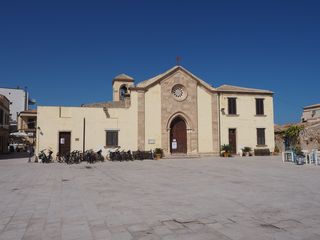
The central piazza forms the architectural focal point of Marzamemi. Its proportions are relatively broad compared to the surrounding street network, allowing uninterrupted visibility across the principal façades of the settlement. The buildings surrounding the square maintain consistent heights and similar materials, producing a balanced urban enclosure without monumental vertical dominance.
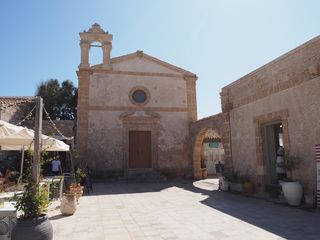
Religious buildings integrated into the square contribute to the compositional stability of the space. Their façades remain restrained in scale and decoration, reflecting the modest dimensions of the village itself. Bell structures, stone portals and symmetrical façades introduce visual rhythm without disrupting the architectural coherence of the surrounding buildings.
The square also preserves traces of its historical relationship with maritime activities. Its open configuration facilitated circulation linked to fishing operations, communal gatherings and commercial exchanges associated with the tonnara. Stone paving, limited vegetation and the close relationship between built volumes and open space reinforce the maritime character of the environment.
Architecture of the Tonnara Complex
The former tonnara structures constitute the most historically significant architectural ensemble within Marzamemi. Their design reflects the operational requirements of seasonal tuna fishing and fish processing. The buildings are characterized by elongated rectangular plans, large interior working spaces and direct connections to loading and unloading areas near the water.
The structural organization of the complex prioritized efficient circulation between maritime access points, storage areas and processing facilities. Open internal spaces allowed the handling and preservation of large quantities of fish during fishing seasons. Exterior walls are generally austere in appearance, with very limited decorative treatment and a strong emphasis on structural solidity.
Several surviving elements continue to illustrate the industrial-maritime character of the site, including storage volumes, service buildings and masonry structures associated with harbor operations. Although parts of the tonnara have undergone adaptive reuse linked to tourism and cultural activities, much of the original spatial logic remains visible within the present urban configuration.
Recent conservation efforts have focused on stabilizing masonry structures and preserving the visual coherence of the historic waterfront environment. Restoration interventions generally maintain the original material palette and low-rise volumetric organization that define the architectural identity of Marzamemi.