

 Français (France)
  Nederlands (nl-NL)
 Tirta Empul Temple is a Hindu religious site located in Tampaksiring, in the Indonesian state of Bali. It is well known for its sacred spring, which draws many devotees seeking purification through traditional Balinese rituals. The water flowing into the pools is believed to hold spiritual and cleansing properties, giving the temple a significant role in religious practice. Beyond its liturgical importance, it is a notable destination for visitors interested in experiencing the spiritual dimension of Bali. Its reputation extends beyond the religious sphere, as it reflects the cultural and symbolic value of water within Balinese tradition.
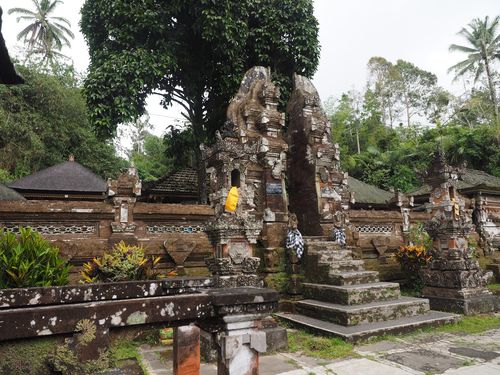
Denpasar • Tirta Empul temple

Denpasar • Tirta Empul temple

Denpasar • Tirta Empul temple
Monument profile
Tirta Empul temple
Monument category: Hindu Temple
Monument family: Temple
Monument genre: Religious
Cultural heritage: Hindu
Geographic location: Tampaksiring • Bali • Indonesia
Construction period: 9th century AD
• Links to •
• List of videos about Denpasar, Tirta Empul, Sukawati on this site •
Indonesia • Bali • The island of the Spirits
• References •
Wikipedia EN: Tirta Empul
The History of Tirta Empul Temple in Tampaksiring
Tirta Empul Temple, located in Tampaksiring on the island of Bali, Indonesia, is one of the most significant Hindu sanctuaries in the region. Built in 962 CE during the reign of the Warmadewa dynasty, the temple has been a place of ritual purification and devotion for more than a millennium. Its history reflects not only the evolution of Balinese religious life but also broader political, cultural, and social dynamics that shaped the island across centuries.
Political and Social Context of Construction
The construction of Tirta Empul took place during the rule of the Warmadewa dynasty, a formative period for Balinese identity and statehood. The rulers of this dynasty sought to consolidate their political authority by anchoring their legitimacy in religious foundations. Building a temple around a natural spring allowed the sovereign to present himself as both a spiritual intermediary and a protector of his people.
Water, in Hindu cosmology, embodies purity, life, and divine blessing. By harnessing a natural spring and framing it within sacred architecture, the Warmadewa king emphasized his role as guardian of cosmic balance (dharma). Such an enterprise was also a statement of power: it demonstrated the ability of the dynasty to mobilize resources, artisans, and priests to create a sanctuary that linked political ambition with religious devotion.
Regional rivalries also played a part. Bali, though distinct, was in regular contact with Java, where competing dynasties promoted their prestige through monumental constructions. By commissioning Tirta Empul, the Warmadewa ruler asserted his authority within Bali while positioning himself in dialogue with broader religious and political trends in the Indonesian archipelago.
Major Historical Events
Over the centuries, Tirta Empul witnessed shifts in dynasties and political structures without ever losing its role as a sacred site. During periods of Javanese influence, particularly under the Majapahit Empire, Balinese temples were often reoriented or adapted, but Tirta Empul retained its centrality due to the enduring sanctity of its spring.
Colonial times brought different challenges. Under Dutch rule, Bali experienced an influx of Western influence, yet temples such as Tirta Empul remained spaces of cultural resilience. They preserved continuity with ancient rituals even as political power shifted dramatically. Unlike fortresses or palaces, temples rooted in natural sanctuaries were less subject to destruction or radical transformation, which explains the continuity of Tirta Empul’s usage.
In the mid-20th century, the temple’s profile rose with the construction of a presidential palace nearby under President Sukarno. This addition highlighted the site not only as a religious center but also as a symbol of Indonesian cultural heritage in the post-independence era.
Global Context at the Time of Construction
The 10th century CE, when Tirta Empul was built, was marked worldwide by ambitious religious and monumental projects. In Europe, Romanesque churches were being established as Christianity spread and consolidated. In India, the parent culture of Balinese Hinduism, monumental temples such as those at Khajuraho and Ellora were reaching their zenith. In China, the Song dynasty promoted Buddhism and Taoism through temple building and artistic patronage.
Tirta Empul fits into this global trend: rulers used monumental religious architecture to strengthen legitimacy and forge collective identity. What distinguishes Tirta Empul, however, is the integration of a natural water source into ritual and architectural form, making the sanctity of nature itself the foundation of the monument.
Transformations of the Monument
Tirta Empul has undergone numerous modifications over its long history. Earthquakes, floods, and the natural erosion of volcanic stone led to periodic repairs and reconstructions. Several pavilions were rebuilt or expanded, often using traditional Balinese wooden structures that allowed for natural ventilation and resilience in a humid tropical environment.
The ritual use of the site also evolved. Initially, purification rites were primarily reserved for elites and specific ceremonial occasions. Over time, these practices became more widespread, extending to village communities and eventually opening to wider participation. Today, even international visitors are invited to take part in purification rituals, albeit within regulated frameworks.
Urban development around Tampaksiring also altered the setting of the temple. What was once an isolated religious site within a rural landscape is now part of a more densely inhabited area, especially with the nearby presidential palace. Yet the temple complex has preserved its integrity as a sacred enclave.
The Role of the Monument Today and Its Cultural Importance
In modern Bali, Tirta Empul remains one of the island’s most frequented temples. Balinese Hindus continue to regard it as a central place of ritual purification, particularly during significant religious festivals. Pilgrims follow a precise sequence of moving from one water spout to another, each associated with specific symbolic functions, embodying continuity with centuries-old practices.
The temple has also become a prominent cultural icon for Indonesia as a whole. Its proximity to the presidential palace underscores its diplomatic and national role. It symbolizes the country’s cultural diversity and the endurance of Hindu traditions within a predominantly Muslim nation.
For local communities, Tirta Empul represents not only religious devotion but also identity and heritage. Ceremonies conducted there reinforce social cohesion and transmit traditional values to younger generations. For tourists, it offers an opportunity to observe and sometimes participate in living rituals, making it both a spiritual and cultural destination.
Conservation and Modern Challenges
The conservation of Tirta Empul faces multiple challenges. The volcanic stone used in its construction is porous and vulnerable to the constant presence of water, leading to erosion. The tropical climate accelerates biological growth on stone surfaces, and periodic earthquakes pose structural risks.
Tourism, while vital economically, places additional pressure on the site. The influx of thousands of visitors each year increases wear on the temple’s infrastructure and sometimes disrupts the sacred atmosphere. Waste management and pollution from surrounding urbanization also threaten the purity of the spring.
In response, Indonesian authorities and local communities have implemented restoration programs. Periodic cleaning of the spring, consolidation of stone structures, and regulations for visitor access are part of ongoing management efforts. While Tirta Empul is not directly inscribed as an individual UNESCO World Heritage site, the recognition of Bali’s cultural landscapes, including temples and irrigation systems (subak), in 2012 has increased global awareness of the need to preserve such heritage.
Conclusion
The history of Tirta Empul Temple spans more than a thousand years of Balinese religious and political life. Built in a period of dynastic assertion, it linked water, divinity, and royal power in a way that ensured its enduring significance. Through wars, dynastic shifts, colonial rule, and independence, the temple maintained its role as a living sanctuary. Its architecture and rituals connect Bali to broader global trends of monumental construction while retaining uniquely local features.
Today, Tirta Empul serves both as a sacred site of purification for Balinese Hindus and as a symbol of Indonesia’s cultural richness. Its conservation reflects the delicate balance between maintaining living traditions and protecting material heritage. As such, Tirta Empul stands not only as a monument of the past but also as a vital element of Bali’s present and future identity.
The Architecture of Tirta Empul Temple in Tampaksiring
Tirta Empul Temple, located in Tampaksiring in the Indonesian province of Bali, is one of the island’s most renowned Hindu sanctuaries. Built in the 10th century during the Warmadewa dynasty, it has preserved its religious significance for more than a thousand years. While it is primarily celebrated for its sacred spring and purification rituals, its architecture represents a remarkable synthesis of Balinese craftsmanship, regional innovation, and religious symbolism. The study of its built form reveals the technical expertise of its builders, the influence of broader cultural exchanges, and the enduring adaptation of architectural traditions to both natural and social environments.
Technological and Architectural Innovations
The most distinctive innovation at Tirta Empul lies in the integration of hydraulics into sacred architecture. The temple was designed around a natural spring, whose waters were captured, channeled, and distributed into purification pools. This system, still functioning today, demonstrates advanced engineering knowledge for the 10th century. Stone-lined channels regulate water flow, while carefully placed spouts release streams into the basins. This combination of practical infrastructure and ritual design exemplifies a sophisticated understanding of hydraulics, rare in other contemporary religious structures.
The temple also reflects broader Balinese urban planning principles, especially the tripartite spatial hierarchy common in Hindu-Balinese temples. The complex is divided into three courtyards of increasing sanctity: the outer courtyard for preparation, the middle courtyard where purification pools are located, and the innermost courtyard housing shrines to major deities. This progression mirrors the Hindu cosmological order, providing worshippers with a ritual journey from the mundane to the sacred. The organization of spaces, clearly defined and structured, illustrates an architectural philosophy where religion, ritual, and spatial logic were inseparable.
Materials and Methods of Construction
Tirta Empul was constructed primarily with locally available materials that shaped both its durability and aesthetic. Volcanic stone, abundant in Bali, was used extensively for walls, channels, and carved reliefs. Its porous yet resilient qualities made it ideal for handling constant exposure to water, though it required regular maintenance to prevent erosion. The stone’s dark hue also provided a striking contrast to the vibrant offerings and ceremonial decorations used in daily worship.
Timber, especially teak and other hardwoods, was employed for pavilions and supporting structures. Wooden columns, sometimes intricately carved, supported lightweight roofs made of alang-alang grass or palm fiber. These natural materials provided both insulation from heat and efficient ventilation in the tropical climate. The open pavilion style allowed air to circulate freely, reflecting a construction method adapted to environmental conditions.
One particularly notable feature of Balinese construction is the precision with which stone blocks were fitted, often without mortar, relying on careful cutting and placement. This technique not only ensured stability but also allowed sculptors to integrate decorative carvings directly into structural elements. Thus, aesthetics and functionality were inseparable from the outset.
Architectural and Artistic Influences
The architecture of Tirta Empul demonstrates a fusion of indigenous Balinese traditions with external influences. The temple’s tripartite layout reflects Hindu temple concepts transmitted from India, but its emphasis on water-centered rituals is distinctly Balinese. Unlike many Indian temples, which focused on enclosed sanctuaries or towering shikharas, Tirta Empul foregrounds open-air pools and purification rites.
The artistic language of the temple includes a rich repertoire of carvings. Reliefs depicting Hindu deities are interspersed with local protective figures such as rakshasas and mythological creatures unique to Bali. Floral and geometric motifs recur throughout, arranged in symmetrical patterns that resonate with broader Southeast Asian design traditions.
The temple’s ornamentation was not purely decorative but also imbued with symbolic meaning. Carved guardians at entrances mark thresholds between sacred zones, while motifs of flowing water and lotus blossoms emphasize purification and renewal. These elements reveal the temple as both an architectural and artistic synthesis, where ritual, symbolism, and design converge.
Organization and Spatial Structure
The overall layout of Tirta Empul follows the standard Balinese temple plan, but its distinctive pools set it apart. The outer courtyard functions as a transitional zone where visitors prepare themselves. The middle courtyard contains two large rectangular pools lined with rows of water spouts. Each spout is associated with a different symbolic purification, and worshippers move sequentially from one to the next. This spatial organization requires architecture to support a carefully choreographed ritual, making circulation as important as enclosure.
The inner courtyard contains shrines dedicated to Hindu deities, including Vishnu, who is often associated with water. Pavilions with multi-tiered roofs supported by carved wooden columns provide shelter for offerings and ceremonies. The tripartite spatial division, combined with the central role of water, distinguishes Tirta Empul from other Balinese temples while maintaining its alignment with Hindu-Balinese cosmology.
Statistics and Notable Anecdotes
The Tirta Empul complex covers approximately 25,000 square meters, making it one of the larger temple compounds in Bali. The purification pools together include more than 30 water spouts, each with its own ritual significance. The spring itself has flowed continuously for over a millennium, sustaining not only the temple but also surrounding irrigation systems, which reflects its integration into both religious and agricultural life.
Local legend attributes the origin of the spring to the god Indra, who is said to have struck the earth to create the water source that saved his poisoned troops during a battle with a demon. This myth continues to shape the ritual meaning of the site, giving the water its enduring association with divine intervention and healing.
Recognition and Conservation
Architecturally, Tirta Empul holds international importance as one of the rare temples where hydraulic engineering is integral to design. Its layout, materiality, and ornamentation embody a unique combination of natural environment and sacred architecture.
In modern times, the temple faces conservation challenges. The volcanic stone is vulnerable to erosion from constant water exposure and tropical humidity. Tourism places additional stress on the site, as large numbers of visitors increase physical wear on structures and threaten the balance between sacred ritual and public spectacle. Urbanization around Tampaksiring also alters the context of the temple, raising concerns about environmental impact on the spring.
To address these challenges, Indonesian authorities have undertaken periodic restoration efforts, including cleaning the pools, reinforcing stone structures, and regulating visitor access. While Tirta Empul is not individually listed as a UNESCO World Heritage Site, it is part of Bali’s broader cultural landscape recognized by UNESCO in 2012, which highlights the interconnectedness of temples, water systems, and agricultural practices.
Conclusion
The architecture of Tirta Empul Temple reflects the technical, artistic, and cultural achievements of 10th-century Bali while remaining a living religious site today. Its innovations in hydraulic integration, use of local materials, fusion of artistic traditions, and carefully structured spatial hierarchy make it a unique example of Balinese temple design. Beyond its aesthetic and functional qualities, the temple embodies a profound link between nature, ritual, and architecture. Its preservation continues to be a matter of both cultural pride and international concern, ensuring that this sanctuary remains a vital testimony to Balinese heritage and the enduring dialogue between environment and sacred space.