

 Français (France)
  Nederlands (nl-NL)
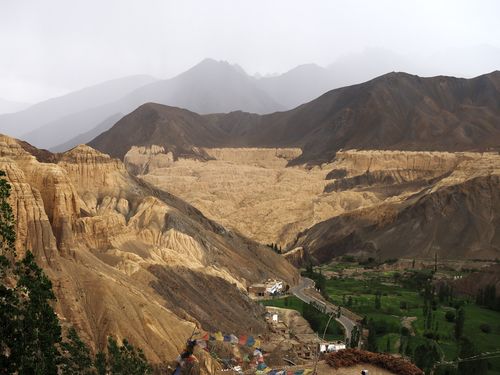
 Lamayuru Gompa is one of the oldest and most emblematic monasteries in Ladakh. Linked to the Tibetan Buddhist tradition, it stands within a dramatic landscape shaped by distinctive geological formations. For centuries, it served as a religious and cultural centre for local communities, hosting a monastic population dedicated to study, meditation, and ceremonial life. Today, Lamayuru remains a destination for pilgrims and travellers alike, illustrating the endurance of Buddhism in the region and the role of this site in preserving spiritual heritage and cultural identity across generations.


Monument profile
Lamayuru Gompa
Monument categories: Monastery, Gompa
Monument family: Monastery
Monument genre: Religious
Cultural heritage: Buddhist
Geographic location: Lamayuru • Ladakh • India
Construction period: 11th century AD
• Links to •
• List of videos about Lamayuru on this site •
Lamayuru Gompa, 11th Century Tibetan Monastery in Ladakh
• References •
Wikipedia EN: Lamayuru Monastery
History of Lamayuru Gompa
Foundation Context and Political Purpose
Lamayuru Gompa, located in western Ladakh, is widely regarded as one of the oldest monastic sites in the region. Its origins are linked to the arrival and consolidation of Buddhist authority among Himalayan communities, serving both spiritual and political functions. Early sources suggest that the monastery emerged as a strategic institution intended to support the spread of Buddhism. Its placement along the Srinagar–Leh trade route made it an ideal centre for influence over commerce, pilgrimage, and local governance. Establishing such a site was therefore not merely religious but a calculated assertion of cultural supremacy in a contested frontier.
The authority behind its foundation may have belonged to regional leaders looking to legitimise their rule through monastic patronage. Supporting the monastery helped rulers align themselves with Buddhist networks extending into Tibet, Nepal, and Central Asia. Lamayuru thus played a role in forging cross-regional alliances, serving as a symbol of loyalty to larger Buddhist orders.
Societal Role and Ambitions of Patronage
The construction of Lamayuru reflects the broader practice in Himalayan polities of grounding authority in religion. Monastic leaders often served as advisors, educators, or mediators, extending influence far beyond strictly devotional matters. Lamayuru would have strengthened the moral prestige of its sponsors by linking them to a sacred topography and an established clerical tradition.
The ambition behind the monastery’s development, therefore, was not only the establishment of a spiritual stronghold but also the creation of a cultural anchor—one capable of reinforcing Buddhist teaching, consolidating economic networks, and maintaining cohesion among dispersed communities.
Conflicts, Dynastic Shifts, and Transformations
The monastery’s long history was shaped by shifts in secular power. Trade rivalries, succession disputes, and invasions periodically destabilised the region, and monastic institutions became targets or beneficiaries depending on allegiances. For example, political tensions between Ladakhi kings and Tibetan interests influenced monastic patronage, affecting the resourcing and renovation cycles of Lamayuru.
The monastery is believed to have endured phases of decline followed by renewal under different rulers. Later Ladakhi kings and influential clerics contributed to its reconstruction or expansion, demonstrating the resilience of monastic centres despite political change. Structural damage from earthquakes, environmental wear, and fluctuating patronage also led to restorations undertaken by religious authorities and local communities.
Lamayuru in Global Context
Lamayuru’s history can be compared to wider medieval trends in monastic construction. Between the 10th and 12th centuries, religious institutions across Eurasia, from Christian abbeys in Europe to Buddhist complexes in Tibet, reflected similar patterns: consolidation of learning, ritual authority, and architectural representation of power. Like its Western counterparts, Lamayuru functioned as an archive of knowledge, an educator of elites, and a custodian of sacred relics.
Furthermore, its strategic location along an international trade route parallels monastic sites in other regions that exerted influence through hospitality, pilgrimage services, and trade facilitation. Lamayuru therefore stands within a broad movement in which religious institutions asserted soft power through architecture, ritual, and territorial presence.
Physical Transformations and Urban Evolution
Over time Lamayuru evolved into a sprawling complex adapted to the changing needs of its clergy and community. Additions included new assembly halls, chapels, residences, storage buildings, and ritual areas. Functional changes also occurred: parts of the site became schools for novices, while other areas were used for seasonal rituals or festivals involving surrounding villages.
Decline periods led to deterioration of structural elements, followed by campaigns of refurbishment inspired by renewed monastic engagement. Urban evolution around the monastery reshaped its setting: paths were widened, access points reconfigured, and visitor facilities gradually introduced as pilgrimage and tourism developed. The surrounding village increasingly depended on monastic activity, intertwining built environment development with the monastery’s fortunes.
Cultural Identity and Contemporary Relevance
Today, Lamayuru Gompa holds both symbolic and lived significance. For local communities, it functions as a center for ritual life, education, and identity maintenance. Its festival calendar reinforces shared belonging, while images of Lamayuru feature prominently in regional representations of Ladakh.
At a national level, it appears in tourism promotion as one of the defining icons of Himalayan Buddhist heritage. Internationally, its identity as an ancient monastery contributes to discourse on Tibetan Buddhist diffusion and cultural preservation. Scholars, travellers, and photographers consider Lamayuru an emblematic expression of spirituality in a dramatic landscape.
Festivals bring together lay practitioners and monks, sustaining continuity of doctrinal transmission. These gatherings serve social functions by reaffirming kinship networks, redistributing wealth through offerings, and hosting performances that embody ethical teachings.
Conservation Challenges and Management Strategies
Lamayuru faces modern threats. Weathering caused by wind, temperature variation, and rainfall undermines the earthen construction. Increasing tourism accelerates interior wear, particularly in painted halls. Infrastructure pressure on the village introduces further degradation risks.
Authorities and monastic leaders have initiated conservation campaigns focusing on stabilisation works, mural protection, and education on responsible visitation. Although not a UNESCO site, Lamayuru benefits from government attention as part of Ladakh’s recognized religious heritage. Conservation strategies must balance traditional building techniques with contemporary engineering, maintaining authenticity while improving longevity.
Conclusion
Lamayuru Gompa’s history illustrates the intersection of religion, politics, architecture, and environment in Himalayan civilisation. Its endurance through centuries of upheaval reflects the adaptability and authority of Buddhist monastic culture. The monastery remains an active space of worship, community, and cultural meaning while posing complex challenges for preservation in an increasingly connected world.
Architecture of Lamayuru Gompa in Lamayuru (India)
Technological and architectural innovations
The architecture of Lamayuru Gompa is a striking example of how monastic builders in the western Himalaya adapted religious space to an extreme environment. The monastery developed over centuries on a steep, geologically fragile slope, forcing architects and craftsmen to integrate stability, ritual hierarchy and visibility into a single coherent scheme. The terraced layout is one of its most distinctive features: buildings are arranged in successive levels that follow the contours of the hillside, with the main assembly halls and temples occupying the higher, more prominent positions.
This configuration is not only symbolic. It reflects a practical understanding of load distribution on unstable rock and sediment, with retaining walls, stepped platforms and carefully controlled drainage to reduce the risk of landslides. The complex also demonstrates early forms of passive environmental control. Thick walls in earth and stone, small window openings and compact room volumes help to buffer the interior spaces against the extreme temperature variations and persistent winds that characterise the Ladakhi climate.
Materials and methods of construction
Lamayuru Gompa relies almost entirely on locally available materials, used in ways that combine technical efficiency with a distinctive aesthetic. The lower parts of the complex rest on stone foundations, often laid in irregular courses and bonded with mud mortar. Above these, the walls are built from sun-dried mud bricks and rammed earth, creating massive envelopes with high thermal inertia. These materials are relatively easy to repair and can be re-used, which is crucial in a context where maintenance is continuous and resources are limited.
Wood is employed more selectively, primarily for beams, floors, window frames, columns in the main halls and decorative brackets. Species such as willow and poplar, brought from nearby valleys, allow for long spans in assembly spaces and create the structural skeleton for flat roofs. The roof build-up typically consists of wooden beams, a layer of branches or brush, and a thick compacted earth covering that provides insulation and creates a usable outdoor surface for drying food, performing certain rituals or simply moving between buildings.
Exterior surfaces are coated with mud or lime-based plaster and often whitewashed. This finish protects the earthen fabric from moisture while reflecting sunlight, reducing overheating and giving the monastery its characteristic luminous presence against the dark rock formations around it.
Artistic and architectural influences
The formal language of Lamayuru Gompa is deeply rooted in Tibetan Buddhist architectural tradition, but it also integrates local and regional influences. The stepped massing of white volumes, punctuated by darker window bands and crowned with prayer flags, recalls fortress-like monasteries in central Tibet. At the same time, certain elements betray affinities with the vernacular architecture of Ladakhi villages, such as the cubic house forms, deep window reveals and the intimate scale of many courtyards.
Inside, the decorative programme draws on a wide iconographic repertoire: wall paintings of deities and mandalas, painted ceilings, carved wooden columns and sculpted altars. These works reflect the transmission of painting and carving techniques from Tibet and neighbouring Himalayan regions, combined with pigments and stylistic touches specific to western Ladakh. Ornamentation is concentrated in ritual spaces rather than on the exterior, so that the plain outer masses conceal a much richer internal world of images and colours.
Spatial organisation and internal structure
Spatially, Lamayuru is organised as a multi-level complex in which functional and symbolic hierarchies overlap. The lower terraces are largely occupied by residential quarters, kitchens, storage rooms and more recent additions serving educational or logistical purposes. As one moves upward, the density of ritual and semi-public spaces increases: small chapels, libraries, subsidiary shrines and, finally, the main assembly hall and principal temples.
Circulation paths take the form of stepped alleys, staircases and roof routes, creating a three-dimensional network that allows movement without disturbing major rituals. Certain paths are clearly intended for processions, especially during festivals, while others serve the daily needs of the monastic community. Roofs act as both structural caps and circulation platforms, linking blocks that would otherwise be separated by changes in level.
The main assembly hall is typically a large, columned space with an axial organisation: entrance area, central zone for monks, and raised platform for images, altars and ritual instruments. Side chapels and circumambulatory corridors offer additional routes for devotional practice, integrating the experience of movement into the spatial logic of the building.
Distinctive structural features, dimensions and anecdotes
While exact measurements vary and have changed over time, the complex occupies a substantial portion of the slope above the modern village and extends laterally along the ridge. The vertical difference between the lowest houses associated with the monastery and the highest shrines accentuates the impression of a “vertical settlement” carved into the rock.
One of the most distinctive features of Lamayuru is its relationship with the surrounding landscape of heavily eroded formations often compared to a “moonland”. The contrast between the sharp, irregular geology and the rectilinear, stacked forms of the monastery reinforces its visual impact and has become part of its identity. Local traditions link the site’s topography to legendary events, such as the drying of an ancient lake by a powerful teacher, reinforcing the idea that architecture and landscape are inseparable here.
Within the complex, certain rooms are reputed to possess special spiritual qualities, either because of relics they contain or because of stories associated with prominent religious figures. These narratives add an additional, intangible layer to the architectural reading of the site.
International recognition and conservation challenges
From an architectural point of view, Lamayuru Gompa is regarded as a key example of Himalayan monastic building practice, illustrating how religious communities have adapted compact, resource-efficient construction to extreme conditions. Its terraced composition, material palette and integration into the landscape make it a frequent subject in studies of Ladakhi and Tibetan Buddhist architecture.
Conservation, however, poses significant challenges. Earthen structures are vulnerable to erosion, seismic activity and changes in drainage patterns. The growth of tourism has increased the load on delicate interiors, particularly painted surfaces and wooden elements in the main halls. Rising expectations for comfort and accessibility also create pressure for modifications, which can threaten the integrity of traditional layouts if not carefully managed.
Efforts to preserve Lamayuru’s architecture therefore focus not only on technical measures—such as stabilising foundations, improving drainage and maintaining traditional roof build-ups—but also on sustaining the local knowledge necessary to work with earth, stone and timber in the established ways. As a living monastic complex rather than a static monument, Lamayuru continues to evolve, and its architecture remains a dynamic interface between ritual practice, community life and a demanding mountain environment.