

 Français (France)
  Nederlands (nl-NL)
 The Cámara Oscura in Havana is an observation installation located in the historic center of the Cuban capital. Based on an optical device historically used to project images of the outside world onto an interior surface, the system allows visitors to observe the city in real time through a combination of mirrors and lenses. The projection provides a moving panoramic view of surrounding streets, squares, and parts of the harbor area. Today the Cámara Oscura functions as a cultural and educational attraction that offers a different perspective on Havana’s urban landscape while demonstrating a scientific principle that has been known for several centuries.

Havana • Cámara Oscura

Havana • Cámara Oscura

Havana • Cámara Oscura
Monument profile
Cámara Oscura
Monument category: Observatory
Monument family: Historic University or Observatory
Monument genre: Cultural or scientific
Geographic location: Havana • Cuba
Construction period: 16th century AD
• Links to •
• List of videos about Havana on this site •
Havana, the capital • Cuba
History of the Cámara Oscura in Havana
Establishment of the installation in the historic center
The Cámara Oscura of Havana was installed in the early twenty-first century in the upper level of a building overlooking Plaza Vieja, one of the principal public squares of the historic center of the Cuban capital. The installation formed part of a broader urban rehabilitation program directed by the Office of the Historian of the City of Havana, which had undertaken extensive restoration work in the district during the late twentieth and early twenty-first centuries. The project sought to introduce a cultural and educational attraction capable of presenting the surrounding urban landscape from an elevated viewpoint.
The initiative to install a camera obscura was intended to create an observation point that could present a live image of the historic district without relying on digital technologies. The system uses a rotating optical mechanism positioned above the building’s roof. Through a combination of mirrors and lenses, the device captures the exterior view and projects it inside a darkened observation room. The projection shows streets, squares, and parts of the harbor area surrounding the historic center.
Integration into the restored urban environment of Plaza Vieja
The Cámara Oscura opened to the public as part of the cultural facilities associated with the restored Plaza Vieja. This square had undergone significant architectural rehabilitation during the 1990s and early 2000s, transforming the surrounding buildings into museums, cultural venues, and educational spaces. The installation was incorporated into this renewed urban setting as an interpretive element that allows visitors to observe the surrounding cityscape.
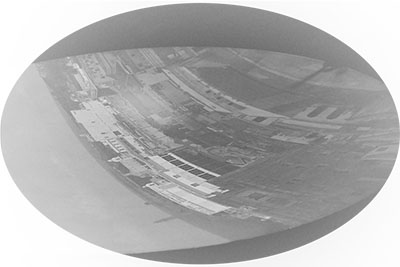
Public demonstrations form an integral part of the installation’s operation. A guide operates the rotating optical system while explaining the different urban features visible in the projected image. The projection changes continuously as the mirror is oriented toward different directions, revealing streets, rooftops, and architectural landmarks visible from the tower. This presentation format combines a technical demonstration with an explanation of the spatial organization of the historic center.
Development of its cultural and educational role
Since its inauguration, the Cámara Oscura has functioned as a permanent observation and interpretation facility within the historic district of Havana. The installation receives visitors throughout the year and forms part of the network of cultural attractions connected with the rehabilitation of the old city. Its use has remained consistent since its opening, with guided demonstrations presenting the projected view of the surrounding urban environment.
Maintenance work has mainly focused on the preservation of the optical mechanism and the structural components supporting the rotating system. These interventions ensure the stability of the projection and the continued operation of the device. The installation remains in active use and continues to serve as an educational attraction that allows visitors to observe the historic urban landscape of Havana through a mechanical optical system.
Global historical context
The installation of the Cámara Oscura in Havana occurred during the early decades of the twenty-first century, a period marked by urban restoration initiatives in historic city centers in many regions of the world. At the same time, cultural institutions increasingly incorporated interpretive devices designed to present urban landscapes to visitors. Technological developments in digital imaging and mapping expanded rapidly during these years. The use of a traditional optical projection system in Havana represents the continued application of an older scientific principle within this contemporary context.
Architecture of the Cámara Oscura in Havana
Urban placement and position within the Plaza Vieja building
The Cámara Oscura in Havana occupies the uppermost level of a building overlooking Plaza Vieja in the historic center of the city. Its architectural configuration is determined by the need to obtain an unobstructed panoramic view of the surrounding urban environment. The installation therefore occupies the highest accessible point of the structure, where the optical system can capture a wide visual field extending across the square, the surrounding streets, and portions of the historic district.
Access to the Cámara Oscura is provided through the interior circulation system of the building. Visitors ascend through the lower floors by staircase before reaching the observation level. This vertical progression separates the observation facility from the other functions of the building. The installation occupies only the upper section of the structure, but its architectural presence is identifiable from the exterior due to the addition of a superstructure rising above the roofline.
The external form of the installation is defined by a cylindrical or circular enclosure that supports the rotating optical mechanism. This structure projects above the original roof of the building and accommodates the technical components required for the functioning of the device.
Spatial organization of the observation chamber
The interior observation chamber is designed as a closed and darkened space. The absence of windows or direct exterior openings is essential to the functioning of the optical projection. Light entering through the optical system becomes the only visible illumination within the room, allowing the projected image to remain clearly visible.
At the center of the chamber stands a circular projection table that functions as the surface upon which the exterior image is displayed. The table forms the focal architectural element of the room. The spatial layout of the chamber is organized concentrically around this central surface, allowing visitors to stand along the perimeter while observing the projected scene.
The geometry of the interior space facilitates collective observation. Circulation occurs along the edges of the room, leaving the central projection area unobstructed. This arrangement also allows the operator to manipulate the optical device while explaining the projected view to visitors. The internal design therefore combines technical functionality with a spatial configuration suitable for guided demonstrations.
Optical dome and mechanical viewing system
The most distinctive architectural element of the installation is the dome-like structure housing the optical apparatus. This superstructure contains the rotating mirror system responsible for capturing the exterior view. The dome is mounted on the roof of the building and designed to allow controlled rotation of the mirror assembly.
The optical system consists of a mirror positioned at an angle to capture light from the surrounding urban landscape. This light is redirected downward through a lens assembly that focuses the image before it reaches the projection table. The mirror can be rotated horizontally, enabling the operator to scan different sectors of the cityscape visible from the observation point.
The architectural design of the dome accommodates both the mechanical rotation of the mirror and the structural support of the optical components. The dimensions of the superstructure are directly related to the size and movement of the apparatus housed within it. The external form therefore reflects the technical requirements of the viewing mechanism rather than decorative considerations.
Construction materials and structural adaptations
The Cámara Oscura installation is not an independent building but an architectural adaptation of an existing structure bordering Plaza Vieja. The construction work required reinforcement of the roof to support the weight and movement of the optical dome. Structural modifications were concentrated in the uppermost part of the building, where the new installation was integrated with the original roof framework.
The dome and its supporting enclosure are constructed using relatively lightweight materials that reduce structural stress on the existing building. These materials allow the rotating optical mechanism to function smoothly while maintaining structural stability. Interior surfaces within the observation chamber are treated to minimize light reflection, ensuring that the projected image remains clearly visible on the central table.
Maintenance interventions focus primarily on the integrity of the dome and the stability of the rotating mechanism. Exposure to tropical weather conditions requires careful monitoring of the roof structure and the external enclosure. These architectural considerations ensure that the installation continues to function while remaining visually integrated into the historic urban environment surrounding Plaza Vieja.