

 Français (France)
  Nederlands (nl-NL)
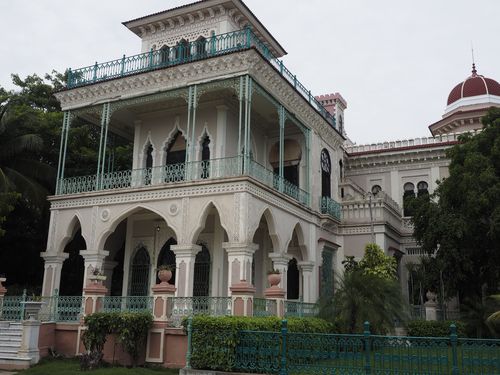
 The Palacio de Valle is a landmark building in Cienfuegos, Cuba. Built in the early 20th century for a wealthy businessman, it stands out for its eclectic architecture blending Moorish, Gothic, and Venetian elements. Its distinctive silhouette and elaborate decoration make it one of the most recognizable structures in the city. Now open to the public, the building houses a restaurant and offers panoramic views of the bay.
Cienfuegos • Palacio de Valle

Cienfuegos • Palacio de Valle

Cienfuegos • Palacio de Valle
Monument profile
Palacio de Valle
Monument category: Historic house
Monument family: Historic or traditional habitat
Monument genre: Residential
Geographic location: Cienfuegos • Cuba
Construction period: 20th century AD
This monument in Cienfuegos is inscribed on the UNESCO World Heritage List since 2005 and is part of the serial property "Urban Historic Centre of Cienfuegos".See the UNESCO monuments featured on this site
• Links to •
• List of videos about Cienfuegos on this site •
Cienfuegos, the Pearl of the South • Cuba
History of the Monument
Construction Context
The Palacio de Valle was built between 1913 and 1917 in the coastal neighborhood of Punta Gorda, in the city of Cienfuegos, Cuba. The initiative came from Acisclo del Valle Blanco, a wealthy Spanish businessman and sugar industry magnate who had settled in Cuba. Seeking to build a grand family residence, he commissioned Italian architect Alfredo Colli to design a structure that would reflect both his social standing and cosmopolitan taste. The construction involved craftsmen and materials imported from Europe, and the total cost reportedly exceeded one million Cuban pesos at the time—a substantial sum, underscoring the ambition behind the project.
Changes of Use and Political Context
Following the death of Acisclo del Valle Blanco in 1920, the property remained under family ownership until the Cuban Revolution in 1959. After the revolution, the building, like many other luxury private estates, was nationalized by the new socialist government. During the early decades of the revolutionary regime, the Palacio de Valle was repurposed for various administrative and public uses, although specific documentation from that period is limited.
By the 1980s, with growing interest in heritage conservation and the gradual opening of Cuba to international tourism, the cultural value of the building began to be recognized. However, it was not until the 1990s and early 2000s that major restoration efforts were initiated. These efforts were part of broader urban heritage initiatives that included the historic center of Cienfuegos, which was inscribed on the UNESCO World Heritage List in 2005 under the title Urban Historic Centre of Cienfuegos.
Heritage Significance and Present-Day Role
While the Palacio de Valle is not individually listed by UNESCO, it lies within the boundaries of the designated World Heritage site and contributes to the architectural richness of the protected area. Restoration work aimed to preserve the structure’s historical integrity while allowing for new uses compatible with tourism and cultural promotion. Today, the building houses a restaurant and is open to visitors, who can explore its opulent interiors and enjoy panoramic views from the rooftop terrace.
Locally, the Palacio de Valle is seen as a symbol of Cienfuegos’ early 20th-century prosperity and international connections. It represents a period when the city was thriving economically due to sugar exports and foreign investment, and when wealthy elites showcased their status through grand architectural statements. The building also plays an important role in the city’s cultural identity, frequently appearing in promotional materials and tourist itineraries as one of Cienfuegos’ most iconic landmarks.
Architecture and Style
Eclectic Design and Cultural Influences
The Palacio de Valle is a striking example of eclectic architecture, blending multiple styles in a way that was fashionable among the upper classes in early 20th-century Cuba. Designed by Italian architect Alfredo Colli, the building incorporates Moorish arches, Gothic details in the balustrades and columns, and Venetian Renaissance motifs in its windows and galleries. This stylistic fusion reflects a desire to break from colonial architectural norms and to embrace international influences that were considered sophisticated and prestigious at the time.
The palace’s layout resembles that of a small urban palace, with an internal arrangement including formal reception rooms, a music salon, and a grand dining hall. Each space was decorated with great attention to detail, and the spatial organization emphasized luxury and theatricality. The central dome, inspired by Islamic architecture, serves as a visual focal point and creates a sense of vertical grandeur within the building.
Materials and Decorative Elements
The structure was built using reinforced concrete—a modern material at the time—combined with ornamental elements in stucco, wrought iron, imported marble, and colorful ceramic tiles. Many of the interior ceilings are decorated with hand-painted frescoes, and stained-glass windows imported from Europe add further visual richness. The main entrance features intricate wrought ironwork, and the staircase balustrades and ceiling moldings display elaborate craftsmanship.
A notable architectural feature is the rooftop terrace, which offers sweeping views of Cienfuegos Bay and adds a functional leisure space to the building. The façade is richly decorated but maintains a balanced symmetry, with a blend of floral motifs, arabesques, and finely carved columns that draw from multiple artistic traditions.
Restoration and Conservation
Over the decades, some alterations have been made to adapt the palace to its changing roles, particularly during its transformation into a public restaurant. Nevertheless, the building has retained its core structure and most of its original decorative features. Restoration efforts in the 1990s and early 2000s focused on stabilizing the edifice, restoring its damaged details, and modernizing certain aspects without compromising its historical authenticity.
Today, the Palacio de Valle stands as one of the most visually distinctive buildings in Cienfuegos. Its architecture encapsulates the cosmopolitan spirit of a bygone era and continues to intrigue both scholars and visitors. The building is often highlighted in academic studies on Cuban eclecticism and serves as a prominent example of how private residences became expressions of global artistic dialogue in the Caribbean context.