

 Français (France)
  Nederlands (nl-NL)
 Of Hindu tradition, (with additional Jain influence), the Kadamba of Banavasi dynasty ruled for approximately 180 years, ± between 345 and 525 over all or part of South India and West India, during the Ancient Period.
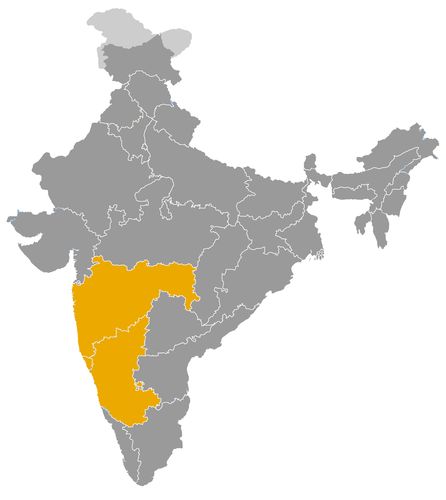
This map illustrates the maximum territory that the Kadamba of Banavasi Dynasty had reached at its height, covering the current regions of Goa, Karnataka and Maharashtra in India. Its main purpose is to provide a visual aid to understand the geographical extent of this dynasty. However, it's important to note that the contemporary borders of these regions may not necessarily coincide with the historical territories.
The Kadambas of Banavasi and Their Foundational Role in Indian History
A regional dynasty rooted in the early history of Karnataka
The Kadambas of Banavasi occupy a major place in the history of early India, particularly in the development of Karnataka as a distinct political and cultural region. Emerging in the fourth century CE, they are generally regarded as one of the earliest important native dynasties of Karnataka. Their capital, Banavasi, became the centre of a kingdom that linked the western Deccan, the inland plateau and the routes leading toward the Arabian Sea coast.
The significance of the Kadambas does not rest only on military power or territorial expansion. Their importance lies in the formation of a regional state that expressed authority through local identity, dynastic legitimacy, religious patronage and administrative organization. In this sense, the Kadambas of Banavasi represent a turning point in the history of South India: they helped transform Karnataka from a zone influenced by larger external powers into a region with its own royal institutions and political voice.
Mayurasharma and the emergence of autonomous kingship
The traditional founder of the dynasty was Mayurasharma, later associated with the royal name Mayuravarman. Epigraphic tradition presents him as a Brahmin who came into conflict with Pallava authority and then established an independent kingdom. Whether this account is read literally or symbolically, it expresses an important political reality: the rise of a local power that challenged external domination and claimed sovereign status.
The foundation of the Kadamba kingdom reflects the wider transformation of early medieval India, where regional elites began to establish durable dynasties outside the direct control of older imperial centres. Banavasi provided Mayurasharma and his successors with a strong base from which they could organize territory, collect revenue, support religious institutions and maintain military authority.
This development gave Karnataka one of its earliest clearly defined royal frameworks. The Kadambas were not merely local chiefs; they presented themselves as legitimate kings whose authority was supported by lineage, ritual status and territorial control.
Political influence among the powers of the Deccan and South India
The Kadambas of Banavasi occupied a strategic position between several important political zones. To the southeast stood the Pallavas, with whom the dynasty had early and sometimes tense relations. To the south were the Western Gangas, another regional power of Karnataka. To the north and northeast lay the wider political world of the Deccan, including the Vakatakas and later the Chalukyas of Badami.
The Kadamba rulers had to balance conflict, diplomacy and alliance. Their kingdom was strong enough to be recognized by neighbouring dynasties, but it existed in a competitive environment where power could shift rapidly. Kakusthavarma, one of the most prominent Kadamba rulers, appears to have raised the prestige of the dynasty through political and matrimonial connections with other royal houses. Under such rulers, the Kadambas became an important force in the regional politics of the western Deccan.
Their later history also shows the limits of regional power. After periods of strength, the dynasty experienced internal divisions, including the emergence of collateral branches such as the Kadambas of Triparvata. These divisions weakened the unity of the kingdom. By the sixth century, the rise of the Chalukyas of Badami reduced Kadamba autonomy and incorporated much of their former sphere into a larger Deccan political order.
A decisive contribution to Kannada political culture
The cultural role of the Kadambas of Banavasi is one of their most enduring legacies. They are closely associated with the early public and administrative use of Kannada, alongside Sanskrit. Sanskrit remained the prestigious language of genealogy, religious expression and royal ideology, but Kannada increasingly appeared as a language connected with regional power and local administration.
This bilingual political culture was highly significant. It allowed the Kadamba rulers to participate in the broader Sanskritic world of Indian kingship while also affirming their roots in Karnataka. The use of Kannada helped strengthen the link between royal authority and regional society. It contributed to the long historical process by which Karnataka developed a recognizable linguistic and cultural identity.
The Kadambas did not create Kannada culture alone, but they gave it an early political framework. Their rule helped establish conditions in which later dynasties, inscriptions, literary traditions and administrative practices could develop more fully.
Religious patronage and the consolidation of royal legitimacy
Religious patronage formed a central part of Kadamba kingship. The rulers supported Brahmins, temples and religious institutions through land grants and privileges. These acts were expressions of piety, but they also served clear political functions. By supporting religious communities, the Kadambas reinforced their legitimacy within the framework of dharmic kingship.
Land donations helped connect the royal court with rural society. Religious beneficiaries often played important roles in settlement formation, agricultural expansion, record keeping and the preservation of royal memory through inscriptions. Temples and Brahmanical establishments became centres of ritual authority, economic activity and social organization.
Through this patronage, the Kadambas strengthened their authority beyond the palace and battlefield. They embedded their rule in local communities, linking political power with sacred legitimacy and agrarian development.
Economic foundations based on agriculture and regional routes
The economy of the Kadamba kingdom was mainly agrarian. Control over villages, cultivated land, irrigation resources and tax revenues formed the material basis of royal power. The rulers redistributed land, maintained dependants, supported religious institutions and financed military activity through the resources generated by their territory.
Banavasi’s location also gave the dynasty access to important regional routes. These routes connected the interior of Karnataka with the western coastal regions and the wider Deccan. Although the Kadambas were not primarily a maritime power, their position allowed them to benefit from inland exchange, movement of goods, administrative communication and military mobility.
Their economic importance therefore lay in regional integration. They linked agricultural production, local elites, religious institutions and routes of circulation into a coherent political system.
A lasting legacy beyond the decline of independence
The Kadambas of Banavasi were not among the largest empires of Indian history, but their role was foundational. They gave Karnataka one of its earliest durable regional kingdoms, strengthened the political use of Kannada, developed patterns of religious patronage and helped shape the balance of power in the western Deccan.
Their decline before the Chalukyas did not erase their historical significance. The Kadamba name, their model of regional kingship and their cultural contribution continued to influence later traditions. Their place in Indian history lies in their ability to give political form to a regional identity that would remain central to the history of Karnataka.
The Geographic Expansion of the Kadambas of Banavasi in Early Indian History
A kingdom centred on Banavasi in western Karnataka
The Kadambas of Banavasi were one of the earliest major regional dynasties of Karnataka, active mainly between the fourth and sixth centuries CE. Their capital, Banavasi, lay in the western part of present day Karnataka, in a region that connected the inland Deccan plateau with routes leading toward the Arabian Sea coast. This location gave the dynasty both political stability and strategic value, allowing it to control agricultural districts, forested zones, local routes and access points between the interior and the western littoral.
The Kadamba kingdom was not a pan Indian empire with fixed borders comparable to later imperial formations. Its geographic extension should be understood as a regional sphere of power, strongest around Banavasi and more variable toward its frontiers. Like many early Indian kingdoms, Kadamba authority depended on control over centres of administration, land revenue, subordinate chiefs, religious grants and military routes rather than on sharply defined territorial boundaries.
The Banavasi heartland and its regional foundations
Banavasi formed the political, symbolic and administrative core of the Kadamba realm. From this centre, the dynasty governed a territory corresponding broadly to parts of western and northwestern Karnataka. The surrounding region offered several advantages: fertile agricultural land, access to forest resources, proximity to hill zones and connections with routes crossing the western Deccan.
This heartland allowed the Kadambas to establish a durable regional kingdom. Their authority was rooted in villages, cultivated fields, religious settlements and local elites who recognized royal power. Land grants and inscriptions helped define political relationships between the court, Brahmanical beneficiaries and rural communities. The strength of the dynasty therefore came not only from military conquest, but also from its ability to organize a productive territory around Banavasi.
The concentration of power in this area gave the Kadambas a recognizable territorial identity. They became closely associated with Karnataka, and their rule contributed to the emergence of the region as a distinct political space in South Indian history.
Expansion toward the western coast and the Konkan corridor
The geographic position of Banavasi gave the Kadambas access to routes leading toward the western coast. Their influence appears to have reached, at least at certain moments, toward the Konkan and the coastal hinterlands near present day Goa and southern Maharashtra. These regions were important because they connected the inland Deccan with maritime exchange across the Arabian Sea.
The Kadambas should not be described primarily as a naval or maritime empire. Their principal base remained inland Karnataka. However, the ability to influence the western approaches strengthened their economic and political position. It gave them access to trade routes, movement of goods and strategic passages linking the plateau to the coast.
This western orientation also affected their relations with neighbouring powers. Any dynasty seeking to control the western Deccan had to take account of Banavasi and its links with the coastal hinterland. The Kadambas thus occupied a position that was geographically limited but strategically significant.
Northern and northeastern contacts within the Deccan world
At the height of their power, especially under strong rulers such as Kakusthavarma, the Kadambas of Banavasi exercised influence beyond their immediate core. Their prestige extended into the wider Deccan political world, where they interacted with dynasties such as the Vakatakas and other regional powers.
Their northern reach was probably not a continuous territorial dominion in the modern sense. It was more likely a zone of influence shaped by alliances, tribute relations, matrimonial diplomacy and temporary military success. The Deccan of this period was a fluid political landscape. Royal authority could expand rapidly under strong rulers and contract when dynastic unity weakened.
This northern orientation placed the Kadambas within a broad network of Deccan politics. Their kingdom stood between southern powers and northern Deccan formations, which made diplomacy as important as warfare. Their territory became a meeting zone between different political traditions, religious networks and regional ambitions.
Relations with the Pallavas and the defence of autonomy
The Pallavas, based farther southeast, were among the most important neighbours of the Kadambas. The traditional account of Mayurasharma’s rise already presents Kadamba power in opposition to Pallava authority. Whether this story is historical in all details or partly symbolic, it reflects the importance of territorial autonomy in the formation of the Kadamba kingdom.
The Kadambas controlled a western and interior zone of Karnataka that allowed them to resist direct Pallava domination. Their geographic distance from the Pallava core, combined with their regional support base, helped them maintain an independent identity. Yet the relationship was not simply one of permanent hostility. Like other early Indian dynasties, the Kadambas and Pallavas likely alternated between conflict, negotiation and diplomatic accommodation.
Their territorial position shaped this relationship. By holding western Karnataka, the Kadambas prevented Pallava influence from extending unchecked across the southern Deccan. They became one of the powers that contributed to the political balance of South India.
Relations with the Western Gangas and other Karnataka powers
To the south and southeast of the Kadamba sphere lay the Western Gangas, another major regional dynasty of Karnataka. The proximity between the two powers created a landscape of rivalry, alliance and shifting frontiers. Both dynasties were rooted in Karnataka, and both participated in the emergence of regional kingship outside the direct control of larger imperial centres.
The relationship between the Kadambas and the Gangas was shaped by geography. Their territories bordered or overlapped in zones where local chiefs, agricultural settlements and strategic routes mattered greatly. Cooperation may have been useful against stronger external powers, while rivalry could emerge over disputed districts or prestige.
Together, these dynasties helped define Karnataka as a politically active region. Their interactions show that the area was not merely a frontier between larger empires, but a space in which local royal houses developed their own authority.
Fragmentation and the rise of secondary Kadamba centres
The geographic unity of the Kadamba kingdom weakened after its period of greatest strength. Branches such as the Kadambas of Triparvata emerged from dynastic division and controlled parts of the broader Kadamba sphere. This fragmentation changed the territorial structure of the dynasty. Instead of one dominant centre at Banavasi, authority became divided among related lines competing for legitimacy and resources.
Such divisions reduced the ability of Banavasi to maintain control over all Kadamba territories. They also made the dynasty more vulnerable to external pressure. Regional branches could act as rivals, allies or intermediaries, depending on the political circumstances.
Absorption into the Chalukya order of the western Deccan
By the sixth century, the rise of the Chalukyas of Badami transformed the political geography of the western Deccan. The Chalukyas expanded into regions previously shaped by Kadamba authority and gradually reduced the independence of Banavasi.
The former Kadamba territories did not lose their importance. They were incorporated into a larger Deccan political order, often through subordinate rulers, local elites and inherited administrative networks. The geographic legacy of the Kadambas therefore survived beyond their political decline. Their kingdom had helped define western Karnataka as a coherent regional space, and that space remained valuable to the powers that followed.
The Kadambas of Banavasi ruled as kings in early Karnataka. The dates are approximate and vary according to inscriptions and historical reconstructions; after Kakusthavarma, the dynasty divided between the main Banavasi branch and the Triparvata branch, whose reigns were partly simultaneous.
Early kings of Banavasi
- Mayurasharma (c. 345–365) • Founder of the dynasty, he established Kadamba power at Banavasi after conflict with the Pallavas.
- Kangavarma (c. 365–390) • He defended the young kingdom against Vakataka pressure and preserved its autonomy.
- Bhageerath (c. 390–415) • He consolidated the kingdom and was remembered in tradition as a restorer of Kadamba power.
- Raghu (c. 415–435) • He ruled amid tensions with the Pallavas and probably died in a military conflict.
- Kakusthavarma (c. 435–455) • He brought the dynasty to its height and formed marriage alliances with major royal houses.
Main branch of Banavasi
- Santivarma (c. 455–460) • He succeeded Kakusthavarma and kept Banavasi as the center of the main branch.
- Mrigeshavarma (c. 460–480) • He strengthened Banavasi’s authority and fought neighboring powers.
- Shivamandhativarma (c. 480–485) • His reign is poorly documented and belongs to a transitional dynastic phase.
- Ravivarma (c. 485–519) • He reasserted the power of Banavasi and fought the rival Triparvata branch.
- Harivarma (c. 519–530) • Last important king of the Banavasi branch, he ruled before partial reunification and the decline of the kingdom.
Parallel branch of Triparvata
- Krishnavarma I (c. 455–475) • Brother or close relative of Santivarma, he ruled the southern Triparvata branch.
- Vishnuvarma (c. 475–485) • He ruled under Pallava pressure and probably had to recognize their suzerainty.
- Simhavarma (c. 485–516) • He maintained the Triparvata branch in a more limited regional position.
- Krishnavarma II (c. 516–540) • He probably defeated Harivarma and reunited part of the Kadamba inheritance before the rise of the Chalukyas of Badami.