

 Français (France)
  Nederlands (nl-NL)
 The Church of La Macarena, officially the Basilica of Santa María de la Esperanza Macarena, is a prominent religious building located in Seville, in the Andalusia region of Spain. It is closely associated with the Brotherhood of Esperanza Macarena, one of the city’s most influential religious institutions, especially known for its participation in Holy Week celebrations. The church was constructed in the twentieth century to accommodate growing devotion to the revered Marian image preserved inside. Today, it serves as an important place of worship and community gathering while also representing a significant element of Seville’s religious identity and attracting visitors throughout the year.

Sevilla • Macarena church

Sevilla • Macarena church
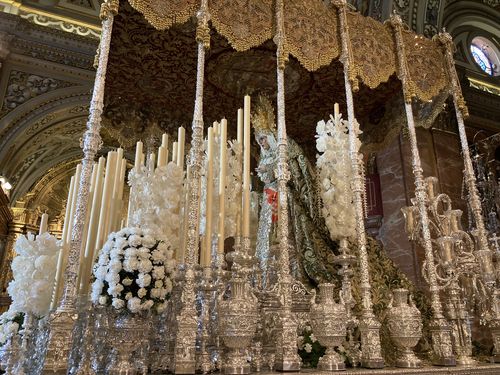
Sevilla • Macarena church
Monument profile
Macarena church
Monument category: Church
Monument family: Church, cathedral, basilica, chapel
Monument genre: Religious
Cultural heritage: Christian
Geographic location: Sevilla • Andalusia • Spain
Construction period: 20th century AD
• Links to •
• List of videos about Toledo, Seville, Ronda, Granada, Baena on this site •
Spain • Holy Week celebrations • Andalusia and Toledo
Tolède • Espagne
History of the Church of La Macarena in Seville
The Church of La Macarena, officially known as the Basilica of Santa María de la Esperanza Macarena, occupies a distinctive place within the religious and social history of Seville in southern Spain. Located near the historic northern boundary of the old city, close to the surviving sections of Seville’s medieval walls, the sanctuary reflects the evolution of urban devotion, political transformation, and collective identity during the twentieth century. Although relatively recent when compared with many Andalusian churches, its history is closely linked to older religious traditions and to major national events that shaped modern Spain.
Political and Social Context of Construction
The origins of the basilica are inseparable from the Brotherhood of Esperanza Macarena, a religious confraternity established during the sixteenth century. Like many Sevillian brotherhoods, it played an essential role in organizing charitable activities, devotional practices, and especially Holy Week processions. For centuries, the brotherhood’s revered sculptures were housed in the parish church of San Gil, which functioned as its spiritual base.
During the early twentieth century, Spain experienced profound social tensions linked to industrialization, political polarization, and growing confrontation between secular movements and institutions associated with the Catholic Church. Seville, despite maintaining strong religious traditions, was not immune to these conflicts. Working-class districts such as La Macarena developed strong communal identities in which religious brotherhoods served not only spiritual functions but also social and mutual support roles.
The outbreak of the Spanish Civil War in 1936 marked a decisive turning point. Episodes of anti-clerical violence affected numerous religious buildings across the country. The church of San Gil suffered serious damage during fires and attacks, threatening the preservation of the brotherhood’s sacred images. The rescue and protection of the image of the Virgin of Esperanza Macarena reinforced its symbolic importance among the local population, who increasingly regarded it as a figure associated with protection and resilience during a period of national crisis.
Following the conflict, the new political authorities promoted the reconstruction of religious institutions as part of a broader ideological program emphasizing Catholic identity within Spanish society. The construction of a dedicated sanctuary for the brotherhood therefore responded both to devotional needs and to the political climate of post-war Spain. The initiative aimed to provide a permanent and prestigious setting capable of accommodating growing public participation in religious ceremonies while reaffirming continuity after wartime destruction.
Major Historical Events Affecting the Site
Construction of the present church began during the 1940s and continued into the mid-twentieth century. The project represented more than a simple replacement of earlier facilities; it symbolized the restoration of religious life in Seville after years of instability.
Unlike medieval monuments shaped by successive dynasties or military conflicts, the basilica’s historical trajectory has been influenced primarily by social transformation rather than warfare. Nevertheless, the memory of the Civil War remained central to its meaning. The relocation of the brotherhood and the installation of its devotional images in the new building marked the beginning of a new phase in the institution’s history.
Throughout the following decades, the basilica became firmly associated with the Madrugá procession during Holy Week, one of the most important religious events in Seville. Massive public participation elevated the sanctuary’s reputation far beyond the neighborhood itself. The church gradually evolved into one of the most visited devotional centers in Andalusia.
Spain’s political transition to democracy after the 1970s altered the relationship between religious institutions and the state, yet the basilica retained its importance. Brotherhoods adapted to new social realities while maintaining traditional ceremonies that continued to attract broad public engagement.
Periodic restorations and organizational adjustments were carried out to accommodate increasing numbers of visitors and to ensure the preservation of devotional artworks housed within the sanctuary.
Global Context at the Time of Construction
The construction of the Church of La Macarena took place within a wider international context marked by reconstruction following major conflicts of the twentieth century. Across Europe, religious architecture underwent renewal as cities rebuilt damaged districts and sought symbolic spaces capable of restoring social cohesion.
While many countries embraced modernist architectural experimentation after the Second World War, Spain often favored stylistic continuity rooted in historical traditions. Religious buildings constructed during this period frequently combined modern engineering methods with references to earlier regional styles. The Macarena sanctuary belongs to this broader movement in which architecture functioned as a vehicle for cultural stability during a time of ideological transformation.
Globally, the mid-twentieth century also witnessed renewed interest in large communal religious spaces capable of hosting growing urban populations. In this sense, the basilica reflects international developments emphasizing accessibility, visibility, and collective participation in worship.
Transformations and Urban Evolution
Since its completion, the church has undergone several adaptations responding to both devotional practices and urban development. The surrounding district experienced considerable demographic and infrastructural change during the later twentieth century as Seville expanded beyond its historic limits.
The basilica gradually became a focal landmark within the neighborhood. Improvements to access routes, public spaces, and visitor circulation were introduced to manage large gatherings associated with processions and religious celebrations. Interior adjustments were also made to improve conservation conditions for sculptures, textiles, and ceremonial objects.
The addition of museum spaces dedicated to the history of the brotherhood represents an important transformation in the building’s use. These facilities allow the preservation and interpretation of religious heritage while accommodating growing cultural tourism.
Despite modernization in nearby urban areas, the church continues to maintain a strong visual and symbolic relationship with the nearby historic city walls and the Arch of La Macarena, reinforcing continuity between different historical layers of Seville.
Contemporary Role and Cultural Importance
Today, the Basilica of La Macarena occupies a central position within Seville’s cultural identity. Its importance extends beyond religious practice, serving as a major reference point for collective memory and civic tradition. The image of the Virgin of Esperanza Macarena has become one of the most recognizable symbols associated with Andalusian Holy Week.
Annual processions attract thousands of participants and spectators, transforming the surrounding streets into spaces of shared ritual and cultural expression. The brotherhood continues to conduct charitable initiatives, maintaining longstanding traditions of social assistance linked to religious institutions in southern Spain.
The basilica also functions as an important destination for international visitors seeking to understand Sevillian devotional culture. Its museum and ceremonial activities contribute to the preservation of intangible heritage connected with craftsmanship, music, and procession traditions.
Conservation and Modern Preservation Challenges
Although relatively modern compared with many monuments in Seville, the basilica faces several conservation challenges associated with intensive use. Continuous visitor flows generate wear on interior surfaces and infrastructure, requiring regular maintenance programs coordinated by the brotherhood and local authorities.
Environmental factors such as humidity variations, urban pollution, and temperature fluctuations also affect materials and artworks housed within the building. Preventive conservation measures have therefore become increasingly important, particularly regarding textiles and sculptural elements used during processions.
Tourism growth in Seville presents both opportunities and pressures. While increased visibility supports preservation efforts through funding and public interest, managing visitor access without disrupting religious functions remains an ongoing concern.
The church itself is not individually listed as a UNESCO World Heritage monument; however, it forms part of a historic urban environment internationally recognized for its cultural value. This broader context encourages continued preservation policies aimed at balancing active religious use with long-term heritage protection.
Architecture of the Church of La Macarena in Seville
The Church of La Macarena, officially the Basilica of Santa María de la Esperanza Macarena, represents a significant example of twentieth-century religious architecture in Andalusia. Designed and constructed during the decades following the Spanish Civil War, the building reflects a deliberate architectural strategy aimed at reconciling modern construction techniques with the visual continuity of Sevillian devotional tradition. Rather than adopting avant-garde experimentation, its design emphasizes monumentality, ceremonial functionality, and integration within an urban environment shaped by centuries of religious processions and collective rituals.
Technological and Architectural Innovations of the Period
The construction of the basilica coincided with a transitional phase in Spanish architecture, when reinforced concrete increasingly complemented traditional masonry systems. Engineers and architects working on religious buildings sought structural reliability while maintaining forms recognizable to local communities. In the case of La Macarena, modern structural solutions were largely concealed behind stylistic references associated with historic Andalusian churches.
The primary innovation lies in the spatial openness achieved within the nave. Reinforced structural elements allow wider spans than those commonly found in earlier parish churches, reducing the need for dense rows of supporting columns. This decision was not purely aesthetic but functional. The church had to accommodate large devotional sculptures and ceremonial platforms used during Holy Week preparations, requiring unobstructed interior circulation.
Structural stability was reinforced through a combination of load-bearing exterior walls and internal frameworks capable of distributing weight efficiently across vaulted ceilings. These solutions improved resistance to vibration and movement caused by large gatherings, an important consideration given the exceptional attendance associated with the brotherhood’s ceremonies.
Environmental adaptation also played a role in the design. Seville’s climate, characterized by intense summer heat, influenced decisions concerning wall thickness, ceiling height, and air circulation. Elevated interior volumes encourage thermal stratification, allowing warmer air to rise above occupied spaces. Carefully positioned openings contribute to cross-ventilation while limiting excessive sunlight penetration.
Urban planning considerations were equally important. Entrances were dimensioned not only for daily worship but also for the controlled movement of large crowds and ceremonial structures entering or leaving the building during processional events.
Materials and Construction Methods
The materials employed reflect both economic realities of post-war Spain and regional architectural continuity. Brick masonry forms a fundamental component of the structure, widely used throughout Andalusia due to availability, durability, and adaptability. Exterior surfaces were finished with protective plaster coatings that enhance resistance to solar exposure while maintaining the luminous appearance associated with southern Spanish architecture.
Stone elements were selectively incorporated in structural accents, portals, and decorative framing. Their use reinforces visual solidity while emphasizing key architectural axes such as entrances and devotional focal points.
Internally, construction methods prioritized durability. Flooring materials were chosen to withstand repeated mechanical stress produced by heavy ceremonial platforms and dense visitor circulation. The building’s surfaces therefore combine aesthetic considerations with long-term maintenance requirements.
Decorative ceramic elements reflect one of Seville’s most enduring artistic traditions. Ceramic panels and ornamental finishes provide color contrast while resisting humidity fluctuations. Their inclusion also connects the basilica visually with regional craftsmanship historically associated with religious architecture across Andalusia.
Metal reinforcements integrated into roofing and secondary structural systems contributed to improved longevity compared with earlier masonry churches. These hidden technological components allowed architects to achieve larger volumes while maintaining safety standards appropriate to modern construction.
Architectural and Artistic Influences
The architectural language of the Church of La Macarena belongs to a regionalist current that sought inspiration from Baroque and Neo-Baroque traditions deeply rooted in Sevillian identity. This stylistic orientation was particularly significant during the mid-twentieth century, when religious architecture often aimed to reinforce historical continuity rather than introduce radical stylistic change.
The façade composition demonstrates balanced symmetry organized around a dominant central entrance. Decorative articulation emphasizes verticality while avoiding excessive complexity. Towers and elevated elements contribute to the building’s visibility within the surrounding neighborhood, allowing it to function as a landmark recognizable from nearby streets.
Mudéjar influences, characteristic of Andalusian artistic heritage shaped by centuries of cultural interaction, appear subtly in ornamental geometry and surface decoration. Ceramic detailing and rhythmic patterns echo historical precedents found throughout Seville without directly reproducing earlier monuments.
Interior decoration focuses primarily on enhancing devotional perception rather than architectural experimentation. Lighting design plays a decisive role, directing attention toward the principal altar housing the revered Marian image. Artificial illumination complements natural light sources to create controlled visual emphasis during ceremonies.
Gold-toned decorative programs, traditional altarpiece arrangements, and carefully framed devotional spaces reinforce the theatrical dimension historically associated with Sevillian religious culture.
Spatial Organization and Structural Layout
The basilica follows a longitudinal plan derived from traditional church typology but adapted to contemporary devotional practice. A broad central nave defines the principal axis, providing uninterrupted visibility toward the sanctuary.
Side areas accommodate smaller devotional spaces while maintaining circulation routes required during large gatherings. The relative simplicity of spatial segmentation distinguishes the building from earlier ecclesiastical structures characterized by multiple chapels or complex compartmentalization.
The sanctuary occupies a dominant architectural position designed to ensure visibility from nearly every point within the nave. Elevated placement and controlled framing enhance ceremonial focus during liturgical celebrations.
Arches linking structural sections contribute both to load distribution and visual continuity. Vaulted ceilings reinforce acoustic performance, allowing spoken and musical elements of worship to reach large congregations without extensive mechanical amplification.
Auxiliary spaces integrated into the complex include preparation areas for processional sculptures, storage facilities, meeting rooms for the brotherhood, and museum areas dedicated to preserving historical artifacts. Their inclusion within the original planning demonstrates the building’s hybrid religious and institutional function.
Large entrance portals constitute one of the most distinctive structural adaptations. Their dimensions respond directly to the logistical requirements of Holy Week processions, allowing monumental platforms to pass without dismantling decorative elements.
Dimensions, Technical Particularities, and Anecdotal Aspects
Although not conceived as one of Spain’s largest basilicas, the building’s proportions are carefully calibrated to ceremonial use. Width and circulation capacity were prioritized over vertical exaggeration. The nave’s scale allows simultaneous devotional activity and logistical preparation associated with major religious events.
One notable architectural characteristic concerns the alignment between interior movement routes and exterior procession paths. The relationship between the church entrance and surrounding streets was intentionally designed to facilitate ceremonial continuity between indoor preparation and outdoor ritual performance.
The visual dialogue established with the nearby Arch of La Macarena, a surviving fragment of Seville’s historic defensive walls, adds another layer of architectural meaning. The juxtaposition of twentieth-century construction with medieval urban infrastructure reinforces historical continuity within the district.
Local narratives occasionally emphasize the speed with which the sanctuary became a focal landmark after completion, illustrating how architectural presence can rapidly redefine neighborhood identity when associated with strong devotional traditions.
Architectural Recognition and Conservation Challenges
Despite its relatively recent construction, the Church of La Macarena contributes significantly to Seville’s architectural landscape. It demonstrates how twentieth-century religious architecture in Spain balanced technological modernization with symbolic continuity.
The principal conservation challenges relate less to structural aging than to intensive use. Continuous visitor flows and large-scale ceremonial activity place pressure on flooring, decorative finishes, and interior installations. Preventive maintenance therefore forms a central component of preservation strategy.
Environmental conditions also require monitoring. Seasonal humidity variation and urban pollution affect surface materials, particularly decorative coatings and ceramic elements. Conservation efforts focus on maintaining both aesthetic integrity and functional safety.
Tourism growth in Seville has increased international attention toward the basilica. Managing visitor circulation while preserving the building’s active religious role remains a delicate balance. Adaptations must respect liturgical requirements while ensuring long-term architectural preservation.
Situated within one of Europe’s most historically significant urban environments, the basilica participates indirectly in broader heritage protection frameworks applied to the historic city. Its architecture illustrates how modern religious buildings can integrate successfully into historic contexts while continuing to serve living traditions.