

 Français (France)
  Nederlands (nl-NL)
 The Petit Bazar Temple, located in Saint-André on Réunion Island, is a Hindu religious building that reflects the presence and organization of communities of Indian origin in the eastern part of the island. It serves as an active place of worship for religious practices, ceremonies, and community gatherings. The temple is situated within an urban environment shaped by cultural diversity. It illustrates the role of religion in local social structures and contributes to the continuity of traditions. Today, it remains an important reference point for the spiritual and cultural life of the area.
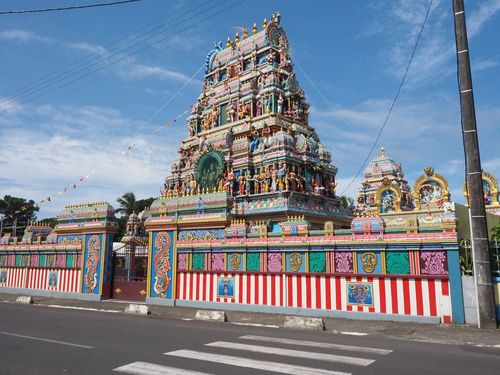
Reunion Island • Petit Bazar Temple

Reunion Island • Petit Bazar Temple

Reunion Island • Petit Bazar Temple
Monument profile
Petit Bazar Temple
Monument category: Hindu Temple
Monument family: Temple
Monument genre: Religious
Cultural heritage: Hindu
Geographic location: Saint André • Reunion Island
Construction period: 19th century AD
• Links to •
• List of videos about on this site •
Reunion: the volcano, the landscapes and the people • Reunion Island
Temple de Petit Bazar in Saint-André: foundation and historical development of a Hindu place of worship
Foundation and local context
The Temple de Petit Bazar in Saint-André emerged within the historical framework of Hindu religious organization among populations of Indian origin settled in eastern Réunion during the nineteenth century. Its establishment corresponds to the need for a structured place of worship following the arrival of indentured labourers who formed stable communities in this part of the island. The choice of location reflects a concentration of settlement in the Petit Bazar area, where families maintained religious practices linked to their cultural background. The initiative for construction appears to have been community-driven, relying on local participation and resources rather than formal colonial planning. The temple thus represents an early stage in the institutionalization of Hindu worship at a local scale.
Religious function and community role
From its inception, the temple fulfilled a central function in organizing religious life. It provided a permanent setting for rituals, offerings and observances aligned with the Hindu calendar. Its role extended beyond strictly liturgical use, acting as a focal point for gatherings that reinforced social cohesion among residents. The site enabled the continuity of practices transmitted within families and adapted to the insular environment. Activities held at the temple contributed to the maintenance of shared norms and to the stabilization of a collective identity rooted in religious affiliation. Its regular use indicates a sustained integration into daily and ceremonial life.
Continuity, adaptations and maintenance
Over time, the Temple de Petit Bazar underwent limited modifications intended to preserve its usability and accommodate gradual changes in the surrounding urban context. Interventions appear to have focused on maintenance rather than transformation, including repairs to structural elements and adjustments to reception capacity. No major change of function is documented, and the building has retained its original religious purpose. The continuity of ritual practices suggests that the temple remained consistently active, without periods of abandonment or significant interruption. Adaptations were carried out in a manner that respected the initial configuration of the site, ensuring functional stability.
Current status and cultural significance
At present, the temple continues to serve as a recognized religious and cultural reference point in Saint-André. It remains integrated into a multi-cultural urban environment where different traditions coexist. The building supports ongoing religious observance and contributes to the visibility of Hindu practices within the region. Its role in the transmission of rituals across generations is sustained by regular participation and community involvement. The condition of the structure reflects ongoing care, with maintenance efforts aimed at preserving both its physical integrity and its continued use.
Chronological perspective
The development of the temple is linked to the broader movement of Indian indentured labour migration to Réunion during the nineteenth century. This period follows the abolition of slavery in French colonies in 1848 and corresponds to a reorganization of labour systems. Globally, the same century saw the expansion of European colonial networks and increased maritime circulation. These dynamics facilitated the transfer and establishment of religious traditions across the Indian Ocean.
Temple de Petit Bazar in Saint-André: spatial organization and architectural characteristics
Site layout and spatial organization
The Temple de Petit Bazar is integrated into the urban fabric of Saint-André without a dominant or isolated position. Its placement reflects proximity to long-established residential areas associated with communities of Indian origin. The site is organized within a clearly defined plot, structured around a central worship space that serves as the primary functional core. Access is typically provided through a direct entrance from the street, creating an immediate transition between public space and the temple enclosure. Circulation areas are arranged in a straightforward manner, allowing movement around and within the building without complex axial planning. The overall layout prioritizes clarity of use rather than formal monumentality.
Volumetric composition and internal configuration
The main structure presents a compact volumetric composition centered on a principal prayer hall. This space accommodates ritual activities and congregational gatherings, defining the internal hierarchy of the building. Secondary volumes, when present, are attached laterally or at the front, forming a continuous built mass rather than a sequence of articulated elements. The elevation remains moderate, consistent with the scale of surrounding buildings and environmental constraints. Interior circulation is fluid, with limited compartmentalization, enabling flexible use during ceremonies. Openings along the walls provide both light and ventilation, establishing a direct relationship between interior spaces and the external environment.
Construction methods and materials
The construction relies on materials commonly used in Réunion, reflecting both availability and practicality. Load-bearing walls are typically composed of masonry, finished with protective coatings that enhance resistance to humidity and weathering. The roof structure is supported by timber or mixed frameworks, covered with metal sheeting or comparable materials to ensure durability and water resistance. These choices indicate an emphasis on structural reliability and ease of maintenance rather than ornamental complexity. Surface treatments, including painted finishes, contribute to the visibility of the building within the urban setting while protecting the underlying materials.
Architectural features and symbolic elements
The architectural expression of the temple includes selected elements that identify its religious function without extensive decorative elaboration. The façade may incorporate vertical markers or simplified ornamental features that distinguish the entrance and signal the sacred character of the site. Interior arrangements emphasize focal areas dedicated to ritual practice, with spatial organization oriented toward devotional use. Structural elements such as supports, openings and thresholds are treated in a restrained manner, maintaining coherence between function and form. Symbolic components are integrated into the architecture in a controlled way, ensuring legibility of the space without visual overload.
Modifications and structural maintenance
The Temple de Petit Bazar has undergone incremental adjustments aimed at preserving its functionality and accommodating evolving patterns of use. Interventions have primarily addressed roofing systems, surface finishes and the adaptation of reception areas. These changes have been implemented without altering the fundamental structure or spatial organization of the building. The current condition reflects ongoing maintenance carried out at the local level, ensuring continuity of use. Environmental factors, including humidity and exposure to tropical weather conditions, require regular upkeep of structural and surface elements, reinforcing the importance of sustained conservation practices.