

 Français (France)
  Nederlands (nl-NL)
 The church of Notre-Dame des Laves, located in Piton Sainte-Rose on Réunion Island, is a Catholic religious building closely associated with the volcanic activity of Piton de la Fournaise. It stands as a significant landmark in the local landscape and in the collective memory of the region. The church is linked to a notable event during which a lava flow diverted around the structure, reinforcing its symbolic importance for local communities. Today, it remains an active place of worship and a cultural point of interest, illustrating the interaction between natural forces and human settlement.
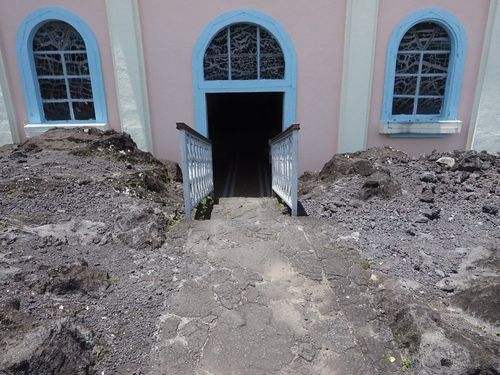
Reunion • Notre-Dame des Laves: church entrance
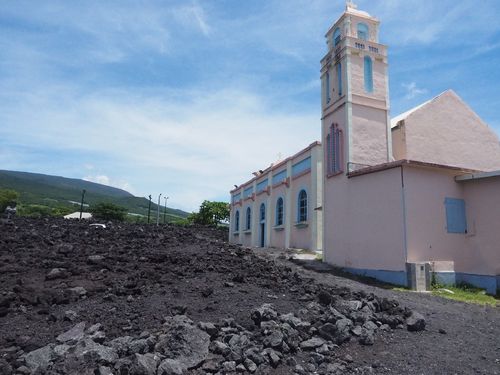
Reunion • Notre-Dame des Laves: lava surrounding the church
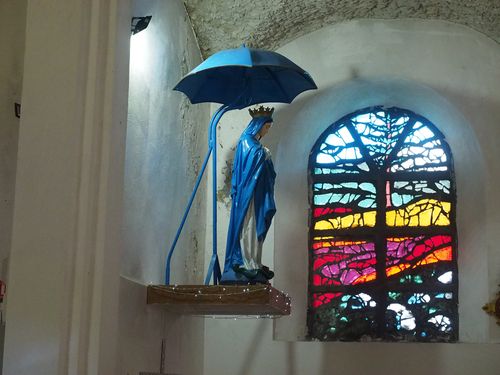
Reunion • Notre-Dame des Laves: Our Lady of the Parasol
Monument profile
Notre-Dame des Laves
Monument category: Church
Monument family: Church, cathedral, basilica, chapel
Monument genre: Religious
Cultural heritage: Christian
Geographic location: Piton Sainte Rose • Reunion Island
Construction period: 19th century AD
• Links to •
• List of videos about on this site •
Reunion: the volcano, the landscapes and the people • Reunion Island
Notre-Dame des Laves in Piton Sainte-Rose: construction, volcanic event, and continuity of use
Construction context and establishment
The church of Notre-Dame des Laves, located in Piton Sainte-Rose on the eastern coast of Réunion Island, was built in the early twentieth century as part of the organization of rural parishes. Its construction responded to the need for a permanent place of worship serving a dispersed population settled along the coastal zone. The building was established in an area exposed to the activity of the Piton de la Fournaise volcano, whose lava flows regularly reach the lower eastern slopes. The choice of location reflects a continuity of settlement despite recurring environmental constraints.
The 1977 eruption and immediate impact
A defining moment in the history of the church occurred in April 1977, during an eruption of Piton de la Fournaise. A lava flow advanced toward the inhabited area of Piton Sainte-Rose and reached the church and its immediate surroundings. The structure stood directly in the path of the flow. The lava moved around the building, partially entering the interior without causing a structural collapse.
This event led to the destruction of parts of the surrounding settlement, while the church itself remained largely intact. The physical impact on the building was limited to localized damage, allowing for restoration work shortly after the eruption. The interaction between the lava flow and the structure became a defining feature of the site’s historical identity.
Continuity of religious function and symbolic redefinition
Following the eruption, the church retained its primary function as a place of worship without long-term interruption. Repairs were carried out to restore damaged areas while preserving the overall structure. Religious services continued, maintaining the building’s role within the parish.
At the same time, the 1977 event altered the perception of the church. Its survival in the presence of the lava flow contributed to a symbolic redefinition, reinforcing its significance within local collective memory. This transformation did not involve any change in use, but it established the church as a reference point associated with a specific volcanic episode.
Current state and preservation
Since the late twentieth century, Notre-Dame des Laves has been subject to regular maintenance aimed at preserving its structural integrity. Interventions have primarily addressed the effects of climate and environmental exposure, including humidity and tropical weather conditions. No major structural modifications have altered the original configuration of the building.
The church remains active and accessible, continuing to serve its religious function. Its location in a volcanically active region requires ongoing attention to preservation, particularly in relation to potential future eruptions and environmental stress factors.
Global historical context
The construction of the church in the early twentieth century coincided with the expansion of religious infrastructure in colonial territories. The 1977 eruption took place during a period of increasing scientific understanding of volcanic activity, supported by improved monitoring techniques. At the same time, global awareness of natural hazards led to the development of more structured risk management approaches. These broader developments provide a chronological framework for situating the event without altering its local significance.
Notre-Dame des Laves in Piton Sainte-Rose: spatial layout, materials, and structural adaptation
Site placement and overall configuration
The church of Notre-Dame des Laves is positioned within the built environment of Piton Sainte-Rose, in a coastal zone exposed to volcanic activity. The building stands on an open plot that allows unobstructed perception of its volumes from the surrounding space. Its orientation follows a longitudinal axis, with a main entrance aligned toward the liturgical focal point at the opposite end.
The plan is defined by a compact and clearly organized structure centered on a single nave. This configuration concentrates all functions within a unified volume, avoiding the subdivision into multiple aisles or annexes. The absence of extended lateral structures reinforces the legibility of the building’s geometry and simplifies both circulation and spatial hierarchy. The immediate surroundings remain relatively open, allowing the church to function as a focal element within the local settlement.
Structural system and construction techniques
The load-bearing system consists of masonry walls that provide the primary structural support. These walls are sufficiently thick to ensure mechanical stability and to moderate internal temperature variations. The construction techniques rely on methods compatible with locally available skills and materials, without the introduction of complex structural frameworks.
The roof is supported by a timber framework forming a pitched structure designed to facilitate efficient rainwater runoff. This configuration reduces the risk of water accumulation and structural stress. The overall construction system prioritizes durability and resistance, particularly in response to environmental conditions such as humidity, heavy rainfall, and potential exposure to volcanic deposits.
Materials and surface treatment
The materials used in the construction are closely linked to the geological context of the island. Volcanic stone forms the primary component of the masonry, providing both structural strength and visual continuity with the surrounding landscape. Mortar and protective coatings are applied to stabilize the surfaces and limit degradation caused by climatic exposure.
Exterior finishes remain restrained, with minimal decorative elements. The façades are defined by the regular arrangement of openings that ensure natural lighting while preserving the integrity of the walls. Interior surfaces follow a similar approach, with finishes that emphasize functionality rather than ornamental complexity. This material economy contributes to the coherence between structure, appearance, and environmental adaptation.
Internal spatial organization and architectural elements
The interior is dominated by a single, elongated nave that accommodates the congregation in a unified space oriented toward the altar. The absence of intermediate structural supports allows for an uninterrupted perception of volume and facilitates movement within the building. This spatial continuity enhances the clarity of the internal arrangement.
Openings along the lateral walls provide consistent natural illumination, complemented by frontal light at the entrance. The chancel area is slightly differentiated, marking the focal point of the liturgical axis without introducing complex spatial subdivisions. Architectural elements are limited to essential components, including the load-bearing walls, the roof structure, and the liturgical furnishings, all integrated within a coherent spatial system.
Alterations following the 1977 eruption and conservation
The volcanic eruption of 1977 introduced a specific modification to the building through the partial incursion of lava into the interior. This event affected certain surface elements while leaving the main structural system intact. The presence of solidified lava within and around the church constitutes a distinct physical feature that differentiates the building from other religious structures.
Subsequent interventions focused on restoring functionality while preserving the existing configuration. Repairs addressed localized damage to floors and wall surfaces without altering the overall structure or layout. Conservation efforts since that time have aimed to maintain both the structural integrity of the building and the visible traces of the volcanic event.
Ongoing maintenance takes into account the combined effects of tropical climate and volcanic risk. Interventions remain limited in scope and are designed to ensure the long-term stability of the structure while respecting its material composition and architectural coherence.