

 Français (France)
  Nederlands (nl-NL)
 The Victory Memorial in Bishkek, Kyrgyzstan, is a commemorative monument honoring the sacrifices made during World War II. Unveiled in 1984 to mark the 40th anniversary of victory, it features a monumental structure of three stylized arches resembling a traditional yurt, beneath which an eternal flame burns. The site serves as a place of remembrance, official ceremonies, and annual commemorations.
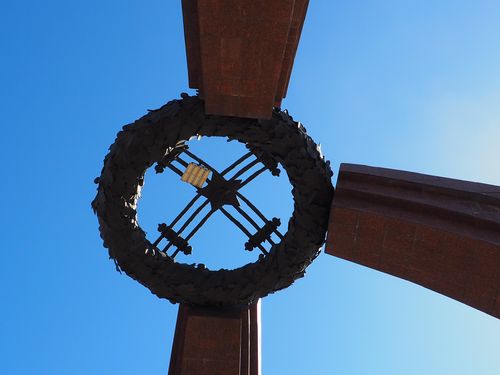
Bishkek • Victory Memorial
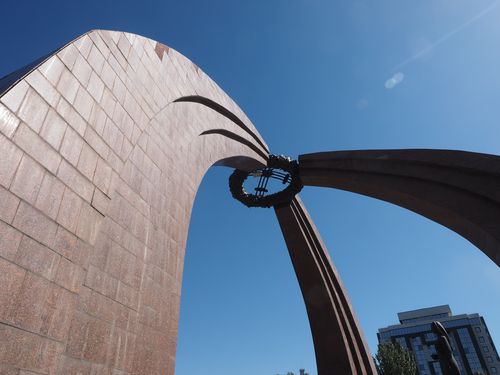
Bishkek • Victory Memorial
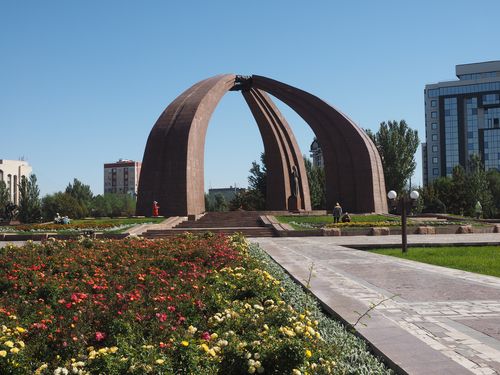
Bishkek • Victory Memorial
Monument profile
Victory Memorial
Monument category: Memorial monument
Monument family: Monument for cultural purposes
Monument genre: Cultural or scientific
Geographic location: Bishkek, Chuy Valley, Karakol, Issyk Kul lake • Kyrgyzstan
Construction period: 20th century AD
• Links to •
• List of videos about Bishkek, Chuy Valley, Karakol, Issyk Kul lake on this site •
Kyrgyzstan • a republic in the heart of Central Asia
Historical Analysis of the Victory Memorial in Bishkek, Kyrgyzstan
Located on a broad ceremonial square in Bishkek, the capital of Kyrgyzstan, the Victory Memorial stands as one of the most enduring Soviet-era monuments in Central Asia. Erected in 1984 to mark the 40th anniversary of the Soviet Union’s triumph in the Great Patriotic War (World War II), the memorial was designed not only to commemorate the immense loss of life suffered by the Kyrgyz people during the war but also to affirm their place within the broader Soviet historical narrative. Beyond its commemorative function, the monument also served complex political and ideological purposes in a time of subtle ideological transition within the USSR. This article explores the layered historical context that gave rise to the Victory Memorial, examining its construction, transformations, and ongoing relevance in modern Kyrgyz society.
Political and Social Context of Construction
The late Soviet period, particularly the early 1980s, was characterized by both stagnation and attempts to reinforce ideological cohesion. In the Kirghiz SSR, as in other republics, the central government in Moscow encouraged monumental commemorations of the Soviet victory in WWII. This drive aimed to unify diverse republics under a shared legacy of sacrifice and heroism. The 40th anniversary of Victory Day provided a timely pretext for constructing new war memorials across the USSR.
In Kyrgyzstan, the political leadership under the Communist Party of the Kirghiz SSR sought to both align with central directives and assert a localized expression of patriotism. The creation of the Victory Memorial in Bishkek was thus as much about reaffirming loyalty to Soviet ideals as it was about fostering national identity within a multiethnic and geographically peripheral republic.
By 1980, Kyrgyz participation in WWII had been widely acknowledged, though often underrepresented in Soviet historiography. Official estimates reported over 360,000 Kyrgyz soldiers conscripted into the Red Army, with approximately 100,000 perishing in combat. The decision to construct a major monument was a deliberate move to elevate this narrative and root it in the public space of the capital city.
Key Historical Events Shaping the Site
Unlike many historical monuments that are built on pre-existing sacred or historically symbolic sites, the Victory Memorial was constructed in a newly developed area of Bishkek. At the time, this part of the city was undergoing significant urban expansion. The choice of site was strategic: it was meant to create a new axis of civic space, centered on collective memory and framed by official ceremonies.
The memorial was completed within just over a year and was inaugurated on May 9, 1984, in a solemn ceremony that included military parades, veterans' marches, and speeches by state officials. The lighting of the eternal flame at the center of the structure was a symbolic act, connecting the past to the present through perpetual remembrance.
Importantly, the monument survived the political upheavals of the post-Soviet period intact. Unlike Lenin statues or other explicitly ideological symbols, the Victory Memorial was never targeted for removal. Its commemorative purpose, devoid of overt political messaging, allowed it to transcend the ideological shift and remain integrated into the post-independence landscape of Kyrgyzstan.
Global Context and Comparative Developments
The Victory Memorial in Bishkek reflects a broader trend of monument building in the Soviet Union during the late Cold War. Similar structures were erected in other Soviet republics—such as the Mother Armenia monument in Yerevan or the Brest Hero-Fortress in Belarus—each emphasizing sacrifice, resistance, and Soviet unity. In terms of form and function, the Bishkek memorial belongs to this family of commemorative architecture that aimed to root a common Soviet identity in diverse local contexts.
Globally, the post-World War II period saw a proliferation of war memorials. However, in contrast to Western nations that increasingly adopted minimalist or abstract forms, Soviet memorials remained monumental, figurative, and ideologically charged. The Bishkek monument reflects this aesthetic but tempers it through local cultural references, especially the incorporation of nomadic symbolism in its design.
Transformations and Evolving Use
Since its construction, the Victory Memorial has undergone minimal architectural alteration. However, its role in society has evolved significantly. During the Soviet era, it served as a stage for political rituals: Victory Day parades, youth pledges, and Party-organized commemorations. After 1991, it transitioned into a more neutral civic space, while maintaining its status as a ceremonial site.
The monument remains central to public life in Bishkek. Every May 9, it is the focal point of national remembrance activities, including wreath-laying ceremonies attended by government officials, war veterans, and schoolchildren. On other days, it functions as a site of quiet reflection, a location for photography, and an informal gathering space. It also plays a role in public education, with school trips often incorporating lessons about Kyrgyz contributions to World War II.
Cultural Significance and National Identity
The Victory Memorial has become a fixture of Kyrgyz national identity, albeit one rooted in a Soviet past. Unlike other post-Soviet states that have sought to erase Soviet-era monuments, Kyrgyzstan has chosen to reinterpret rather than remove them. This is particularly evident in the way the Victory Memorial is framed in state discourse: as a testament to the courage of Kyrgyz ancestors, rather than as a monument to Soviet power.
This reframing is supported by public sentiment. Many Kyrgyz citizens, particularly those with familial ties to the war, view the monument as a site of personal and collective memory. It stands as a rare example of a Soviet monument that has successfully been absorbed into a national narrative without deep cultural dissonance.
The monument’s visual language, which combines Soviet symmetry with regional symbolism, has also helped to maintain its relevance. It does not feel foreign or imposed, but rather integrated into the city’s architectural and symbolic vocabulary.
Conservation Status and Modern Challenges
The Victory Memorial is currently listed as a cultural heritage site of national significance. Regular maintenance by the Bishkek municipality ensures the structure remains in good condition. A partial restoration was conducted in 2010 to commemorate the 65th anniversary of Victory Day. This included resurfacing the granite, repairing the eternal flame’s gas supply system, and strengthening the internal supports of the arching structure.
However, several preservation challenges persist. Air pollution from increasing traffic and urbanization threatens the monument’s aesthetic integrity, especially the darkening of granite surfaces and corrosion of bronze details. Furthermore, unregulated construction in surrounding areas risks compromising the visual prominence of the site.
Efforts to mitigate these risks have included urban planning initiatives aimed at preserving sightlines and open space around the monument. Additionally, the site has been equipped with surveillance systems and improved lighting, reinforcing its role as a safe and respectful civic space.
As of today, the Victory Memorial is not listed as a UNESCO World Heritage site, nor has it been formally nominated. Nonetheless, its architectural uniqueness and cultural significance make it a strong candidate for inclusion in regional heritage circuits, particularly those focusing on Soviet-era monumentalism in Central Asia.
Conclusion
The Victory Memorial in Bishkek stands as a powerful reminder of the complex layers of memory, identity, and political intent embedded in monumental architecture. Constructed at a time of ideological consolidation, it has managed to evolve into a space of national remembrance that transcends its original Soviet context. Its endurance, both physical and symbolic, reflects the capacity of well-designed monuments to adapt to new narratives while honoring the past. Today, it continues to serve not only as a place of historical reflection but also as a vital component of Bishkek’s civic and cultural landscape.
Architectural Analysis of the Victory Memorial in Bishkek, Kyrgyzstan
Located in the capital city of Bishkek, the Victory Memorial (Мемориал Победы) stands as one of the most visually iconic and structurally distinctive war monuments in Central Asia. Inaugurated in 1984 to commemorate the 40th anniversary of the Soviet victory in the Great Patriotic War (1941–1945), the monument was conceived at a time when the architectural language of Soviet monumentalism was reaching maturity, while local cultural elements were increasingly integrated into public art and design. The Victory Memorial embodies this duality: it is at once a product of Soviet-era engineering and a reflection of Kyrgyz cultural identity, rendered in stone, bronze, and geometric abstraction.
Technological and Architectural Innovations
Constructed during a period of advanced technical proficiency in Soviet civil engineering, the Victory Memorial incorporates a series of structural innovations that allowed for a bold and ambitious design. The central feature of the monument consists of three enormous granite arches, rising to a height of approximately 10 to 12 meters, which meet at a single point above an eternal flame. These arches are not merely decorative; they are freestanding and load-bearing, relying on a deep foundation of reinforced concrete and an internal framework of stainless steel rods.
The geometry of the arches was calculated with precision using Soviet-era engineering models, incorporating dynamic load-bearing principles. Unlike more traditional column-and-lintel structures, the Victory Memorial’s cantilevered arches required the use of pre-stressed tension cables during assembly, a technique relatively uncommon in Central Asian public monuments at the time. The ability to form such a sweeping overhead structure with no central support columns was a mark of engineering confidence and innovation.
Additionally, the monument was designed with natural ventilation in mind. The open form allows air to circulate freely around the eternal flame, preventing smoke and heat buildup. The plaza’s drainage system, hidden beneath granite paving, ensures that rainwater does not collect near the flame, an essential feature given the harsh continental climate of Bishkek, with its snow-heavy winters and torrential spring rains.
Materials and Construction Techniques
Material selection played a key role in the visual and structural longevity of the monument. The arches are composed of locally quarried red granite, chosen not only for its symbolic resonance—red representing both sacrifice and Soviet ideological strength—but also for its durability. The stone was cut and polished on-site, then hoisted into position using specialized cranes adapted from industrial construction projects.
The central eternal flame basin is crafted from cast bronze, a material with excellent thermal resistance and a dignified aesthetic. The bronze is adorned with stylized motifs, including abstracted representations of stars, laurel wreaths, and fire patterns, subtly blending Soviet iconography with Kyrgyz ornamental traditions. This approach avoids overt figurative depictions, in favor of a universal symbolism easily interpreted across ethnic and generational lines.
Beneath the monument, a network of gas lines fuels the eternal flame, protected by fireproof insulation and regulated by pressure controls housed in a subterranean chamber. The flame itself is elevated on a triangular plinth—a subtle reference to stability and balance—crafted from the same polished granite as the outer arches.
Artistic and Cultural Influences
A unique aspect of the Victory Memorial is its architectural dialogue between Soviet monumentalism and Kyrgyz nomadic symbolism. The three arching forms, when viewed from below, mimic the circular silhouette of a traditional yurt, the mobile dwelling historically used by Kyrgyz nomads. This design choice establishes an organic link between ancestral cultural forms and the modern state narrative of unity and resilience.
From an aesthetic standpoint, the monument reflects the late-modernist sensibility prevalent in Soviet public architecture of the 1970s and 1980s. Clean lines, bold geometric forms, and restrained ornamentation are combined with a monumental scale that is intended to inspire solemn reflection. Unlike many Soviet-era war memorials that feature heroic sculptures or dramatic battle scenes, the Victory Memorial in Bishkek uses abstraction and spatial composition to evoke a contemplative atmosphere.
There are also traces of Islamic architectural influence, particularly in the use of symmetry, the central open dome-like space, and the radial layout of the plaza. These stylistic integrations were likely intended to resonate subtly with local cultural memory, without contradicting the secular ideals of Soviet ideology.
Spatial Organization and Structural Composition
The monument occupies a circular plaza with a diameter of approximately 30 meters, with the three granite arches arranged in a triangular configuration, equidistant from one another. This structure draws the eye upward while also enclosing the visitor in a symbolic embrace of remembrance. The central platform, upon which the eternal flame is set, is raised by three wide steps, emphasizing the sanctity of the inner sanctum without creating a physical barrier.
Surrounding the central space is a ring of granite paving segmented by radiating lines that direct foot traffic and symbolically echo the spreading impact of wartime sacrifice. The broader memorial site is integrated into a public park, which was landscaped during the 1980s with low shrubbery, ornamental trees, and minimalist benches of stone and metal.
At night, the arches and flame are illuminated by concealed ground-level floodlights, which cast dramatic shadows that enhance the monument’s visual prominence. The absence of fencing or boundary walls ensures public accessibility, reinforcing the notion that remembrance is a communal, not isolated, act.
Notable Statistics and Anecdotes
The Victory Memorial’s dimensions are not formally published in architectural registers, but approximate measurements suggest that the arches weigh several hundred tons each, with the entire structure likely exceeding 1,000 metric tons of granite. The precision required in the assembly of such large elements, particularly at the joining point above the flame, is often cited by engineers as a significant accomplishment in Central Asian civil architecture.
A widely shared anecdote claims that a time capsule was buried beneath the eternal flame during construction, containing documents from Soviet veterans and messages to future generations. Although this has never been publicly confirmed, the story contributes to the monument’s aura and intergenerational appeal.
Conservation and International Recognition
Today, the Victory Memorial is listed as a protected cultural heritage site within Kyrgyzstan. While it does not hold UNESCO status, it has been proposed for inclusion in thematic heritage circuits focused on Soviet monumentalism in Central Asia. Maintenance is overseen by the Bishkek city administration, which conducts annual inspections and minor restorations, particularly in advance of Victory Day commemorations on May 9.
Challenges to the site’s preservation include urban development, which threatens to encroach upon the once-spacious setting, and environmental factors such as air pollution and temperature fluctuations that accelerate stone weathering. Restoration work conducted in 2010 included deep cleaning of the granite surfaces, restoration of the gas supply mechanism for the eternal flame, and structural reinforcement of the arches.
Although the site remains accessible and in generally good condition, conservationists have called for greater educational signage and formal recognition by international heritage bodies. Such steps would not only protect the monument but also elevate its status as an architectural and cultural landmark beyond the post-Soviet sphere.
Conclusion
The Victory Memorial in Bishkek exemplifies a distinct mode of commemorative architecture that merges Soviet technical rigor with regional cultural resonance. Through its structural ingenuity, symbolic design, and durable materials, it communicates a message of sacrifice, continuity, and national pride. Unlike many other Soviet monuments that have fallen into disrepair or disfavor, the Victory Memorial continues to function as a vital part of Kyrgyzstan’s civic landscape—both as a space of public memory and as a refined example of late Soviet architectural expression.