

 Français (France)
  Nederlands (nl-NL)
 The Mural de la Prehistoria, located near Viñales in Cuba, is one of the country’s best-known monumental artistic ensembles. Created on the face of a hillside, it combines public art, landscape, and large-scale cultural ambition. Through its remarkable dimensions and colours visible from afar, it forms a striking landmark within the Viñales valley. The site attracts visitors interested in Cuban cultural history, major twentieth-century artistic projects, and monumental outdoor expression. Today, it remains one of the most recognizable images of the region.
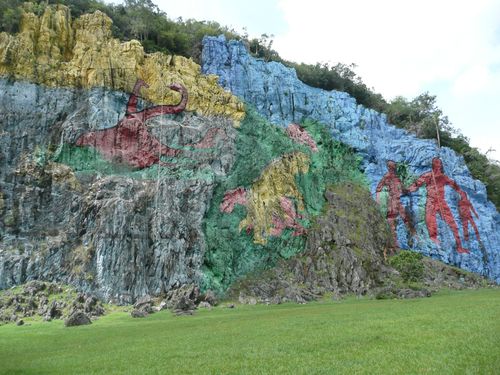
Vinales • Mural de la Prehistoria

Vinales • Mural de la Prehistoria
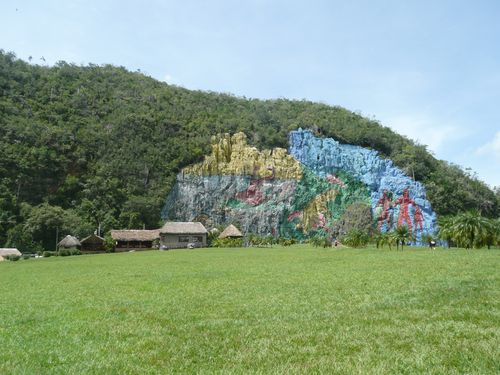
Vinales • Mural de la Prehistoria
Monument profile
Mural de la Prehistoria
Monument category: Monumental bas-relief
Monument family: Rock Sanctuary and Monumental Bas-reliefs
Monument genre: Religious
Geographic location: Vinales • Cuba
Construction period: 20th century AD
• Links to •
• List of videos about Vinales on this site •
Pinar del Rio. Vinales and surroundings • Cuba
Mural de la Prehistoria at Viñales: Monumental Art of Revolutionary Cuba
Creation of the Site and Political Context
The Mural de la Prehistoria is located in the Viñales valley, in the province of Pinar del Río in western Cuba. It was created in the early 1960s on the face of a mogote, the steep limestone hill formations characteristic of the region. The project emerged during the first years of the Cuban revolutionary government, a period marked by strong efforts to reshape public space through education, symbolism, and cultural programs.
The work is generally associated with Leovigildo González Morillo, an artist linked to revolutionary cultural circles and, according to several accounts, influenced by Mexican mural traditions. Its execution reflected a broader policy that promoted monumental art accessible to the population rather than confined to museums or elite institutions.
Selecting a dramatic natural cliff as the support matched that ambition. The surrounding landscape became part of the artistic statement.
Cultural Purpose and Original Meaning
The mural was conceived as a stylized representation of the evolution of life, from ancient organisms to later human development. Although its title refers to prehistory, the composition functions more as symbolic narrative than as scientific reconstruction.
In the Cuba of the 1960s, such a project connected ideas of progress, collective knowledge, and national transformation. It also served to highlight a rural region important for agriculture and domestic tourism.
Its immense scale expressed the capacity of the revolutionary state to intervene visibly in the environment through cultural works. The mural therefore combined artistic communication, political prestige, and regional promotion.
The use of vivid colours and simplified forms ensured immediate recognition from a distance, reinforcing its public character.
Construction Process and Later Development
The creation of the mural required substantial preparatory work. Sections of the rock face had to be cleared and prepared before the large painted forms could be applied. Because of the size of the cliff, execution depended on organized teams, technical planning, and access systems suitable for working on steep surfaces.
Once completed, the site quickly became a well-known destination within Cuba. Over time, weather exposure, humidity, vegetation growth, and fading pigments made regular maintenance necessary. Repainting campaigns became essential to preserve visibility and colour intensity.
The surroundings were gradually adapted for visitors through road access, viewing areas, restaurants, and service spaces. What began as an isolated artistic intervention developed into a structured cultural and tourist site.
Present Role, Regional Identity, and Heritage Context
Today the Mural de la Prehistoria is one of the most recognizable images of the Viñales region. It attracts Cuban and international visitors interested in monumental public art, twentieth-century Cuban history, and the landscape of western Cuba.
The Viñales Valley was inscribed on the UNESCO World Heritage List in 1999 under the official name Viñales Valley. The mural was not the principal reason for inscription, which focused on the cultural landscape and agricultural traditions, but it has become one of the most visited places within the protected area.
Its current significance extends beyond art alone. It contributes to the touristic identity of the valley and preserves a visible expression of Cuba’s early revolutionary cultural ambitions.
The monument also illustrates how natural scenery was transformed into a medium of state-sponsored visual culture.
Global Historical Context
The mural was created in the early 1960s, during the Cold War. In 1961 Yuri Gagarin completed the first human spaceflight. Many African states were gaining independence. The Berlin Wall was erected in 1961. In the Caribbean, Cuba had become a major geopolitical focus after the 1959 Revolution and before the 1962 Missile Crisis.
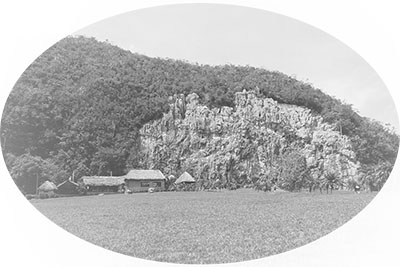
Monumental Configuration of the Mural de la Prehistoria at Viñales
Placement on the Limestone Cliff and Landscape Relationship
The Mural de la Prehistoria stands in the Viñales valley on the face of a mogote, one of the steep limestone hills that define the region. Its essential architectural characteristic is that it uses a natural mountain wall as its primary support. Rather than being attached to an independent building, the monument transforms geology into façade, structure, and visual field.
The selected cliff offers a broad inclined surface visible from the valley floor. This position allows the mural to be read across considerable distance. The monument was therefore conceived according to landscape scale rather than urban scale. It is perceived gradually through movement across open ground instead of through immediate close contact.
The relationship between painted forms and the mountain mass is central to the composition. The imagery does not erase the cliff but overlays it, allowing natural contours, irregularities, and changes in slope to remain perceptible beneath the colour fields.
Its setting within agricultural land and open valley space gives the monument an expansive visual forecourt. The surrounding emptiness strengthens the effect of scale.
Rock Surface Preparation and Technical Execution
The limestone face of a mogote is uneven, fractured, and naturally weathered. It contains ledges, cavities, erosion lines, and vegetation growth. Before painting could begin, sections of the rock required cleaning and preparation so that the outlines would remain legible.
The transfer of design from drawing to monumental surface demanded accurate scaling methods. Because of the cliff’s dimensions, artists and workers likely relied on measured reference points, progressive marking systems, and coordinated teams operating at multiple heights. Execution on a steep natural wall introduced logistical conditions closer to engineering works than to conventional studio painting.
Pigments had to withstand tropical sunlight, seasonal rain, humidity, and biological growth. Strong, saturated colours were selected not only for symbolic effect but for visibility over long distance. Broad areas of red, yellow, green, blue, and white remain readable where subtle tonal modelling would disappear.
The monument therefore combines mural technique with site-specific construction methods adapted to terrain and climate.
Visual Composition and Formal Organization
The mural extends horizontally across the cliff face, balancing the natural verticality of the mogote. This lateral spread prevents one narrow focal point and instead creates a panoramic composition. The eye moves across the mountain as if reading a giant sequential panel.
Large curving forms, simplified silhouettes, and heavy outlines organize the imagery. At this scale, precision detail would be ineffective, so the design depends on bold contour and colour contrast. Each figure must remain recognizable from hundreds of metres away.
The arrangement suggests a chronological narrative of life forms and development. Architecturally, this produces a left-to-right procession across the natural wall. The mountain becomes a monumental narrative façade rather than a neutral background.
Natural fractures and topographic interruptions subtly segment the composition into zones, yet the continuity of colour unifies them. The visual order results from negotiation between graphic intention and irregular terrain.
Visitor Space, Viewing Distance, and Spatial Experience
The monument includes an approach zone at the base of the cliff, with access roads, open areas, and viewing points designed to provide sufficient distance for full perception. Without setback space, the mural cannot be comprehended as a complete image.
Its experience changes according to position. From afar, the work appears as a coherent giant composition integrated into the hill. At medium range, individual figures become clearer. At close distance, rock texture, paint edges, weathering, and the actual scale of brushwork or repainting become visible.
This shifting perception gives the site a spatial logic comparable to architecture. The monument organizes movement, sightlines, and scale relationships between human observer and oversized surface.
Light conditions also affect reading. Morning, midday, and late afternoon sun alter contrast and shadow on the cliff, changing the prominence of certain sections.
Maintenance, Restoration, and Conservation Conditions
The Mural de la Prehistoria depends on regular maintenance more than many built monuments. Rainfall, wind erosion, vegetation, mineral deposits, and pigment fading continually affect the surface. Periodic repainting is necessary to preserve colour intensity and contour clarity.
Conservation presents a specific challenge because two materials must be protected simultaneously: the painted image and the living geological support. Stabilizing rock areas, clearing vegetation, and renewing pigments must be balanced without destroying the character of the site.
Today the monument remains a rare example of large-scale environmental art in which landscape, image, and constructed visitor space form a single monumental ensemble. Its continuing legibility demonstrates how natural relief can function as architecture when transformed into an organized visual surface.