

 Français (France)
  Nederlands (nl-NL)
 Nurullaboy Saroyi Palace, located in Khiva, is one of the most notable royal residences from the late period of the local khanate. It reflects the development of political and ceremonial spaces in a city already renowned for its historic urban heritage. Through its residential and representative functions, the complex illustrates the ambitions of its patrons during a time of regional change. The palace is also significant for combining local traditions with external influences visible in its overall design. Today, it stands as an important heritage site that broadens the historical understanding of Khiva beyond its walls and religious monuments.

Khiva • Nurullaboy Saroyi Palace

Khiva • Nurullaboy Saroyi Palace
Khiva • Nurullaboy Saroyi Palace
Monument profile
Nurullaboy Saroyi Palace
Monument category: Palace
Monument family: Palace and Annexes
Monument genre: Residential
Cultural heritage: Islamic
Geographic location: Khiva • Uzbekistan
Construction period: 19th century AD
This monument in Khiva is inscribed on the UNESCO World Heritage List since 1990 and is part of the serial property "Itchan Kala".See the UNESCO monuments featured on this site
• Links to •
• List of videos about Khiva on this site •
Khiva, open-air museum • Uzbekistan (EN)
• References •
UNESCO: Itchan Kala
Nurullaboy Saroyi Palace: Dynastic Residence and Late Khivan Statecraft
Foundation under the Khiva Khanate
Nurullaboy Saroyi Palace was built in Khiva during the late nineteenth century, principally under the rule of Muhammad Rahim Khan II, known as Feruz, who governed from 1864 to 1910. Unlike earlier royal compounds concentrated within the walled city of Itchan Kala, this palace was established outside the historic inner enclosure in a more spacious area. Its location allowed the creation of a broader residential and ceremonial complex than was possible inside the dense urban core.
The name derives from Nurullabai, associated with the original estate later incorporated into the khan’s domain. The subsequent development of the site into a formal palace reflected changing priorities within the khanate. After the Russian conquest of Khiva in 1873, the state retained limited internal autonomy under imperial supervision. In that context, the ruling court sought new architectural forms through which authority and prestige could still be displayed.
Ceremonial and Political Functions
Nurullaboy Saroyi was designed as more than a private residence. It served as a venue for official receptions, diplomatic encounters, and court ceremony. Russian administrators, regional notables, merchants, and envoys could be received in surroundings intended to communicate continuity of rule together with selective modernization.
The palace also answered practical needs of governance. More open grounds outside the old city made movement easier for escorts, servants, guests, and administrative staff. The complex could host audiences and festivities with fewer spatial constraints than the older palatial quarters inside Itchan Kala. Its layout therefore embodied a reorganization of princely life in response to new political realities at the end of the nineteenth century.
Twentieth-Century Reassignments
The fall of the khanate in 1920 transformed the palace’s status. With the end of dynastic rule and the establishment of new revolutionary authorities, Nurullaboy Saroyi lost its original courtly role. As occurred with many former royal residences in Central Asia, the complex was reassigned to public, administrative, or institutional uses depending on the period.
These changes often altered internal arrangements. Reception halls could be subdivided, domestic rooms repurposed, and service spaces adapted for offices or storage. During the Soviet era, growing recognition of Khiva’s historical value gradually encouraged preservation efforts. The palace came to be viewed not only as a former residence but as evidence of the final phase of the khanate and of its contacts with external powers.
Global Historical Context
During the principal construction phase of the palace, European colonial empires dominated large parts of Asia and Africa. The Russian Empire continued its expansion in Central Asia. British rule in India had become firmly established. At the same time, industrialization was reshaping major cities in Europe and North America.
Heritage Role and Present Condition
Nurullaboy Saroyi now forms an important component of the broader historical landscape of Khiva. While Itchan Kala was inscribed on the UNESCO World Heritage List in 1990 under the official name Itchan Kala, the palace illustrates the later outward expansion of Khivan royal authority beyond the medieval walls.
Today the complex functions primarily as a cultural and heritage site. It offers insight into the ceremonial life of the late khanate, the adaptation of local elites to imperial pressure, and the visual language of rulership in a transitional age. Conservation focuses on structural stability, decorative interiors, and the preservation of spaces modified by successive uses. The palace remains one of the clearest monuments of Khiva’s final dynastic century.
Palatial Layout and Architectural Language of Nurullaboy Saroyi Palace
Site Planning and General Composition
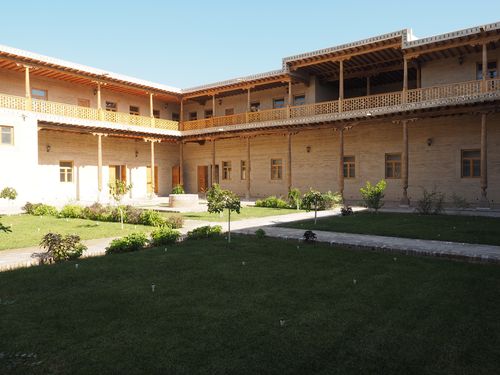
Nurullaboy Saroyi Palace in Khiva differs from the compact royal compounds of Itchan Kala by its location outside the historic inner walls, where more open land permitted a broader architectural composition. Rather than a single monumental block, the palace forms an ensemble of buildings distributed across a landscaped precinct with courtyards, gardens, service zones, and transitional open spaces. This dispersed arrangement creates a sequence of controlled approaches from entrance areas to reception quarters and then to more private residential sectors.
The complex operates through spatial hierarchy. Public and ceremonial buildings occupy the most accessible and visually prominent areas, while domestic apartments and secondary functions are set deeper within the site. Service structures, storage areas, and staff circulation routes are organized with relative discretion. The result is a palace conceived as a small autonomous compound rather than an isolated residence.
Construction Systems and Materials
The palace combines traditional Central Asian construction methods with later nineteenth-century materials and finishes. Load-bearing walls are primarily built of mud brick or fired brick depending on location and structural need. Exterior surfaces were protected with plaster coatings, while interior walls often received finer decorative treatment. Timber was widely used for roof structures, ceilings, verandas, and carved columns.
Thick masonry walls provide thermal mass suited to Khiva’s continental climate, moderating summer heat and winter cold. Room proportions often reflect this environmental logic: deeper wall sections allow recessed openings and shaded interiors. Roofs over principal halls rely on timber beams capable of spanning reception rooms more generously than ordinary domestic spaces.
Some later portions incorporated imported or industrially produced elements, including glass, metal fittings, and manufactured decorative components. Their presence marks the palace as a product of transition, where local craftsmanship coexisted with new supply networks.
Interior Distribution and Ceremonial Spaces
A defining architectural feature of Nurullaboy Saroyi is the contrast between formal reception suites and more intimate residential rooms. Audience halls and ceremonial salons are generally larger, taller, and more richly finished than private chambers. Their proportions emphasize axial views, ordered seating arrangements, and the controlled display of authority.
Decorated ceilings in painted wood, sometimes divided into geometric coffers or patterned panels, form major visual surfaces. Walls may contain niches, mirrors, ornamental plasterwork, and framed decorative zones that articulate the room vertically. Windows are often larger in representative rooms, allowing increased light and visual refinement.
Covered galleries and verandas mediate between enclosed interiors and open courtyards. These semi-exterior zones provide shade, ventilation, and circulation sheltered from direct sun. Courtyards themselves organize movement, admit daylight to surrounding rooms, and separate functional sectors of the palace. Private apartments use smaller interconnected rooms, alcoves, and resting areas, expressing domestic rather than ceremonial priorities.
Decorative Synthesis and Stylistic Character
The palace is especially notable for combining Khorezmian decorative traditions with Russian and broader European influences. Carved wooden columns, painted vegetal or geometric ornament, tiled surfaces, and traditional color schemes appear alongside features associated with late imperial taste: larger glazed windows, chandeliers, parquet floors, symmetrical room planning, and furniture suited to formal receptions.
This synthesis is not uniform across the complex. Exterior elevations may remain comparatively restrained, while interiors contain the richest decoration. Such contrast heightens the experience of entering principal halls. In some rooms, imported finishes and local craftwork coexist on the same surfaces, creating layered visual identities rather than a complete stylistic replacement.
Alterations and Conservation Issues
Twentieth-century changes of use led to modifications in room divisions, circulation patterns, and finishes. Some halls were adapted for administrative or public functions, while practical repairs occasionally replaced original joinery or surface materials. Later restoration campaigns aimed to recover decorative schemes and stabilize structures affected by moisture, settlement, or neglect.
Current conservation requires attention to painted timber ceilings, carved woodwork, plaster ornament, and masonry vulnerable to salt and climate stress. Glass elements and later imported materials pose additional restoration challenges distinct from earthen or timber components. Architecturally, Nurullaboy Saroyi remains one of the clearest examples in Uzbekistan of a late Central Asian palace where traditional planning principles were reinterpreted through selective international influence.