

 Français (France)
  Nederlands (nl-NL)
 The Sagrada Familia, located in Barcelona, is one of the most iconic monuments in Catalonia and Spain. Designed by architect Antoni Gaudí, this impressive basilica is a remarkable example of Catalan modernism, with its unique architecture and nature-inspired forms. Construction began in 1882 and remains unfinished, making it an ever-evolving architectural project. The Sagrada Familia attracts millions of visitors each year, drawn by its intricate sculptures and religious symbolism. The monument was designated a UNESCO World Heritage site in 2005.

Barcelona • Sagrada Familia: in the early 90
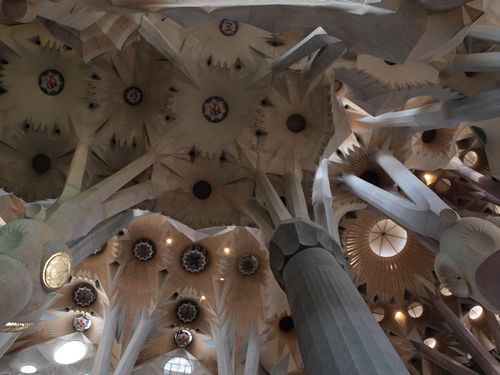
Barcelona • Sagrada Familia: ceiling in 2011
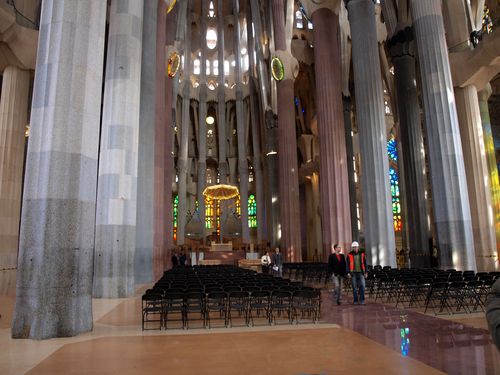
Barcelona • Sagrada Familia
Monument profile
Sagrada Familia
Monument categories: Basilica, Modernist architecture
Monument families: Church, cathedral, basilica, chapel • Modern architecture
Monument genres: Religious, Cultural or scientific
Cultural heritage: Christian
Geographic location: Barcelona • Spain
Construction period: 19th century AD
This monument in Barcelona is inscribed on the UNESCO World Heritage List since 1984 and is part of the serial property "Works of Antoni Gaudi".See the UNESCO monuments featured on this site
• Links to •
• List of videos about Barcelona on this site •
Barcelona, the city of Gaudi • Spain
• References •
UNESCO: Œuvres d’Antoni Gaudí
Britannica: Sagrada Família
Wikipedia FR: Sagrada Família
The Sagrada Familia: Political, Social, and Cultural Motivations Behind an Iconic Monument
Political and Social Motivations and the Beginning of Construction
The construction of the Sagrada Familia in Barcelona, initiated in 1882, was driven by a blend of political, social, and religious motivations. At the time, Barcelona and the Catalonia region were undergoing significant economic growth due to industrialization, and this urban expansion fueled a sense of regional pride. The rising Catalan nationalist movement sought to assert its identity in the face of a centralized Spanish state, and the construction of a grand basilica was seen as both a spiritual and cultural assertion. Additionally, Spain was experiencing a period of religious revival, particularly within conservative sectors, following the secularization trends of the 19th century. This revival aimed to re-establish Catholic values in Spanish society, and the Sagrada Familia was conceived as a project to symbolize this religious renewal.
Antoni Gaudí, who took over the project in 1883, imbued the basilica with deep Catholic symbolism, intending it to be a monumental representation of Christian faith. Beyond the spiritual dimension, it also reflected the artistic and political aspirations of Catalonia, positioning itself as a cultural beacon distinct from the rest of Spain.
Historical Events and Their Impact on the Region
Several major historical events have shaped the Sagrada Familia and influenced its significance in Catalonia. The Spanish Civil War (1936–1939) had a profound impact on the basilica. During the conflict, many of Gaudí’s original plans and models were destroyed by anarchists, halting construction for several years. This period marked a time of intense political upheaval, with the Catholic Church often seen as aligned with the Francoist regime, which made religious structures like the Sagrada Familia targets for anti-Franco forces. The destruction of parts of the basilica highlighted the deep political rifts in Spain and the ideological battles surrounding religion and power.
In the post-war period, Spain transitioned from dictatorship to democracy, and the Sagrada Familia became a symbol not only of religious devotion but also of resilience. As Catalonia regained a sense of political and cultural autonomy during Spain’s democratization, the basilica emerged as an emblem of Catalan identity and pride.
Context in the Global Sphere
At the time of its construction, the world was undergoing a transformation marked by industrialization, urbanization, and the rise of nationalism. In Europe, cities like Barcelona were experiencing rapid growth, similar to industrial hubs such as Manchester and Paris. Nationalist movements were rising in regions like Germany and Italy, paralleling Catalonia's own search for political and cultural autonomy within Spain.
Globally, empires were expanding, with Britain at the height of its colonial dominance, while the United States was emerging as a powerful nation after its Civil War. The construction of monumental buildings, such as the Eiffel Tower in Paris (completed in 1889), became symbols of national pride and industrial progress. The Sagrada Familia, though deeply rooted in religious tradition, can be seen within this context of monumental architectural projects aimed at showcasing a region’s power and identity on the global stage.
Major Transformations and Cultural Influences
Over the centuries, the Sagrada Familia has undergone significant transformations, both architecturally and symbolically. Initially designed by Francisco de Paula del Villar, Gaudí transformed the project into a unique fusion of modernist and Gothic styles. His designs drew heavily on natural forms and advanced engineering techniques, such as hyperbolic and parabolic structures, to create an innovative yet organic architectural vision. After Gaudí's death in 1926, the continuation of the basilica’s construction has involved multiple architects, each contributing to its evolution while attempting to remain faithful to Gaudí’s vision.
The basilica's evolution mirrors the political changes in Catalonia and Spain. Under Franco’s regime, Catalonia experienced suppression of its language and culture. However, following Spain's transition to democracy in the 1970s, the Sagrada Familia became a symbol of cultural resurgence and an enduring emblem of Catalan identity.
Cultural Significance and UNESCO Recognition
The architectural elements of the Sagrada Familia, such as its towering spires and intricate façades, have made it an internationally recognized symbol of both religious devotion and artistic innovation. Its blend of Gothic and modernist influences, along with Gaudí's integration of natural forms, has captivated millions of visitors from around the world. The basilica’s inclusion on UNESCO's World Heritage list in 2005 cemented its status as a cultural and historical treasure.
This UNESCO designation has brought not only increased international attention but also additional resources for preservation. It has helped ensure that the ongoing construction and restoration work respects the integrity of Gaudí's original designs while safeguarding the basilica for future generations.
Current Conservation Challenges
Despite its status as a world-renowned monument, the Sagrada Familia faces numerous challenges in terms of preservation. One of the primary threats is the strain of mass tourism, with millions of visitors each year contributing to the wear and tear of the structure. The urban development of Barcelona also poses risks; construction projects, such as the extension of the city’s metro system, have raised concerns about the potential impact on the basilica's structural stability.
Environmental factors, such as pollution and climate change, further threaten the integrity of the materials used in the basilica’s construction. Preservation efforts require constant innovation, combining modern conservation techniques with Gaudí's original vision. Striking a balance between maintaining the authenticity of the monument and adapting it to modern conditions remains a key challenge for those involved in its restoration.
Conclusion
The Sagrada Familia is not just an architectural marvel but also a reflection of the political, social, and cultural currents that have shaped Catalonia and Spain over the past century. From its origins as a symbol of religious and cultural revival to its role in Catalan identity today, the basilica’s evolution reflects the changing landscape of power and influence in the region. While the challenges of preserving this monumental structure are significant, the Sagrada Familia remains a global symbol of innovation, resilience, and the enduring importance of cultural heritage.
The Architectural Innovation and Cultural Fusion of the Sagrada Familia
Technological Advances and Construction Materials
The Sagrada Familia, located in Barcelona, stands as a testament to both technological innovation and artistic grandeur of the late 19th and early 20th centuries. Antoni Gaudí, the primary architect after 1883, revolutionized the project with his use of cutting-edge techniques and materials. One notable advancement was the implementation of reinforced concrete, a material that allowed for greater structural flexibility and strength. Gaudí also employed local materials, such as Montjuïc stone, which linked the basilica to the regional landscape. The introduction of advanced geometrical forms, such as hyperbolic paraboloids and helicoids, showcased the avant-garde engineering of the time, enabling the creation of bold, organic shapes that were unprecedented in religious architecture.
Gaudí’s approach to construction was highly innovative, incorporating catenary arches, inverted models, and natural forms that mimicked the growth patterns of plants and animals. This bio-inspired design, combined with engineering precision, not only demonstrated the technological prowess of the era but also redefined what was possible in architectural design.
A Blend of Regional Traditions and Foreign Influences
The architecture of the Sagrada Familia is a unique synthesis of local Catalan traditions and foreign artistic influences. Rooted in modernism, the basilica reflects the organic forms and decorative richness characteristic of the Art Nouveau movement. However, its design also draws from the Gothic tradition, with towering spires, pointed arches, and extensive use of stained glass, elements that connect it to European medieval cathedrals. Gaudí infused these traditional elements with his signature modernist flair, incorporating dynamic curves and floral motifs into the facades and interiors.
Foreign influences are also evident in Gaudí’s use of Islamic and Oriental architectural patterns. The incorporation of colorful mosaics, intricate tile work, and geometrically complex designs can be traced to Moorish and Eastern artistic styles, a reflection of Barcelona's history as a cultural crossroads. This fusion of regional and foreign motifs gives the Sagrada Familia a timeless and universal appeal, transcending geographical and cultural boundaries.
The Notable Structure and Plan of the Basilica
The Sagrada Familia follows a traditional cruciform plan, commonly found in Christian basilicas, but its execution is anything but conventional. The structure is dominated by 18 towers, each symbolizing significant religious figures: 12 for the apostles, 4 for the evangelists, one for the Virgin Mary, and the tallest for Jesus Christ. Once completed, the central tower, dedicated to Christ, will reach 172.5 meters, making it the tallest religious building in Europe.
Inside, the basilica’s design is equally remarkable. Gaudí designed the interior columns to resemble trees, with branches that spread out to support the ceiling, creating the sensation of being in a vast forest. This blend of form and function is one of the most innovative aspects of the building, as the columns distribute weight efficiently while adding to the naturalistic aesthetic. The nave’s ceiling, inspired by honeycomb patterns, allows light to flood the interior, enhancing the spiritual atmosphere.
Statistics and Notable Anecdotes
The construction of the Sagrada Familia began in 1882 and has yet to be completed. Gaudí dedicated the last 15 years of his life entirely to the project, living on-site and immersing himself in the work. Tragically, he died in 1926 after being hit by a tram, leaving much of the basilica unfinished. Anecdotally, Gaudí is often quoted as saying, “My client is not in a hurry,” referring to God, whom he believed guided the project’s timeline.
The project is financed entirely by donations and ticket sales, a testament to the public’s ongoing support. The basilica receives over 4.5 million visitors annually, contributing significantly to the local economy and ensuring continuous construction progress. The estimated completion date is 2026, which will mark the centenary of Gaudí’s death.
Global Recognition and UNESCO Designation
The architectural ingenuity and spiritual depth of the Sagrada Familia have earned it global recognition, culminating in its designation as a UNESCO World Heritage Site in 2005. This recognition has solidified its status as one of the most important architectural achievements of modern times. The UNESCO listing specifically highlights the Nativity and Passion façades, recognizing them as masterpieces of human creativity.
This international recognition has had a profound impact on the basilica’s preservation efforts. It has brought increased global attention to the need for careful conservation, especially given the challenges posed by modern urban development and environmental factors. The ongoing work is now as much about preserving Gaudí’s original vision as it is about completing the structure.
Challenges in Preserving Historical Integrity
As with any major cultural landmark, the Sagrada Familia faces numerous preservation challenges. The mass tourism it attracts places stress on the structure, while ongoing urban projects in Barcelona, such as the nearby metro extension, pose risks to its foundations. Environmental factors, such as pollution and changing climate conditions, also present threats to the building’s materials, necessitating constant restoration work.
One of the most significant debates surrounding the Sagrada Familia is the balance between finishing the project and staying true to Gaudí’s original designs. Given that much of Gaudí’s plans were lost during the Spanish Civil War, contemporary architects have had to rely on surviving drawings and models to continue the construction. This has raised questions about how faithfully the modern work reflects Gaudí’s vision, and whether completing the basilica could compromise its historical integrity.
Conclusion
The Sagrada Familia stands not only as a marvel of architectural innovation but as a symbol of Catalonia’s cultural and spiritual identity. Its pioneering use of materials and construction techniques, combined with a unique fusion of regional and foreign artistic traditions, has made it one of the most admired buildings in the world. Despite the challenges of its prolonged construction and preservation, the Sagrada Familia continues to inspire millions, its unfinished state a reminder of the enduring vision of Antoni Gaudí. As it nears completion, its legacy as an iconic masterpiece of world architecture remains firmly intact.