

 Français (France)
  Nederlands (nl-NL)
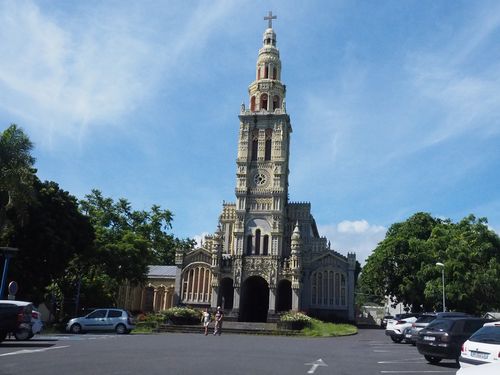
 St Anne Church, located in Saint-Benoît on Réunion Island, is a Catholic religious building that plays a significant role in the cultural landscape of the region. It remains an active place of worship, hosting services and community gatherings. Its presence in the eastern part of the island reflects the organisation of parishes within a territory shaped by colonial history and diverse religious influences. Today, the church stands as an important local landmark, both for its spiritual function and for its role in social life, supporting the continuity of religious practices.
Reunion Island • Saint Anne Church

Reunion Island • Saint Anne Church

Reunion Island • Saint Anne Church
Monument profile
Saint Anne Church
Monument category: Church
Monument family: Church, cathedral, basilica, chapel
Monument genre: Religious
Cultural heritage: Christian
Geographic location: Saint Benoît • Reunion Island
Construction period: 20th century AD
• Links to •
• List of videos about on this site •
Reunion: the volcano, the landscapes and the people • Reunion Island
Sainte-Anne Church in Saint-Benoît: construction, transformation, and continuity of use
Foundation and initial construction phase
Sainte-Anne Church in Saint-Benoît was built in the second half of the nineteenth century, within a context of expanding parish organisation in the eastern part of Réunion Island. Construction took place between 1857 and the early 1860s to serve a growing population in the area. The initiative was led by local ecclesiastical authorities seeking to establish a permanent and functional place of worship. The original building was relatively simple in design, reflecting available resources and practical considerations. From its completion, the church became a stable focal point for religious activity within the parish.
Early twentieth-century transformation
A major transformation occurred from the 1920s onward, significantly altering the appearance of the church. Under the direction of the clergy in charge at the time, extensive works were undertaken to enlarge the structure and enhance its visual impact. These modifications primarily affected the exterior surfaces and decorative elements, which became more elaborate and structured. The process unfolded over several years, relying on local labour and materials. This phase represents a decisive moment in the building’s history, as it established the distinctive identity that characterises the church today.
Religious function and parish role
Since its construction, Sainte-Anne Church has maintained a continuous role as a place of worship for the Saint-Benoît parish. It accommodates regular services as well as ceremonies marking key moments in religious life. The building also functions as a space of social organisation, reinforcing communal ties through shared religious practices. Its uninterrupted use demonstrates its integration into the local environment. The church serves as a stable reference point within the community, combining spiritual and social dimensions in its ongoing activity.
Preservation, recognition, and current status
Sainte-Anne Church has been officially recognised for its heritage value and has been listed as a historic monument since 1982. This status has led to increased attention to its preservation and maintenance. Restoration efforts have focused on protecting structural elements and decorative features affected by tropical climatic conditions. The building continues to fulfil its religious function while also being acknowledged as a significant element of the island’s built heritage. Its current condition reflects a balance between active use and conservation.
Chronological perspective
The construction of Sainte-Anne Church took place during a period of infrastructural development in colonial territories during the nineteenth century. It coincides with the abolition of slavery in 1848 and the subsequent reorganisation of colonial societies in the Indian Ocean. Globally, this period is marked by the expansion of European empires and increasing maritime exchanges, facilitating the spread of institutional frameworks, including religious establishments, across overseas territories.
Architectural composition of Sainte-Anne Church in Saint-Benoît
Site positioning and overall layout
Sainte-Anne Church is set within an open environment in Saint-Benoît, allowing its volume and façade to be clearly perceived from multiple viewpoints. The building follows a longitudinal plan organised along a main axis extending from the entrance to the chancel. This orientation establishes a direct visual and spatial progression through the structure. The church stands as an isolated construction, without adjoining buildings, which reinforces the clarity of its form and the prominence of its front elevation. The spatial arrangement prioritises frontal composition, with the façade functioning as a dominant architectural element.
Internal spatial organisation
The interior is structured around a single nave that extends toward a defined chancel area. The nave is articulated by a sequence of supports that rhythmically divide the space while maintaining visual continuity. This configuration creates a clear directional movement toward the altar. The chancel is slightly elevated, marking its functional importance within the liturgical layout. Vertical proportions contribute to a sense of height, with the interior volume emphasising continuity rather than fragmentation. Openings along the lateral walls provide consistent natural lighting, enhancing the perception of surfaces and reinforcing spatial coherence.
Construction methods and materials
The structural system relies on solid masonry walls coated with protective plaster. These surfaces are finished with paint layers that unify the exterior and interior appearance. The building materials are selected for their capacity to withstand humidity and climatic exposure typical of the region. The roof structure is supported by a timber or mixed framework designed to ensure stability while accommodating ventilation. The roofing materials allow efficient drainage, reducing the impact of heavy rainfall. These construction techniques reflect a balance between durability, maintenance requirements, and adaptation to environmental conditions.
Façade design and decorative articulation
The façade of Sainte-Anne Church is the most distinctive architectural component of the building. It is organised symmetrically around a central entrance that anchors the composition. Vertical elements such as pilasters and projections create a layered effect, introducing depth and visual complexity. The decorative treatment is characterised by an accumulation of sculpted forms and applied motifs that cover much of the façade surface. Polychrome finishes enhance the readability of these elements, highlighting contours and ornamental details. The density of decoration contrasts with the relative simplicity of the lateral elevations, reinforcing the hierarchical importance of the main façade.
Architectural transformations and preservation
The church underwent significant modifications during the twentieth century, primarily affecting its external appearance. These interventions introduced extensive decorative elements without altering the fundamental structural layout. Additions were integrated into the existing framework, maintaining the coherence of the original plan. Ongoing maintenance focuses on preserving surface finishes, structural integrity, and decorative features exposed to climatic stress. Conservation efforts ensure that the architectural identity of the building remains intact while allowing continued use as an active place of worship.