

 Français (France)
  Nederlands (nl-NL)
 The former Aw Chu Kin Hospital, located in Monywa in Myanmar’s Sagaing Region, represents an unusual example of twentieth-century medical and philanthropic heritage. Associated with the name of Aw Chu Kin and the history of the famous Tiger Balm, the building reflects the connections between Asian commercial networks, philanthropy, and social institutions in Burma. Its colorful Sino-Burmese decorative elements distinguish it within the urban landscape of Monywa. Situated near Thanboddhay Pagoda, the former hospital also illustrates the role played by private initiatives in the development of medical and social infrastructure in modern Myanmar.
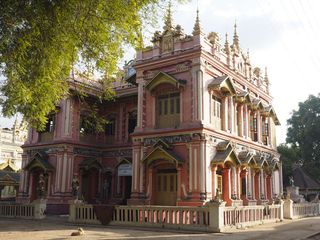
Monywa • Former Aw Chu Kin Hospital
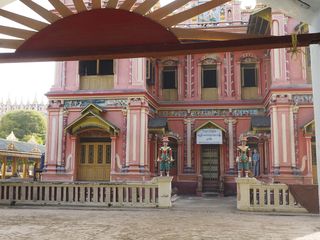
Monywa • Former Aw Chu Kin Hospital
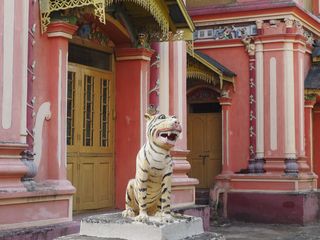
Monywa • Former Aw Chu Kin Hospital
Monument profile
Former Aw Chu Kin Hospital
Monument category: Hopital
Monument family: Hospital, Dispensary or Historic Medical Institution
Monument genre: Cultural or scientific
Geographic location: Monywa • Myanmar
Construction period: 20th century AD
• Links to •
• List of videos about Monywa on this site •
Monywa, Thanboddhay pagoda • Myanmar
Monywa, Buddhas and more Buddhas • Myanmar
Historical Development of the Former Aw Chu Kin Hospital in Monywa
Foundation of the Institution and Historical Context
The former Aw Chu Kin Hospital in Monywa appears to have been established during the twentieth century, in a period when private philanthropy played an important role in the development of medical and social infrastructure in Burma. The building is associated locally with Aw Chu Kin, linked to the Aw family known for the commercial success of Tiger Balm in Southeast Asia. Although the precise circumstances of the foundation remain insufficiently documented, the monument reflects a broader pattern in which wealthy overseas Chinese and Sino-Burmese patrons financed religious, charitable and medical institutions throughout the region.
Its location near the Thanboddhay Pagoda indicates that the institution was integrated into an environment where religious activity, pilgrimage and social services coexisted closely. Rather than being isolated from the surrounding sacred landscape, the hospital formed part of a larger cultural complex shaped by Buddhism, local patronage and public charity.
The architectural scale of the building suggests that it was intended to function as more than a small rural dispensary. Its elaborate façade and monumental presentation indicate a desire to create a visible institution associated with prestige, generosity and social influence.
Medical Role and Social Function
The Burmese inscription still visible above the entrance confirms the building’s medical identity. The monument originally served as a healthcare institution intended to provide medical assistance to the local population and visitors circulating through the religious sites of the Monywa region.
Its foundation corresponds to a period during which private donors frequently financed hospitals, schools and monasteries in Burma. Such institutions often reflected both charitable motivations and the social prestige attached to philanthropy. In this case, the association with the Aw family suggests connections between commercial wealth and public benefaction.
The building also illustrates the coexistence of modern medical institutions with strongly religious surroundings. Unlike colonial hospitals designed according to strict administrative models, the Aw Chu Kin Hospital adopted a visual language closer to ceremonial and religious architecture. This gave the institution a symbolic presence extending beyond its strictly medical function.
Over time, the hospital appears to have lost its original role. The current condition of the structure and the absence of active medical activity indicate that the building has gradually shifted from a functioning institution to a historical and architectural landmark.
Evolution of the Building and Present Condition
Although the structure remains standing, several parts of the monument show signs of aging and partial deterioration. Weathering, humidity and lack of continuous maintenance have affected portions of the painted surfaces and decorative details. Nevertheless, the main structure retains much of its original visual coherence.
The monument continues to occupy a recognizable place within the environment surrounding Thanboddhay Pagoda. Its unusual appearance and vivid colors distinguish it from both ordinary residential buildings and more conventional institutional architecture in central Myanmar.
Today, the building functions primarily as a historical remnant associated with a particular phase of twentieth-century philanthropy and urban development in Monywa. Its survival also preserves evidence of a lesser-known category of heritage: privately funded medical architecture linked to religious landscapes and commercial patronage networks.
International Historical Context
The probable construction period of the hospital corresponds to major transformations across Asia during the mid-twentieth century. Burma experienced political transition from British colonial rule toward independence in 1948. During the same decades, large philanthropic projects financed by Chinese business families expanded throughout Southeast Asia. In Europe and North America, the postwar period saw rapid modernization of public healthcare systems and urban infrastructure.
Sino-Burmese Institutional Architecture of the Former Aw Chu Kin Hospital in Monywa
General Layout and Urban Position
The former Aw Chu Kin Hospital stands near Thanboddhay Pagoda in an area dominated by religious monuments and pilgrimage activity. Despite its medical purpose, the building possesses a highly theatrical architectural presence that immediately distinguishes it from ordinary utilitarian structures. Surrounded by an open courtyard and low ornamental boundary walls, the monument occupies a visually prominent position within the surrounding religious landscape.
The structure follows a rectangular plan organized around a strongly emphasized central entrance. The façade displays a rigorous symmetry created through the repetition of openings, projecting entrance bays and vertical pilasters. This regular institutional composition is transformed by an exceptionally dense decorative program covering nearly every visible surface.
The building rises over several levels, producing a substantial mass reinforced by stacked galleries, repeated roof elements and decorative pinnacles. The upper sections gradually lighten the composition and create a silhouette visually closer to ceremonial or religious architecture than to a conventional hospital.
Façades and Decorative Program
The façades constitute the monument’s most distinctive architectural feature. Painted in shades of pink, red and cream, the walls are articulated through layered pilasters, moldings, projecting porches and decorative bands. The ornamentation extends continuously across the exterior rather than being limited to the principal entrance.
Small triangular canopies repeated above doors and windows create a rhythmic pattern across the elevations. These projecting elements include carved wooden fringes and ornamental details inspired by Burmese architectural traditions. Their repetition contributes significantly to the building’s visual density.
Horizontal decorative friezes separate the different levels of the façade. Painted scenes, floral motifs and figurative elements create continuous ornamental bands running around the structure. Massive corner pilasters visually stabilize the building while reinforcing the vertical character of the composition.
Tiger-head motifs incorporated into several decorative sections are among the monument’s most unusual features. In the historical context of the building, these elements may refer symbolically to the Aw family and the Tiger Balm connection, although no direct documentary confirmation currently exists.
Entrance Composition and Symbolic Elements
The main entrance forms the symbolic center of the building. Two male statues dressed in Western-style suits stand symmetrically beside the central doorway within recessed niches. Their placement gives the façade a commemorative and representational character. They may depict patrons, administrators or individuals connected to the institution’s foundation.
The Burmese signboard above the entrance clearly identifies the building as a medical institution. Its integration into the architectural composition demonstrates that the structure was intended to be immediately recognizable and publicly visible.
Staircases, raised access points and low flanking walls create a staged approach toward the entrance. The architecture therefore organizes not only circulation but also visual presentation and institutional prestige.
The large number of windows and open galleries indicates a strong emphasis on natural ventilation. This feature responded directly to the climatic conditions of central Myanmar and to the sanitary requirements of the building’s original medical function.
Construction Techniques and Current Preservation
The structure appears to have been built primarily in masonry covered with painted plaster. Decorative elements were likely executed using molded cement, stucco and carved wood for parts of the galleries and canopies. The monument combines relatively straightforward structural techniques with highly elaborate surface decoration.
The open galleries and numerous windows facilitate air circulation and reduce interior heat accumulation. These climatic adaptations remain integrated into an architectural composition dominated by visual spectacle and symbolic representation.
Today, portions of the building show visible deterioration, particularly along lower walls, painted surfaces and exposed decorative features affected by tropical weather conditions. Despite this aging, the monument retains strong visual coherence and remains one of the most unusual surviving civic buildings in the Monywa region.