

 Français (France)
  Nederlands (nl-NL)
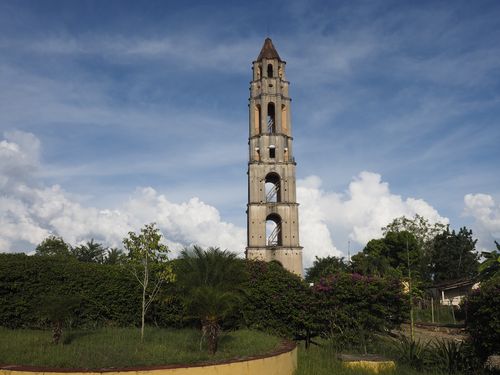
 The Torre Manaca Iznaga, located near Trinidad in the Valle de los Ingenios of Cuba, is one of the best-known monuments of the region. It is closely connected to the economic and social history of an area shaped by sugar production. With its tall silhouette and strong presence in the landscape, it serves as a major landmark for visitors. The site attracts people interested in Cuban heritage and in understanding former agricultural systems of the Caribbean. Today, the tower remains one of the most representative symbols of the Valle de los Ingenios.
Trinidad and the valley de los ingenios • Torre Manaca Iznaga
Trinidad and the valley de los ingenios • Torre Manaca Iznaga
Trinidad and the valley de los ingenios • Torre Manaca Iznaga
Monument profile
Torre Manaca Iznaga
Monument category: Watch tower
Monument family: Civil engineering structures (bridges, wells, etc.) and factories
Monument genre: Economic
Geographic location: Trinidad and the valley de los ingenios • Cuba
Construction period: 19th century AD
This monument in Trinidad and the valley de los ingenios is inscribed on the UNESCO World Heritage List since 1988 and is part of the serial property "Trinidad and the Valley de los Ingenios".See the UNESCO monuments featured on this site
• Links to •
• List of videos about Trinidad and the valley de los ingenios on this site •
Trinidad & Valle de Los Ingenios, sugar capital • Cuba
Torre Manaca Iznaga near Trinidad: Monument of Cuba’s Colonial Sugar Economy
Construction and Historical Context
Torre Manaca Iznaga stands in the Valle de los Ingenios near Trinidad, in central Cuba. It was built in the early nineteenth century, usually dated around 1816, as part of a large sugar estate owned by the Iznaga family, one of the most prominent landholding families in the region.
Its construction belongs to the period when the valley reached the height of its economic importance. Sugar production transformed the area into one of the wealthiest rural zones in colonial Cuba. Estates combined cane fields, mills, transport routes, owner residences, and labour compounds worked largely by enslaved Africans and their descendants.
Within this plantation system, the tower was not an isolated monument but a functional component of a wider agricultural and social complex. Its exceptional height immediately distinguished it from surrounding buildings and marked the authority of the estate.
Functions within the Plantation Estate
The tower served several interconnected purposes. Its elevated position provided broad visual control over fields, roads, and work areas. From the upper levels, supervisors could monitor agricultural labour, movements across the estate, and the general organization of production.
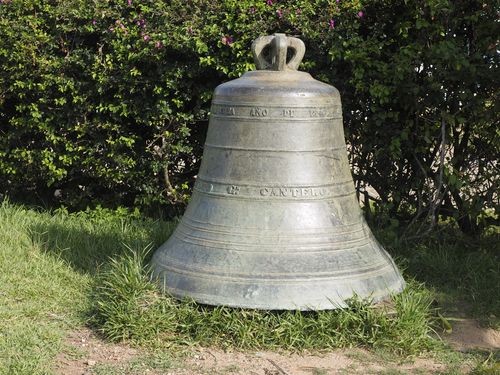
Historical tradition also links the tower to a bell installed near the summit. This bell was used to regulate daily routines, announce work periods, or signal specific events. In the context of a plantation economy dependent on enslaved labour, this feature represented a mechanism of discipline and time control.
The structure also had an important symbolic role. Rising above the surrounding plain, it demonstrated the wealth and prestige of the Iznaga family. Its visibility converted architecture into a statement of economic power.
Decline of the Sugar System and Survival of the Tower
During the nineteenth century, the plantation economy of the Valle de los Ingenios entered gradual decline. International competition, technological shifts, changing trade patterns, and the progressive abolition of slavery weakened the older estate model. Sugar production increasingly concentrated in larger and more mechanized regions of Cuba.
As the Manaca Iznaga estate lost its original importance, many productive structures deteriorated, disappeared, or were adapted to new uses. The tower, however, survived as the most recognizable element of the property.
Its endurance can be explained partly by its strong landmark value. While mills, workshops, and service buildings were easier to abandon or replace, the tower remained a visually dominant structure with enduring symbolic significance.
Heritage Role and Present-Day Meaning
Today Torre Manaca Iznaga is one of the best-known historic monuments associated with Trinidad and the former sugar valley. It represents both the prosperity generated by the sugar trade and the deeply unequal labour system on which that prosperity depended.
The Valle de los Ingenios was inscribed on the UNESCO World Heritage List in 1988 together with Trinidad under the official designation Trinidad and the Valley de los Ingenios. Within this heritage landscape, the tower is among the most identifiable surviving monuments of colonial plantation society.
The site now receives visitors interested in Cuban history, rural heritage, and the material traces of slavery-era economies. Conservation efforts focus on structural stability, masonry maintenance, visitor access, and interpretation of the site’s historical context.
Global Historical Context
The tower was built in the early nineteenth century, during a period shaped by Atlantic revolutions and the Napoleonic Wars. Haiti had gained independence in 1804, profoundly affecting Caribbean plantation economies. Europe was entering industrial expansion. Across Spanish America, independence movements were underway. Cuba remained a Spanish colony strongly tied to export-oriented sugar production.
Architectural Structure of Torre Manaca Iznaga in the Valley of the Sugar Mills
Setting within the Plantation Landscape
Torre Manaca Iznaga stands in the Valle de los Ingenios near Trinidad, within an open rural plain historically shaped by sugar cultivation. Its architectural identity depends strongly on this setting. Unlike towers enclosed by dense urban fabric, it rises from relatively low surrounding ground, making the structure visible across long distances.
The tower originally formed part of a plantation complex that included the owner’s residence, service buildings, industrial areas, yards, and workers’ quarters. Within that ensemble, it functioned as the principal vertical marker. Its isolated prominence established a clear hierarchy between the elevated observation structure and the horizontal spread of productive land around it.
The flatness of the surrounding terrain increases the monument’s visual effect. With few competing high buildings nearby, the tower appears exceptionally dominant. Fields, access roads, and former plantation zones act as a territorial forecourt, extending the monument’s presence beyond its immediate footprint.
Form, Proportions, and Vertical Composition
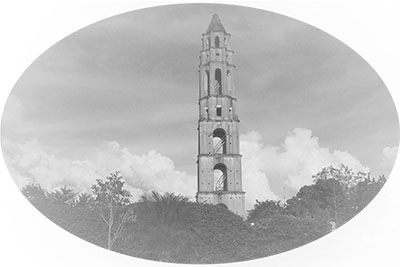
The monument is defined by a slender vertical mass rising through several levels toward a lookout platform and bell chamber. Its plan is compact, emphasizing height rather than internal surface area. This proportion distinguishes it sharply from the lower residential and agricultural buildings historically associated with the estate.
The elevation is organized in stacked stages marked by aligned openings and subtle horizontal divisions between floors. These repeated levels create rhythm while visually reinforcing upward movement. The structure appears narrower as it rises, partly because of perspective and partly because the upper sections contain more openings and lighter parapet elements.
Its height, commonly estimated at about forty-five metres, made it one of the most imposing rural structures of nineteenth-century Cuba. The design therefore combined practical surveillance requirements with deliberate monumentality.
At the summit, the viewing zone and bell area complete the composition. This upper termination gives the tower a clearly articulated crown rather than the appearance of a simple masonry shaft.
Construction Materials and Structural Logic
The tower was built primarily in masonry, using brick and stone bonded with lime-based mortar typical of the period. Thick lower walls provide the mass necessary to carry the vertical load and resist lateral pressure from wind exposure across the plain. As in many tall masonry towers, wall thickness likely decreases toward the upper levels to reduce weight.
Exterior surfaces were finished with plaster or render, protecting the masonry core and creating a more unified appearance. Light-coloured finishes also improve visibility under strong Caribbean sunlight and reduce heat absorption.
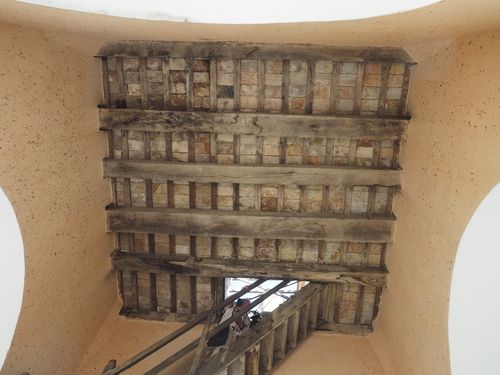
The internal structure depends on load-bearing perimeter walls combined with inserted floor levels at successive stages. These intermediate platforms help stiffen the structure while organizing vertical circulation. The monument’s survival over two centuries suggests effective original engineering despite tropical humidity, storms, and periods of varying maintenance.
Openings are limited in size and carefully distributed. This preserves wall strength while allowing ventilation, daylight, and visual control over the surrounding estate.
Access, Interior Circulation, and Functional Features
Entry is made through a modest ground-level opening leading to the internal stair system. Vertical circulation is a central functional element: users ascended level by level toward the upper platform. Because floor space is restricted, the stairs had to remain compact, probably arranged against the inner wall.
Each level likely served practical purposes such as temporary storage, observation pauses, or access to intermediate windows. Openings placed at different heights widened sightlines over fields, roads, and work zones.
The bell installed near the summit was an architectural component integrated into the upper design rather than an ornamental addition. Its elevated placement allowed sound to travel across the plantation. The support frame and open chamber were therefore essential functional features.
The final platform created a panoramic control point from which labour areas and movements could be monitored efficiently.
Surface Character, Restoration, and Present Condition
The visual character of Torre Manaca Iznaga relies on simplicity: plain wall surfaces, repeated openings, and a commanding silhouette. Ornament is minimal. The tower derives authority from scale, proportion, and isolation rather than decorative richness.
Restoration campaigns have addressed structural cracks, erosion of render, moisture penetration, and wear caused by visitor traffic. Masonry towers of this height require continuous monitoring, especially in exposed upper zones affected by wind and rain.
Today the tower remains fully legible as both architecture and landscape infrastructure. Even after the disappearance or transformation of much of the surrounding plantation complex, its preserved vertical form still explains how visibility, supervision, and power were expressed through construction.