

 Français (France)
  Nederlands (nl-NL)
 The Bagaya Wooden Monastery, located in Amarapura in the Mandalay region of Myanmar, represents an important example of Burmese monastic tradition. The monastery forms part of the network of Buddhist institutions that have long played a central role in the religious, educational and social life of the country. In Myanmar, monasteries serve not only as places of spiritual practice but also as centers where Buddhist teachings are studied and transmitted to younger generations of novices. In the historical context of Amarapura, once a royal capital, the Bagaya Monastery reflects the enduring importance of Theravāda Buddhism in shaping cultural and social institutions.

Amarapura • Bagaya Wooden Monastery
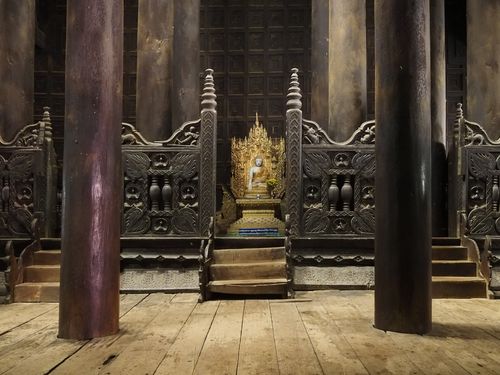
Amarapura • Bagaya Wooden Monastery
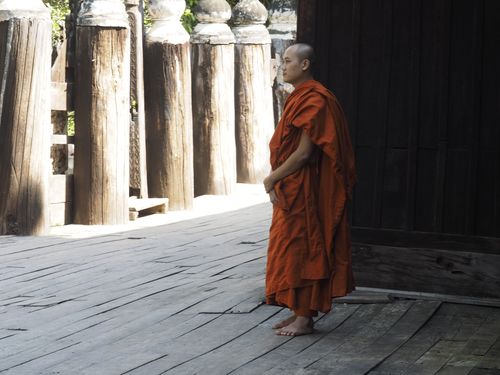
Amarapura • Bagaya Wooden Monastery
Monument profile
Bagaya Wooden Monastery
Monument category: Monastery
Monument family: Monastery
Monument genre: Religious
Cultural heritage: Buddhist
Geographic location: Amarapura • Myanmar
Construction period: 16th century AD
• Links to •
• List of videos about Amarapura on this site •
Amarapura, Bagaya, wooden monastery • Myanmar
Mandalay, Su Taung Pyae Pagoda • Myanmar
Amarapura • U Bein Bridge, historic landmark of Myanmar
• References •
Wikipedia EN: Bagaya Monastery
History of the Bagaya Wooden Monastery in Amarapura
Political and Religious Context of the Foundation
The Bagaya Wooden Monastery, located in Amarapura in the Mandalay region of central Myanmar, was established during the period of the Konbaung dynasty, the last royal dynasty of Burma before the British colonial conquest. The monastery emerged within a political and religious framework in which Buddhist institutions played a central role in the legitimacy and cultural identity of the kingdom.
Amarapura itself was founded as a royal capital in 1783 by King Bodawpaya. The establishment of a new capital was not merely an administrative decision but also a symbolic act intended to reinforce the authority of the monarchy and to consolidate political power within the kingdom. In the Burmese political tradition, royal capitals were typically accompanied by the construction of monasteries, pagodas and religious institutions that embodied the connection between the throne and the Buddhist monastic community.
The foundation of the Bagaya Monastery reflects this close relationship between political authority and religious patronage. According to historical tradition, the monastery was associated with a royal prince who financed its construction as an act of religious merit and as a demonstration of loyalty to the Buddhist order. In Theravāda Buddhist societies, such acts of patronage were considered both spiritual investments and expressions of political legitimacy.
By supporting the monastic community, members of the royal family reinforced their prestige and their role as protectors of the Buddhist faith. Monasteries were therefore not only religious centers but also important institutions within the social and political structure of the kingdom.
Amarapura and the Ambitions of the Konbaung Dynasty
During the late eighteenth and early nineteenth centuries, the Konbaung dynasty sought to strengthen its authority across a vast and diverse territory. The kingdom expanded through military campaigns and diplomatic relations with neighboring regions, including Siam and parts of present-day northeastern India.
Amarapura became one of the principal political and religious centers of the kingdom during this period. The city was planned as a major administrative hub, and its urban landscape included royal palaces, monasteries and religious complexes that symbolized the power of the dynasty.
Within this environment, the construction of large monastic institutions served multiple purposes. Monasteries functioned as centers of learning where Buddhist scriptures and Pali texts were studied and transmitted. They also provided education for young novices, many of whom later became influential figures within the religious hierarchy.
The Bagaya Monastery must therefore be understood as part of a broader network of monastic institutions that supported both religious scholarship and the cultural cohesion of the kingdom. Its foundation represented a continuation of long-standing traditions in which rulers and members of the royal court sponsored religious architecture to reinforce their authority and demonstrate their devotion to the Buddhist faith.
Historical Events and Transformations of the Site
The history of the Bagaya Monastery is closely connected to the political changes that affected the region during the nineteenth century. Although Amarapura initially flourished as a royal capital, the Konbaung dynasty relocated the capital several times as political priorities shifted.
In 1857 King Mindon established Mandalay as a new royal capital, moving the administrative center of the kingdom northward. This decision gradually reduced the political importance of Amarapura, although the city retained a strong religious and cultural presence because of its monasteries and monastic schools.
The region also experienced the impact of the Anglo-Burmese wars during the nineteenth century. These conflicts between the Burmese kingdom and the British Empire profoundly altered the political landscape of Southeast Asia. After a series of wars beginning in 1824, British influence steadily increased until the complete annexation of the Burmese kingdom in 1885.
Despite these upheavals, monastic institutions such as the Bagaya Monastery continued to function as centers of religious life. Monasteries played a key role in preserving Buddhist learning and cultural traditions during periods of political instability.
Global Context of the Nineteenth Century
The construction of the Bagaya Monastery occurred during a period of major transformation in the global political order. Across Asia, many traditional kingdoms faced increasing pressure from expanding European colonial powers.
In response to these challenges, several Asian states sought to reinforce their cultural and religious institutions as a means of strengthening national identity and political cohesion. Monumental architecture, including religious buildings, became an important tool in expressing continuity with long-standing traditions.
In Burma, the Konbaung rulers continued to invest in religious architecture even as external pressures intensified. Monasteries such as Bagaya served as visible symbols of the kingdom’s commitment to the Buddhist faith and its cultural heritage.
At the same time, the nineteenth century witnessed the construction of monumental religious structures in many parts of the world, reflecting the enduring importance of religious institutions in shaping societies. The Bagaya Monastery can therefore be understood within a broader global pattern in which architecture played a role in expressing political authority and spiritual values.
Transformations Through Time
Over the course of its history, the Bagaya Monastery underwent various phases of maintenance, restoration and adaptation. Wooden structures require constant care, particularly in tropical climates where humidity, insects and seasonal weather conditions can affect the durability of building materials.
Local monastic communities played a significant role in maintaining the structure. Repairs were periodically undertaken to replace deteriorating wooden elements and to preserve the integrity of the building. These interventions often followed traditional construction methods in order to maintain the original character of the monastery.
Urban development in the Mandalay region gradually transformed the surrounding landscape. Amarapura, once a royal capital, became integrated into the wider urban area associated with Mandalay. Despite these changes, the monastery retained its historical significance and continued to function within the local religious environment.
Contemporary Role and Cultural Importance
Today the Bagaya Wooden Monastery is widely recognized as one of the most important historic monasteries in the Mandalay region. It attracts visitors interested in the religious and cultural history of Myanmar while continuing to serve a religious function for the local community.
In contemporary Burmese society, monasteries remain central to the practice of Theravāda Buddhism. They provide spaces for meditation, religious study and the ordination of novice monks. Many boys in Myanmar spend part of their youth living in monasteries, where they receive both religious instruction and general education.
The Bagaya Monastery contributes to the historical identity of Amarapura and the broader Mandalay region. As a surviving example of a major monastic institution from the Konbaung period, it reflects the enduring relationship between Buddhist monastic culture and the political history of the Burmese kingdom.
The monastery also plays a role in local religious life. Ceremonies, offerings and educational activities continue to take place within the monastic environment, maintaining the connection between the building and the spiritual traditions that shaped its creation.
Conservation and Modern Preservation Challenges
Preserving the Bagaya Monastery presents several challenges due to the nature of its materials and the environmental conditions of central Myanmar. Wooden structures are vulnerable to humidity, termites and gradual deterioration over time. As a result, conservation requires careful monitoring and periodic restoration.
Efforts have been undertaken by cultural authorities and local communities to maintain the monastery and protect its architectural features. Restoration projects aim to respect traditional building techniques while ensuring the structural stability of the monument.
Tourism has also become an important factor in the preservation of historical sites in the Mandalay region. Visitors contribute to the visibility of the monastery and help support conservation initiatives, but increased foot traffic also requires careful management to prevent damage to delicate wooden elements.
Although the Bagaya Monastery is not currently part of the UNESCO World Heritage list, it forms part of a wider historical landscape associated with former royal capitals such as Amarapura, Inwa and Mandalay. These sites collectively represent an important chapter in the cultural and political history of Myanmar.
Through its continued presence, the Bagaya Wooden Monastery stands as a testimony to the religious patronage of the Konbaung dynasty and to the enduring importance of monastic institutions in Burmese society. It illustrates how architecture, religion and political authority were closely interconnected in the historical development of the Burmese kingdom.
Architecture of the Bagaya Wooden Monastery in Amarapura
A major example of Burmese monastic timber architecture
The Bagaya Wooden Monastery in Amarapura, located in the Mandalay region of central Myanmar, represents one of the most significant surviving examples of traditional Burmese monastic timber architecture. Constructed during the Konbaung dynasty, the monastery reflects the architectural principles that governed religious buildings intended for the residence, education, and spiritual practice of Buddhist monks. Unlike the brick pagodas that dominate the sacred landscape of Myanmar, monasteries traditionally served as living institutions and were therefore built primarily from wood, a material that allowed both structural flexibility and refined artistic expression.
The Bagaya Monastery illustrates the culmination of centuries of carpentry traditions in Upper Myanmar. Its monumental timber framework, elaborate wood carvings, and carefully organized spatial layout demonstrate the technical and artistic achievements of Burmese builders during the late royal period. The building was designed not only as a religious space but also as an architectural statement reflecting the prestige of monastic institutions and their role within the political and cultural framework of the Konbaung kingdom.
Structural design and technological innovations
The architectural strength of the Bagaya Monastery lies primarily in its structural system, which relies on a dense forest of teak columns supporting the entire building. The structure is famously supported by more than two hundred massive teak pillars arranged in carefully aligned rows. These columns form a rigid yet flexible framework capable of supporting the multi-tiered roof and elevated floors.
Teak wood was the preferred material for major Burmese structures because of its durability and resistance to insects, moisture, and temperature variations. The use of large teak columns provided both structural stability and longevity. Each column transfers the weight of the roof and upper levels directly to the ground, creating a modular system that distributes loads evenly throughout the building.
Traditional Burmese carpentry techniques are evident throughout the structure. Wooden joints, mortise-and-tenon connections, and interlocking beams allow the building to maintain stability without relying heavily on metal fasteners. This method offers a degree of flexibility that helps wooden structures absorb environmental stresses, including minor seismic activity and seasonal movement of materials.
The monastery is elevated on stilts, a common architectural strategy in Southeast Asia. This elevation protects the wooden structure from ground moisture and seasonal flooding while also promoting natural airflow beneath the floor. Ventilation is a crucial aspect of the design, helping regulate temperature in the tropical climate and preserving the wooden components.
Materials and construction methods
The entire building is constructed primarily from teak, one of the most valuable hardwoods in Southeast Asia. The use of teak reflects both the abundance of forest resources historically available in Burma and the advanced woodworking traditions developed by royal craftsmen. Teak’s natural oils protect it from rot and insect damage, making it particularly suitable for large religious buildings intended to endure for generations.
Construction required carefully selected logs of significant size and quality. These timbers were shaped and assembled by skilled artisans using specialized tools and techniques passed down through generations of carpenters. Each beam and column was carved and fitted with precision to ensure the structural integrity of the entire framework.
The flooring consists of thick wooden planks that span between the structural beams. These surfaces create large open halls suitable for gatherings, teaching, and religious ceremonies. The extensive use of timber surfaces contributes to the distinctive aesthetic atmosphere of the monastery, characterized by warm tones and intricate carved textures.
Protective finishes were often applied to exposed wood, including traditional lacquers or natural oils. These treatments helped preserve the material while enhancing the visual richness of the carved elements.
Artistic influences and decorative traditions
One of the defining characteristics of the Bagaya Monastery is the extraordinary detail of its carved wooden ornamentation. The columns, beams, balustrades, and decorative panels are covered with finely executed relief carvings that reflect the artistic traditions of Burmese monastic architecture.
Common motifs include floral scrolls, geometric patterns, and symbolic elements drawn from Buddhist iconography. These carvings serve both decorative and symbolic purposes. In Burmese religious architecture, ornamental motifs often represent spiritual themes such as harmony, protection, or cosmic order.
The decorative program of the monastery also reflects the influence of courtly art during the Konbaung period. Skilled artisans associated with the royal workshops produced elaborate carvings for palaces and monasteries alike. The Bagaya Monastery demonstrates how these artistic traditions extended beyond royal buildings to important monastic institutions.
Although strongly rooted in Burmese design traditions, the architecture also reflects broader cultural interactions within mainland Southeast Asia. Regional exchanges of artistic techniques influenced stylistic elements in wood carving, particularly in the treatment of vegetal patterns and ornamental panels.
Spatial organization and architectural layout
The spatial design of the Bagaya Monastery follows a layout adapted to the daily life of a Buddhist monastic community. The main building consists of a large central hall surrounded by peripheral spaces that once accommodated monks, novices, and religious activities.
The central hall served as the primary gathering space for instruction, meditation, and communal ceremonies. Its open layout, supported by rows of columns, allows for unobstructed movement and visibility. The repetition of pillars creates a rhythmic interior perspective that reinforces the sense of architectural order.
Surrounding corridors and verandas provide transitional spaces between the interior and exterior environments. These areas function as circulation zones while also offering shaded areas where monks and visitors could gather. The open design promotes airflow, an essential feature in the tropical climate of central Myanmar.
Access to the elevated structure is provided by staircases positioned on multiple sides of the building. These stairways mark the threshold between the surrounding landscape and the sacred space of the monastery. Their symmetrical placement contributes to the balanced architectural composition.
Roof structure and vertical composition
The roof structure is one of the most visually distinctive features of the monastery. Like many Burmese religious buildings, it consists of multiple tiers arranged in ascending levels. This layered roof system creates a strong vertical emphasis while also improving the building’s performance in heavy rainfall conditions.
The steeply sloping roof surfaces facilitate rapid water drainage during the monsoon season. Extended eaves protect the wooden walls and carved decorations from direct exposure to rain and sunlight. The combination of structural and climatic considerations demonstrates the integration of environmental knowledge into traditional Burmese architecture.
The vertical composition of the roof also reflects symbolic hierarchies common in Buddhist architecture. The rising tiers visually emphasize the central axis of the building and contribute to the monumentality of the structure despite its entirely wooden construction.
Dimensions and notable architectural features
The Bagaya Monastery is notable for the scale of its timber construction. The building extends across a large footprint supported by hundreds of structural columns. The repetition of these pillars forms one of the most striking interior visual effects, creating a sense of depth and rhythm within the hall.
The structural grid formed by the columns also provides flexibility in organizing interior space. This modular design allowed different sections of the monastery to be used for teaching, meditation, and residential functions.
Among the most distinctive architectural features is the elaborate carving of the column capitals and beam ends. These sculptural elements transform structural components into decorative forms, illustrating the close relationship between architecture and wood carving in Burmese artistic traditions.
Local traditions often emphasize the remarkable craftsmanship involved in producing the monastery’s decorative elements. The complexity of the carvings is frequently interpreted as evidence of the high level of skill achieved by artisans during the Konbaung period.
Architectural significance and conservation challenges
Today the Bagaya Wooden Monastery is recognized as one of the most important examples of historic wooden architecture in Myanmar. It represents a rare surviving example of large-scale monastic timber construction from the Konbaung era, a period when religious architecture played a central role in the cultural identity of the Burmese kingdom.
However, the preservation of wooden monuments presents significant challenges. Tropical climates accelerate the deterioration of organic materials, while termites and other insects pose constant threats to structural elements. Continuous maintenance is therefore essential to preserve the integrity of the building.
Conservation efforts aim to balance preservation with the continued religious use of the monastery. Restoration work typically relies on traditional carpentry methods to ensure that repairs remain consistent with the original construction techniques.
Urban growth in the Mandalay region has also increased visitor numbers, making careful management necessary to protect delicate carved surfaces and structural components. Despite these pressures, the monastery remains a major cultural landmark and an important testimony to the architectural ingenuity of Burmese builders.
Through its monumental teak structure, refined carving traditions, and sophisticated spatial design, the Bagaya Wooden Monastery illustrates the peak of traditional monastic architecture in Myanmar. It demonstrates how religious buildings combined engineering knowledge, artistic craftsmanship, and environmental adaptation to create enduring architectural forms within the cultural landscape of the former royal capitals of Upper Burma.